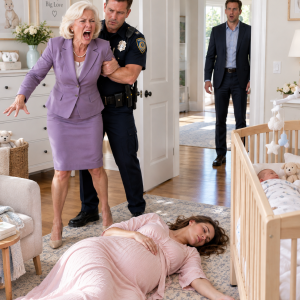
The Flowers in Room 408

The door to Room 408 opened with barely a sound, and for one brief moment I remained in the hallway of St. Catherine’s Medical Center, balancing a vase of pale garden roses against my hip while trying not to crush the gift bag hanging from my wrist.
I had expected to find my younger sister, Camille, resting beneath stiff white sheets with her newborn son asleep beside her. I had imagined our mother adjusting the baby’s blanket, our father taking far too many photographs, and perhaps a nurse reminding everyone to lower their voices.
Instead, I found my husband leaning over Camille’s bed.
Reid was not checking on the baby or offering the careful, distant affection a brother-in-law might show. His hand rested against my sister’s cheek, and he pressed a kiss to her forehead with a tenderness I had spent months waiting to receive from him at home.
Camille held the baby against her chest as calmly as if the scene had been rehearsed. When she noticed me standing in the doorway, she did not pull away, lower her eyes, or pretend that I had misunderstood.
She smiled.
It was a small, satisfied smile, and in that instant I understood that whatever had happened between them had not begun recently. There had been conversations, plans, private promises and probably dozens of moments when they had watched me enter a room while sharing a secret neither of them believed I would ever discover.
My mother, Beverly, stood beside the window holding a basket of fruit. She looked uncomfortable but not surprised. My father, Kenneth, moved closer to the sink and became unusually interested in the paper cup beside it.
The baby stirred, and Camille gently touched his cheek.
“His name is Elliot Reid Langley,” she announced.
She placed special emphasis on my husband’s name.
Reid straightened but did not step away from her bed.
For eleven years, I had paid most of the expenses in our marriage. My residential restoration company had grown from a rented workshop into one of the most respected historic-home firms in central Ohio, while Reid moved from one uncertain business idea to another. I covered our mortgage, his car payments, our family vacations and, more recently, several of Camille’s medical expenses after she claimed the baby’s father had disappeared.
Now I knew why she had refused to identify him.
Camille’s gaze moved toward my leather handbag before returning to my face.
“You don’t have to make this difficult, Mara,” she said. “Keep making the house payments for a little while. Reid and I need time to get settled, and then we’ll let you know when we’re ready to move in.”
My father cleared his throat.
“We should all try to remain practical,” he murmured.
That was when I realized my parents had known.
Perhaps they had not approved in the beginning, but somewhere along the way they had decided that preserving Camille’s comfort mattered more than telling me the truth. They had probably convinced themselves that I was strong enough to absorb the humiliation, just as I had absorbed every other family burden placed in front of me.
My pulse beat heavily beneath my collar, yet my hands remained steady as I crossed the room and placed the roses on the table.
“Congratulations,” I said.
Camille’s smile widened. Reid released a breath he must have been holding, while my mother finally looked relieved.
They mistook my calmness for surrender.
They believed I would go home, cry behind a locked bathroom door, and then return to work on Monday because I had always been the dependable one. They assumed I would continue paying the mortgage because I cared too much about appearances to challenge them publicly.
None of them knew that sixteen days later, at the elaborate garden celebration they were already planning, every adult guest would receive an envelope containing the truth.
At that moment, however, neither did I.
The Message Inside the Gold
I remained in my car for nearly half an hour after leaving the hospital, watching visitors cross the parking garage while the roses’ empty paper wrapping lay on the passenger seat.
I did not call a friend. I did not confront Reid through a message, and I did not return upstairs to demand explanations from people who had already shown me how little they respected me.
Instead, I removed the narrow gold bracelet I had worn since my grandmother Eleanor left it to me seven years earlier.
Grandmother Eleanor had raised me for much of my childhood while my parents devoted their attention to Camille, whose needs always seemed louder and more urgent than mine. Eleanor taught me how to refinish old wood, read property records and recognize the difference between something that merely looked valuable and something built to endure.
The bracelet had never seemed particularly remarkable. It was heavy, old-fashioned and slightly too large for my wrist, yet my grandmother had asked me never to sell it or allow anyone else to wear it.
That afternoon, I noticed a tiny seam along the inside edge.
Using the tip of a key, I pressed against it until a narrow panel opened. Two words had been engraved into the gold beneath it.
Morning Star.
My grandmother had called me that when I was a child.
Whenever I woke before sunrise to follow her into the garden or help her sand the cabinets in her workshop, she would smile and say, “There’s my morning star. You always see what other people miss.”
Sitting alone in the hospital garage, I finally understood that the bracelet had never been only an heirloom. It was an instruction waiting for the right moment.
I drove toward my house in Bexley, but when I turned onto Ashbourne Road, I saw an unfamiliar silver SUV parked in the driveway. The license plate belonged to Camille.
Warm light glowed through the front windows, and two moving boxes stood on the porch.
They had already begun entering my home.
I kept driving.
My company occupied a converted brick warehouse near the Scioto River, where we restored carved doors, built custom cabinetry and preserved architectural details from homes that might otherwise be stripped of their character. The workshop should have been empty, but a single lamp shone through the glass wall of my upstairs office.
My accountant, Peter Donnelly, was sitting beside my desk when I entered. A gray document case rested across his knees.
He stood when he saw me.
“I’ve called you six times.”
“My phone was in my bag.”
He studied my face and seemed to decide that whatever had happened to me could wait.
“There’s something you need to review before Reid knows I found it.”
Peter had managed my company’s finances for nine years. He was cautious to the point of irritation, the kind of person who verified every decimal and kept printed copies of documents everyone else trusted to computers.
That evening, I became grateful for every one of those habits.
Inside the case were bank statements, loan applications, property records and transfers involving companies with names I had never seen. Over the previous eighteen months, money had been moved from our joint accounts into three small corporations registered in Delaware and Nevada.
Each transfer led back to Reid.
Several applications carried my signature, or something close enough to fool anyone who had never watched me sign my name. Credit had been opened against jointly held property. My income had been listed as security for loans I had never approved.
Peter turned one page toward me.
“I assumed these arrangements were part of a tax strategy you and Reid had discussed. Then one of the lenders called this morning to verify a new transfer, and the authorization form didn’t look right.”
“I didn’t sign any of these.”
His expression tightened.
“Then we have a serious problem.”
He removed a small velvet box from the document case and placed it on my desk.
Inside was another gold bracelet.
It was almost identical to mine.
“Your grandmother’s estate attorney gave this to me three years ago,” Peter explained. “I was instructed to hold it until you discovered the hidden engraving in the first bracelet.”
My fingers felt cold as I opened the inner panel.
Evening Star.
Beneath the velvet lining of the box lay a brass key no longer than my smallest finger.
“What does it open?” I asked.
Peter shook his head.
“The attorney said you would recognize it when the time came.”
My phone lit up on the desk.
Camille had sent me a photograph.
She was standing in my living room with Reid, the newborn resting in his arms while delivery workers carried a cream-colored sofa through the front door. My mother was visible near the fireplace, arranging flowers as though she were preparing the room for its rightful owners.
Beneath the image, Camille had written:
Thank you for taking care of our future until we were ready for it.
I enlarged the photograph.
In the far corner stood an antique walnut cabinet that had belonged to my grandmother. It was the only object she had ever forbidden me to alter, move or open by force. Two small brass circles were embedded in the carved stars on its doors.
I looked at the bracelets, then at the key.
For the first time since entering the hospital, I smiled.
Sixteen days no longer seemed like very little time.
It seemed generous.
What Eleanor Had Protected

Peter contacted a financial attorney before we left the office, and by the following morning I was sitting across from Marjorie Sloan, a former banking investigator who spoke in calm, precise sentences and never promised more than the law could provide.
She examined the documents for almost three hours.
“Do not confront your husband yet,” she advised. “Do not reveal what Peter found, and do not sign anything your family places in front of you. We’ll notify the lenders, secure the business accounts and request an immediate restriction on further transfers.”
That afternoon, while Reid believed I was staying at a hotel to recover from the family’s announcement, I returned to the house with Marjorie and a locksmith.
The antique cabinet stood exactly where it had appeared in Camille’s photograph.
I pressed the Morning Star bracelet into the brass circle on the left door and the Evening Star bracelet into the one on the right. Both fit as though they had been designed as parts of the lock.
The tiny key turned between them.
Inside the cabinet were six leather ledgers, a sealed letter, original trust documents and decades of property records organized in my grandmother’s careful handwriting.
The house on Ashbourne Road had never belonged to Reid and me jointly, despite what he had repeatedly claimed. It had been placed in the Eleanor Caldwell Heritage Trust before our marriage, with me as the sole beneficiary and my grandmother’s attorney as temporary trustee.
More importantly, my parents did not own the family estate where Camille planned to hold her son’s naming celebration and announce her engagement to my still-married husband. They had been permitted to live there and receive income from two rental properties, but the trust retained ownership.
Control of that trust was scheduled to pass to me once I opened the cabinet with both bracelets.
My grandmother’s letter explained why.
“Generosity is a virtue only when it is freely given,” she had written. “The moment others begin treating your kindness as an obligation, it becomes a chain. I protected these properties because I feared your family might one day confuse your patience with permission.”
She had also preserved records showing that my parents had repeatedly borrowed against future trust distributions without authorization. Reid had discovered those financial weaknesses and used them to gain their cooperation.
He had promised to hide their unauthorized loans if they supported his plan to remove me from the company, obtain control of my income and move Camille into my home.
The betrayal in the hospital had not been an impulsive family scandal.
It had been part of a financial arrangement.
During the next sixteen days, Marjorie and Peter worked with the lenders, a document examiner and the trust attorney. The questionable transfers were frozen. My company accounts were separated from every account Reid could reach. The locks at the house were changed legally under the trust’s authority, and Camille’s furniture was placed in secure storage with written instructions explaining how she could retrieve it.
Reid called me repeatedly.
At first, he sounded patient.
“Mara, we should sit down and discuss the transition like adults.”
Later, his patience thinned.
“You can’t pretend this marriage still exists.”
I answered only once.
“You’re right. I’m no longer pretending.”
He did not understand what I meant.
My parents sent messages about forgiveness, dignity and protecting the baby from unnecessary conflict. None of them mentioned protecting me.
I prepared one gift for the child: a small hand-carved wooden star made in my workshop, along with a savings bond that only he would be able to access as an adult. Whatever his parents had done, he had entered the world innocent.
The adults would receive something different.
The Celebration Beneath the Elm Trees

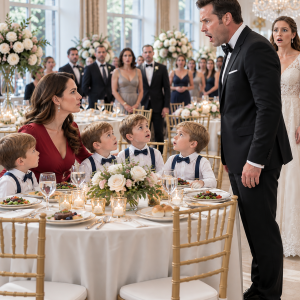
Camille’s event took place on a warm Sunday afternoon beneath the old elm trees at the Caldwell estate. White tables covered the lawn, musicians played near the fountain, and nearly a hundred guests gathered to celebrate Elliot’s naming ceremony and what Camille described on the invitations as the beginning of her new family.
She wore an ivory dress with pearl buttons. Reid stood beside her in a navy suit, carrying the baby as though he had already stepped into the life they had taken from me.
My mother saw me first.
Her smile disappeared.
“Mara, what are you doing here?”
“I came to bring Elliot his gift.”
My father moved toward me.
“This isn’t the time for a scene.”
“I agree.”
Behind me, four staff members from my company entered the garden carrying cream-colored envelopes. At my instruction, they handed one to every adult guest.
Camille looked around as people began opening them.
Each envelope contained a copy of the trust certificate identifying me as the controlling beneficiary, a notice suspending my parents’ distributions pending financial review, and a summary prepared by Marjorie documenting the unauthorized transfers associated with Reid’s companies.
The final page stated that formal civil filings had been submitted that morning.
The garden gradually became quiet.
Reid crossed the lawn toward me, his face rigid.
“What have you done?”
“I stopped paying for a life you were building behind my back.”
He lowered his voice.
“Those documents are private.”
“So were my signatures.”
Camille handed the baby to my mother and stepped forward.
“You’re humiliating us in front of everyone.”
“No, Camille. I’m correcting the story you planned to tell them.”
She glanced at the estate behind her.
“Mom and Dad own this house.”
Marjorie, who had been standing near the garden entrance, approached with the trust attorney.
“They do not,” she said. “Their right to occupy the property is currently under review.”
My father’s face lost its color.
“Mara, your grandmother would never have wanted this family divided.”
I looked at him for a long moment, remembering how he had stood beside the hospital door and refused to meet my eyes.
“Grandmother divided kindness from surrender. You were the ones who forgot the difference.”
Reid attempted to recover the confident tone that had carried him through years of excuses.
“You won’t maintain that company without me.”
Peter almost laughed.
Reid had never known that my business had been profitable long before he began introducing himself as its strategic adviser. He attended dinners, repeated ideas he heard from my employees and acted as though standing beside my work made it partly his.
“The company accounts are protected,” I told him. “Your access ended twelve days ago.”
For the first time, he seemed to understand that the future he and Camille had celebrated in my living room no longer existed.
I walked past them and placed the wooden star beside the baby’s white bassinet.
“This belongs to Elliot,” I said. “Nothing in these envelopes is his burden.”
Then I left the garden without raising my voice.
Behind me, the musicians had stopped playing, the guests were reading every page, and the people who had mistaken silence for weakness were finally learning how different those things could be.
The House I Chose to Keep

The months that followed were not easy, although they were far quieter than the sixteen days that changed my life.
The document examiner confirmed that several signatures had not been mine. The lenders reversed transactions that had not yet been completed, while state financial investigators reviewed the rest. Reid’s companies collapsed once they could no longer rely on my income or property as security.
Our marriage ended through attorneys rather than arguments.
My parents moved from the Caldwell estate into a smaller home after reaching an agreement to repay funds they had taken from the trust. Camille remained with them for a while, though her relationship with Reid did not survive the loss of the house, the company access or the comfortable future he had promised her.
That truth brought me no pleasure.
It simply confirmed that their partnership had been built around what they believed they could take from me.
I kept the house on Ashbourne Road, but I changed nearly every room. I removed the furniture Camille had selected, repainted the living room and turned Reid’s old office into a library filled with my grandmother’s ledgers, photographs and woodworking tools.
The antique cabinet remained in its corner.
Inside it, I kept both bracelets and Eleanor’s letter.
One morning the following spring, I woke before sunrise and walked through the quiet house with a cup of coffee in my hands. The first light entered through the eastern windows, touching the restored floors and the carved wooden staircase my grandmother and I had repaired together many years earlier.
For most of my life, I had believed strength meant carrying whatever the people I loved placed upon me.
My grandmother had understood something I had needed much longer to learn.
Real strength was knowing when to set the burden down.
I opened the cabinet, placed the Morning Star bracelet around my wrist and returned the Evening Star to its velvet box.
Then I closed the doors and turned the small brass key.
The house was still mine.
More importantly, so was the life inside it.