The House on Briarwood Lane

The Winter I Came Home
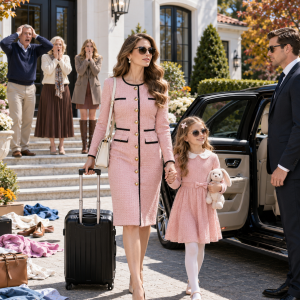
When I returned to Colorado after fourteen months overseas, I believed the hardest part of my life was behind me. I had spent ten years as an Air Force aeromedical evacuation technician, learning how to remain composed inside noisy aircraft while frightened patients searched my face for reassurance, yet nothing in my training prepared me for the sight of my father pushing my duffel bags onto a snow-covered driveway while my six-year-old daughter stood beside me holding a stuffed fox.
My parents had agreed to care for Emma while I was away. I had transferred $1,500 to them every month for food, clothes, and household expenses, and every Sunday they had assured me that she was happy. Now my mother remained behind the glass storm door while my father changed the front lock.
**“Dad, where are we supposed to go?”** I asked.
He would not meet my eyes. **“This arrangement was never permanent. You’re home now, so she’s your responsibility.”**
**“She was always my responsibility. That’s why I paid you.”**
When I stepped toward the porch, he caught my arm and squeezed hard enough to leave marks. I pulled free and told him never to touch me again. In response, he tossed Emma’s little suitcase toward the curb. The zipper opened, sending pajamas, crayons, and picture books across the snow. Emma darted after them, and I caught her just before she reached the slick street.
We spent three nights in my twelve-year-old sedan behind an all-night supermarket. I called it camping because children deserve gentler words than adults sometimes give them, and each evening I made a game of arranging coats around her like blankets. On the fourth morning, as we waited for a family shelter to open, I noticed crackers tucked inside both pockets of her coat.
**“Why are you saving those?”** I asked.
She lowered her voice. **“For later, in case the next place doesn’t have food.”**
That sentence stayed with me long after the shelter coordinator found us two narrow beds. A child should save drawings, seashells, or dandelions—not food against the possibility that the adults around her may fail again.
The Woman in the Black SUV
At 6:10 the following morning, a black SUV stopped outside Haven House. An older woman in a camel-colored coat stepped onto the sidewalk, followed by an attorney and two security officers. I recognized her before my tired mind could make sense of her presence.
Adelaide Prescott was my maternal grandmother and the founder of a large aviation-parts company in Denver. We had not spoken in four years because my parents and my uncle had repeatedly told me she was too frail for visitors and had become resentful of my military career. As she hurried toward me, however, she looked neither confused nor resentful. She looked furious and deeply afraid.
Her expression softened when she saw Emma asleep against my shoulder.
**“Morgan, why are you staying in a shelter?”**
I almost laughed, because the answer seemed too large for an early winter morning. **“My parents put us out.”**
She stared at our bags, the marks on my arm, and my daughter’s worn stuffed fox. Then she asked the question that changed everything.
**“What happened to the house on Briarwood Lane—the one I bought for you?”**
**“What house?”**
Her attorney, Brooke Ellis, opened a leather case and placed a deed on the shelter director’s desk. The property was a four-bedroom home held by the Morgan Hale Residential Trust, created shortly before my deployment. Adelaide said she had sent the keys, certified notices, and copies of the deed to my parents because I had already left for training. They had later claimed I rejected the gift.
Brooke called the property manager. The home was occupied by a family paying $7,600 a month under a corporate lease. The listed landlord was Morgan Hale, represented by my parents, Glenn and Patricia Hale.
The lease carried a convincing version of my signature, except for one small mistake: whoever copied it ended the last stroke with an upward curve, while mine always finished straight. The authorization form had supposedly been signed five weeks after I left the country. Another search revealed a credit account opened with Emma’s Social Security number and secured by the education fund Adelaide had established for her.
Then Brooke found a court petition claiming that I had become unreachable during my assignment and that my parents needed authority over my affairs. The notary approval traced back to my uncle, Wesley Prescott, Adelaide’s only son and the chief financial officer of her company.
Adelaide sat very still.
Four days later, Wesley was scheduled to announce a $650,000 contribution at my parents’ annual winter benefit. The money would come from the trust that owned my home.
**“Take Morgan and Emma to my hotel,”** Adelaide told Brooke. **“Give them the penthouse and put security at the elevator.”**
I was still trying to understand how an entire house could exist in my name without my knowledge. **“Why didn’t you call me yourself?”**
Pain crossed her face. **“Because I trusted the wrong people to carry my messages.”**
What the Papers Revealed
That evening, after Emma fell asleep in a bedroom where the door locked from the inside, Adelaide and I sat before the hotel windows while Denver glowed below us. She admitted that Wesley had controlled her appointments and correspondence during a long recovery from surgery. He had told her I wanted no contact; he had told me the same thing about her.
Brooke arrived with more records. Rent from Briarwood Lane had passed through several consulting companies connected to Wesley, while withdrawals from the education account had covered private expenses and a second household he maintained in Europe. My parents’ benefit organization had also paid generous “administrative fees” to businesses they secretly controlled.
**“Did my parents know everything?”** I asked.
**“They signed enough papers to know they were taking what did not belong to them,”** Brooke replied.
Before dawn, a detective called to report a serious fire in my parents’ detached garage. Both had been treated for smoke exposure and were expected to recover, but investigators had found signs that the fire began in more than one place. A new insurance policy had been purchased four days earlier, on the same afternoon the bank first questioned the trust documents.
My parents asked me to come to the hospital. I declined. Protecting Emma had finally become more important than performing loyalty for people who had treated our devotion as something they could spend.
Later that morning, I visited Briarwood Lane with Brooke. The tenants, a young couple named Daniel and Rebecca Mercer, had believed their lease was legitimate. Two children’s backpacks rested by the stairs, and a paper snowman was taped crookedly to the front window. I could not punish one family for having been deceived by another.
**“We paid every month,”** Daniel said. **“The agent warned us never to contact the owner directly.”**
**“You acted in good faith,”** I told him. **“You will not be sued, and I’ll cover your moving costs. We have also found you another home at the same rent.”**
Rebecca held her toddler closer. **“Why would you help us after what happened?”**
**“Because you were caught inside someone else’s wrongdoing. So were we.”**
A court order allowed us to inspect the property, and in the back of the primary bedroom closet we found a box labeled with my name. Inside was a handwritten timeline recording the arrival of the deed, the decision to tell Adelaide I had rejected her gift, and instructions for imitating my handwriting. A note from Wesley recommended using the court petition so banks would stop asking questions.
The people who deceived us had documented their own plan with the confidence of those who believe family members will remain silent forever.
Five Minutes for the Truth