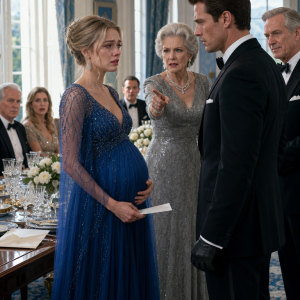
Part 1 — The Night My Father Finally Saw the Truth
The first blow split the inside of my lip before I managed to set my hospital bag on the kitchen counter of our townhouse outside Baltimore, Maryland.
My husband, Caleb Warren, stood over me beneath the bright ceiling lights, one hand still raised while his mother, Marjorie, watched from the breakfast table with the irritated expression of someone whose dinner had been delayed.
I was still wearing navy nursing scrubs beneath my rain-soaked coat. Adhesive circles from the cardiac monitor remained on my chest because I had fainted during my shift at Chesapeake Mercy Medical Center and spent several hours in the emergency department undergoing tests.
The physician had warned me to rest, avoid heavy lifting, and return immediately if the dizziness worsened.
Caleb knew none of that.
He had not asked.
“Do you have any idea how late you are, Megan? My mother and I have been waiting here without dinner for hours.”
Blood filled my mouth.
“I passed out at work, and they sent me downstairs to the emergency department. My phone died before I could call.”
His second strike sent me sideways into a dining chair.
My discharge envelope slid across the tile floor, followed by the bottle of heart medication a physician had prescribed.
Marjorie glanced down at both objects.
“There is always some excuse whenever this household actually needs something from you.”
Caleb grabbed my upper arm.
Fresh pain spread beneath bruises he had left three nights earlier.
Then I saw the red recording light on the doorbell camera.
Caleb had disconnected the indoor security cameras that morning because he had become increasingly paranoid about recordings. He apparently believed the entire house had finally gone blind.
He had overlooked the open front door.
More importantly, he had overlooked the man standing on the porch.
My father, Richard Hale, stood beneath the rain in a plain gray coat, holding his phone toward Caleb with one hand while using the other to place an emergency call.
For one terrible second, Dad looked frozen.
Then his entire expression changed.
Caleb struck me again.
I fell hard enough that my shoulder hit the tile.
My father stepped through the doorway.
“Take your hands off my daughter immediately, and do not touch her again.”
Caleb turned.
He had never met my father.
For six years, he had convinced me that Dad wanted nothing more to do with me.
Now Caleb looked at my father’s inexpensive coat and rain-soaked shoes and laughed.
“This is my family business, old man, so get out before I throw you outside myself.”
Dad looked at my hospital bracelet, then at my swollen cheek.
His voice became almost unnervingly calm.
“Megan, may I come closer to you?”
The question broke something inside me.
After years of being grabbed, ordered, monitored, interrupted, and punished, somebody had asked permission before moving toward me.
I nodded.
Police sirens were already approaching.
Then Dad looked directly at Caleb.
“I have spent three months tracing the money you thought you successfully buried, and tonight you just gave me the evidence I needed to get my daughter out before you discovered what we were doing.”
Part 2 — The Story Caleb Had Prepared
Two officers entered less than a minute later.
Caleb transformed immediately.
His shoulders lowered, his voice softened, and the man who had just knocked me against a chair suddenly became a concerned husband trying to manage an unstable wife.
“She has been under enormous stress lately, Officer. She became aggressive when she got home, and this stranger forced his way into our house.”
Marjorie nodded solemnly.
“Megan has not been herself for months, and my son has tried very hard to protect her reputation.”
My father did not argue.
He handed his phone to the nearest officer.
The video showed Caleb’s hand crossing my face, my body striking the chair, Marjorie ordering me to cook while my medicine rolled across the floor, and my father standing outside until he intervened.
The officer looked from the video to my bruised arm.
He noticed the hospital bracelet.
Then he asked whether I needed medical help.
For years, I had learned that answering honestly created consequences later.
That night, something shifted.
“Yes, I need help, and I do not feel safe staying here.”
Caleb’s face changed.
The officers separated us.
He was arrested after they reviewed the recording and documented my injuries, while I returned to Chesapeake Mercy in an ambulance.
Imaging showed a cracked rib and mild concussion.
This time, when the hospital social worker asked whether I felt safe at home, I gave her the answer I had previously been too frightened to say.
“No, and I have not been safe there for a long time.”
My father sat beside my hospital bed until sunrise.
Caleb knew him only as the useless father who had supposedly abandoned me years earlier.
The truth was almost the exact opposite.
Richard Hale founded Hale Forensic Advisory, a court-appointed forensic accounting firm frequently retained by banks, hospital systems, federal investigators, and law firms when money disappeared behind legitimate-looking paperwork.
He had not abandoned me.
Caleb had isolated us from each other.
He blocked Dad’s phone numbers from my devices, returned birthday cards, intercepted letters, and eventually created messages that convinced both of us the other person no longer wanted contact.
Three months earlier, I had finally discovered the crack in that lie.
Part 3 — The Bank Statement Beneath the Mattress

I found the first suspicious bank statement beneath Marjorie’s guest-room mattress while changing the sheets.
It showed payments from Chesapeake Mercy’s vendor account into a company registered using my Social Security number.
I had never heard of the company.
The transfers were large enough to make my hands shake.
I took a photograph and mailed a printed copy to the last office address I remembered for my father because I was too frightened to store it electronically.
Dad called me from a new number that same evening.
I nearly hung up.
Then he said something only he would know from my childhood.
I cried before either of us could discuss the money.
From that night forward, we communicated carefully.
Dad never told me to confront Caleb.
He taught me to photograph statements, preserve voicemail files, copy dates, and store everything where Caleb could not access it.
A domestic-violence attorney prepared emergency documents in case I needed to leave quickly.
Meanwhile, Chesapeake Mercy’s internal investigators quietly began comparing vendor payments with procurement approvals.
The pattern was worse than I expected.
Caleb was deputy director of procurement for the hospital system.
He approved invoices from several shell companies that appeared to provide equipment consulting, facilities coordination, and staffing services.
In reality, many delivered nothing.
Marjorie controlled those companies through nominees and mail addresses.
Money then moved into accounts created using my identity.
Nearly $1.7 million had been diverted over several years.
The apparent purpose was chillingly simple.
Caleb intended to make the fraud look like mine.
He could then divorce me, portray himself as the betrayed husband of a criminal employee, and pressure me into surrendering the townhouse my mother had left to me.
I whispered from the hospital bed, “You already had the financial evidence. Why did you say tonight gave you the piece you needed?”
Dad’s eyes filled.
“Because financial proof could expose him eventually, but I needed enough documented danger to remove you safely before he realized we were investigating him.”
That answer hurt because it revealed how far the plan had progressed.
We had not simply been investigating missing hospital money.
We had been planning my escape.
Part 4 — The Threat That Arrived After Bail
Caleb was released on bail the following afternoon subject to court restrictions.
Within hours, he found a borrowed phone.
His voicemail arrived while my attorney was sitting beside my hospital bed.
“Come home, withdraw the complaint, and sign the property transfer. If you refuse, I will make certain the hospital believes you stole every dollar missing from those accounts.”
Marjorie sent a photograph shortly afterward.
Several legal documents were arranged neatly across my dining table.
My mother’s china had been placed beside them.
Her message read:
“Caleb is prepared to forgive you. Be home at six.”
Forgive me.
The phrase would have sounded absurd if I had not spent years living inside the world where they controlled the definitions.
Dad wanted me nowhere near the house.
My attorney agreed.
Then investigators examined the voicemail and the photograph.
The compliance team had been waiting for something more direct connecting Caleb’s threats about the hospital money to his demand for my property.
A controlled meeting became possible.
Nobody ordered me to participate.
That distinction mattered.
A detective explained the risks carefully and made clear that the investigation could continue without me returning.