“I invited Claire because she doesn’t have children. I felt bad imagining her alone at Christmas.”
I heard my ex-husband say those words before he saw me.
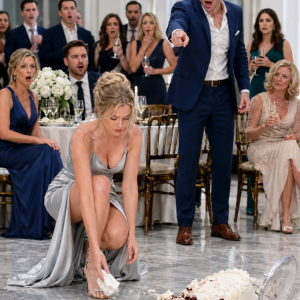
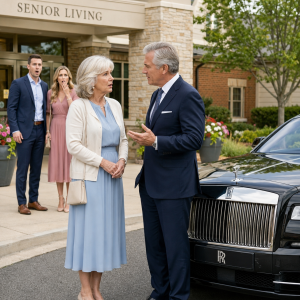
Alexander Whitmore stood beneath the covered terrace of his family’s Virginia estate with one arm around his fiancée, Vanessa. Behind him was a twelve-foot Christmas tree, a string quartet, and nearly sixty members of the Whitmore family and their closest friends.
I was still fifty yards away.
The medical helicopter behind me had barely finished shutting down.
And standing beside me in four navy coats were the four children Alexander had spent eight years telling people did not exist.
Mason looked up at me.
“That’s him?”
I nodded.
He took my hand.
“Then don’t talk first, Mom.”
Before I could ask what he meant, my oldest son walked across the lawn toward his father.
His three brothers followed.
Four Boys Walked Across the Lawn
Eight years earlier, Alexander and I had been married for three years.
I was twenty-seven, finishing my surgical fellowship in Washington, D.C. Alexander was an Army officer from a family where military service was treated almost like inheritance.
His father, retired Major General Richard Whitmore, had opinions about everything—where we lived, what assignments Alexander should accept, when we should have children.
Then my pregnancy became complicated.
Not one baby.
Four.
By the time I was twenty-six weeks along, I had been hospitalized. Alexander and I were already separated by then. He had moved out after months of arguments about his career, his family and whether I was deliberately making my pregnancy “more dramatic than it was.”
The boys came early.
Mason weighed two pounds, four ounces.
Ethan was slightly smaller.
Caleb needed respiratory support.
Noah was the last one delivered and spent weeks frightening me every time one of his monitors changed rhythm.
I called Alexander.
I wrote.
I sent certified letters.
I sent photographs.
Eventually, I stopped.
Not because I thought he deserved peace.
Because I had four premature babies who needed every useful part of me.
Years passed.
I became a pediatric surgeon in Washington. The boys grew into loud, funny, exhausting children who left socks everywhere and could turn breakfast into a congressional hearing over who had received the larger pancake.
I never hid Alexander’s identity.
I simply refused to make him larger in their lives by constantly discussing him.
Then, two weeks before Christmas, an invitation arrived.
Whitmore Hall.
Christmas Eve dinner.
Alexander had written a note beneath the printed invitation.
“I think enough time has passed for us to be adults about this.”
I almost threw it away.
Mason found it on the kitchen counter.
He read Alexander’s name twice.
Then he asked, “Does his family know about us?”
I didn’t answer quickly enough.
Mason understood.
“They think we’re not real?”
“Some of them were told that.”
Ethan stopped eating.
“By him?”
“Yes.”
That was the conversation that changed my decision.
I wasn’t taking my sons to Virginia to demand a father.
I was taking them because eight years was long enough for four living children to be treated like an embarrassing story someone had invented.
“You Said We Never Existed”
Christmas Eve did not go according to plan.
At 3:20 that afternoon, I was still at Children’s National after an emergency operation.
I called the Whitmore estate and said we would be late.
One of my colleagues was scheduled to travel by medical helicopter to a facility west of Washington, and after several calls and a change in transport arrangements, we were able to get close enough to the estate that a car could have picked us up.
The Whitmores had a large open field used occasionally for charity events and military ceremonies.
Someone apparently assumed the arriving helicopter was carrying a senior military guest.
So when we landed, half the party came outside.
I stepped down first in a dark green dress beneath my winter coat.
Then Mason.
Ethan.
Caleb.
Noah.
I watched Alexander’s expression change before anyone spoke.
He looked at Mason.
Then Caleb.
Then back at me.
All four boys had my dark hair.
But the eyes belonged to Alexander.
Blue-gray.
Even the slight downward tilt at the outer corners was the same.
Vanessa’s hand slowly slipped from his arm.
Mason kept walking.
He stopped about six feet from Alexander.
“Are you Alexander Whitmore?”
Alexander stared at him.
“Who are you?”
Mason’s face remained still.
“Mason Bennett.”
He pointed behind himself.
“That’s Ethan. That’s Caleb. That’s Noah.”
Alexander looked at me.
“Claire, what the hell is this?”
I walked closer.
“Watch your language around them.”
His face reddened.
“You brought children here?”
Mason interrupted him.
“You’re the man who said we never existed, right?”
Nobody moved.
Alexander looked around at his relatives.
I recognized that look.
He was checking the room before choosing his answer.
“Claire has obviously told you some things that are complicated.”
“Not complicated,” Ethan said. “She said you told people she lied about being pregnant.”
Alexander turned toward me.
“You planned this.”
“You invited me.”
“Not this.”
I took a folder from my bag.
It was thick, but there was nothing mysterious inside it.
Four birth certificates.
Hospital records.
A DNA report from testing I had arranged years earlier through attorneys when I first considered pursuing formal support.
And copies of certified letters.
I placed the folder on a table beside a bowl of silver Christmas ornaments.
“Then let’s make it simple.”
Alexander didn’t touch it.
His mother did.
Margaret Whitmore was sixty-eight then. She had always been polite to me during my marriage, although never warm.
She opened the folder.
Her fingers stopped on the first photograph.
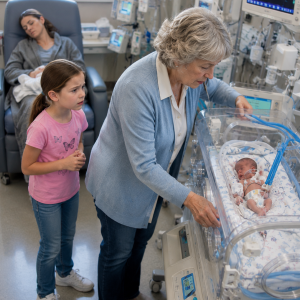
Four incubators.
Four tiny babies.
She sat down.
“What is this?”
“Your grandsons,” I said.
She looked up at Alexander.
Then at me.
“I never saw this.”
“I sent you that photograph eight years ago.”
Her mouth opened slightly.
“No.”
“Certified mail.”
I found the copy.
Margaret examined the address.
It was correct.
She looked genuinely confused.
“Claire, I swear to you, this never reached me.”
Alexander stepped forward.
“Mom, don’t get pulled into this.”
She looked at him.
“Pulled into what?”
He had no answer.
Then I handed her another receipt.
This one had not been mailed to Whitmore Hall.
It had been sent directly to Alexander’s Army unit.
Someone had signed for it.
Alexander.
Margaret stared at his signature.
“Alex?”
His jaw tightened.
“I received a lot of correspondence back then.”
I looked at him.
“You signed for it.”