The Invitation We No Longer Needed

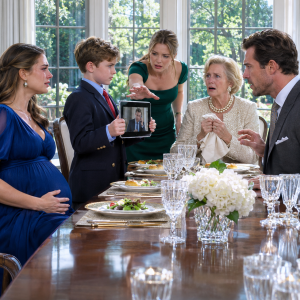
The evening my father dismissed my husband as a man without prospects, he did it beneath a chandelier bright enough to reveal every expression around the table, including the delighted curve of my sister’s mouth, the practiced stillness in my mother’s face, and the bewilderment in my six-year-old son’s eyes.
It was the final Sunday of October, when the hills outside Asheville had turned copper and red and the first cold wind had begun slipping down from the Blue Ridge Mountains. My parents’ house stood on a landscaped rise in Biltmore Forest, all pale stone, black shutters, and carefully trimmed boxwoods, the sort of place where nothing was ever out of position except the people who failed to satisfy my father.
My husband, Ben Hartley, had planned to come with me, but a burst pipe had damaged part of the workshop he managed, and he had spent the day moving lumber and protecting several unfinished orders. So I arrived alone with our son, Caleb, after promising Ben I would leave if my father started one of his familiar performances.
I had made that promise before. Until that night, I had never kept it.
Dinner began with my sister Lauren describing the new European sedan her husband, Scott, had leased. She mentioned the hand-stitched seats, the special paint, and the waiting list, then added the monthly payment with the false embarrassment of someone who had been waiting all evening to share it.
My father, Thomas Whitaker, smiled over the rim of his glass.
“A good car is a reward for a man who knows how to move up in the world.”
Scott gave a modest shrug, although he looked pleased. Lauren leaned closer to him, glowing under our father’s approval.
Then Dad turned toward me.
“Of course, some women choose security, and some choose sentiment.”
I knew what was coming. My shoulders tightened before he even said Ben’s name.
“Rachel, you had every advantage we could give you, and you married a man who makes cabinets in a rented shed.”
The room grew quiet. Caleb’s fork stopped halfway to his mouth.
“Ben builds custom interiors,” I said. “And the workshop isn’t a shed.”
Lauren laughed softly. “Come on, Rach. He comes home covered in sawdust. Dad isn’t inventing anything.”
“Honest work leaves evidence,” I replied. “That doesn’t make it lesser work.”
My father set down his glass. “There you go again, turning a poor decision into a noble cause.”
Caleb looked from his grandfather to me. “Is Dad bad at his job?”
The question was so innocent that it stripped away every excuse I had made for my family. My son did not understand status or class or the private competition my father had cultivated between his daughters. He only understood that three adults were discussing his father as if Ben were something embarrassing.
I laid my napkin beside my plate. “Your dad is wonderful at his job, sweetheart.”
Dad leaned back. “Children eventually need to understand how the world works.”
“Then let him learn this,” I said. “A person’s worth is not printed on a paycheck.”
My father’s expression hardened. He had built a successful career developing office parks, and over time he had come to treat his opinions like deeds to property: once he claimed them, no one else was permitted to stand there.
“If you’re going to correct me in my own home, you can leave.”
Mom stared at her plate. Her name was Margaret, though Dad usually called her Maggie in the affectionate tone he used when she was cooperating. That night he did not have to call her anything. One look from him kept her silent.
I waited a few seconds, hoping she might surprise me. She didn’t.
Lauren lifted her water glass, watching.
Dad pointed toward the foyer. “And don’t come for Thanksgiving. We can have one holiday without everyone tiptoeing around your choices.”
Caleb’s face folded. I stood, helped him into his navy jacket, and lifted him against my hip, although his legs were long enough to bump against mine.
At the doorway, Dad spoke again.
“Someday you’ll understand what you gave up.”
I turned and looked at the table where I had spent most of my life trying to earn a welcome that could be withdrawn whenever I disagreed.
“You just gave us our freedom.”
Then I carried my son outside.
What We Had Built Quietly
For the first twenty minutes of the drive home, Caleb watched the dark trees pass beyond his window. I kept both hands on the wheel because I needed something steady to hold.
Finally he asked, “Grandpa doesn’t like Dad because Dad builds things?”
“Grandpa has confused expensive things with important things,” I told him. “Your father builds places where families live, eat, and spend time together. That matters.”
“Are we poor?”
I glanced at him in the mirror. “We have a safe home, food, people who love us, and enough to share. We are fortunate.”
He considered that answer, then rested his head against the window.
Ben and I had met nine years earlier at a neighborhood restoration project in Hendersonville. I was twenty-six and working as an operations analyst for a medical supply distributor. He was thirty, broad-shouldered and quiet, with a pencil behind one ear and an ability to study a crooked doorway as if it were asking him a question.
My father disliked him immediately. Ben had attended a two-year trade program instead of a prestigious university. His mother had raised him and his younger brother in a small mountain town, and no family name opened doors for him. He drove an old pickup, spoke only when he had something worth saying, and never seemed impressed by Dad’s house.
What my father called a lack of ambition was actually patience.
When Ben’s employer, a respected cabinetmaker named Arthur Bell, decided to retire, he offered Ben the chance to purchase the workshop. The building was modest, the equipment was aging, and the order book was thin, but Ben could see possibilities in it. So could I.
We invested nearly everything we had saved. I kept my day job and took over invoicing, supplier negotiations, payroll, and scheduling at night. Ben improved the shop floor one machine at a time, trained two apprentices, and developed a reputation among local builders for solving difficult problems without missing deadlines.
For three years, our lives looked unimpressive from the outside. We postponed vacations, repaired appliances instead of replacing them, bought used furniture, and remained in our small brick house near Swannanoa. Ben drove the same pickup, while I carried the same brown handbag to every family gathering.
My parents assumed we were struggling because we did not advertise our progress.
The truth was that Hartley Woodworks had become one of the most dependable custom millwork companies in western North Carolina. We were producing cabinetry for renovated historic homes, libraries for private residences, and reception desks for boutique hotels. We owned the workshop outright, had no consumer debt, and had accumulated enough retained earnings to consider a much larger step.
For seven months, we had quietly negotiated to purchase a vacant furniture plant east of Asheville. The property included a finishing room, a loading dock, office space, and enough floor area to triple production. More importantly, the purchase came with two multiyear contracts to provide custom interiors for a regional hotel group.
On the night my father sent us away, Ben was waiting at our kitchen table beside a stack of closing papers.
He stood when he saw Caleb’s face. “What happened?”
I sent our son to wash up and told Ben every word. He did not interrupt. When I finished, his hands rested flat on the table, his fingertips rough from years of working with wood.
“He said that in front of Caleb?”
“Yes.”
Ben looked toward the hallway. “Then we’re finished asking that family to treat us kindly.”
I nodded, and only then noticed the documents.
“Did the lender call?”
His face changed. The anger receded, replaced by a restrained smile.
“The appraisal cleared this afternoon. The contracts transferred, and the sellers accepted our final terms.”
I sat down slowly. “So it’s ours?”
He pushed the top page toward me. “It will be on November fifteenth.”
For a moment neither of us spoke. The old plant was not merely a second location. It would allow us to employ more than twenty people within the first year and move into commercial projects we had once considered far beyond our reach.
I covered my mouth, laughing and crying at once. Ben came around the table and knelt beside me.
“We built this together,” he said.
“Mostly after midnight.”
“Those hours still count.”
We celebrated with grocery-store pie after Caleb went to bed. We did not post an announcement, buy a new car, or call my parents. We signed the final papers three weeks later and went back to work.
Six days before Thanksgiving, Mom phoned me at the office.
“Your father wants you to come Thursday.”
“He told us not to come.”
“He was upset.”
“He was deliberate.”
There was a pause, followed by a long breath.
“Scott was let go from the hotel group,” she said. “His department was eliminated.”
The news startled me. Scott had spent fourteen years in brand partnerships and recently become a vice president. His salary had financed the car, the club membership, and the renovated kitchen Lauren displayed as proof that she had chosen better than I had.
“I’m sorry,” I said. “That must be frightening for them.”
“Your father thinks everyone should be together when the family is having a difficult time.”
I almost laughed, but Mom’s voice sounded too fragile.
“He wanted us absent when humiliating Ben made him feel powerful. Now he wants us present because someone else is uncomfortable.”
“Rachel, please. I don’t know how to manage this.”
There it was: not an apology, but an invitation to resume my old assignment. I was expected to absorb enough of Dad’s attention to give everyone else room to breathe.
Ben entered my office with Caleb sitting on his shoulders, both of them pretending to be explorers searching for dessert. I watched my son laugh and remembered his face at my parents’ table.
“We already have plans, Mom.”
“Can you reconsider?”