Part One: The Gloves on the Driveway

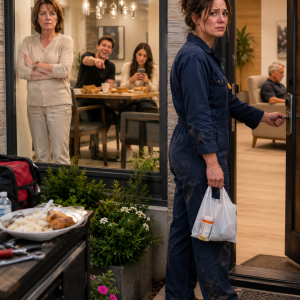
By the time the boxing gloves landed at my feet, nearly half of Hawthorne Ridge had gathered along the sidewalks, pretending they had stepped outside to water their hydrangeas, retrieve their mail, or call their children home for supper. In truth, everyone had come to watch Bryce Halford teach the quiet woman in the gray house a lesson.
I was forty-four years old, five feet seven, and still wearing the faded jeans and paint-speckled shirt I had put on that morning to repair the shelves in my garage. Bryce was twenty-three, broad through the shoulders, trained in competitive kickboxing, and dressed as if a photographer might arrive at any moment. Behind him stood his father, Preston Halford, a prosperous commercial architect who had built half the luxury offices on the north side of Boise and behaved as though he owned the streets between them. Preston held his phone at chest height, recording everything.
My sixteen-year-old son, Caleb, stood on our porch with his backpack still hanging from one shoulder. His eyes moved from the black gloves with silver stitching to Bryce, and then to me.
“Mom?”
There was fear in his voice, though not for himself. That was what tightened my chest. I gave him the smallest shake of my head, the signal we had used since he was little: stay where you are, watch carefully, and do not let someone else’s foolishness decide your next move.
The trouble had begun with Bryce racing his motorcycle through the neighborhood while children played near the street. After he ignored two polite warnings and nearly clipped a boy on a scooter, I asked the neighborhood association to install speed bumps. Preston learned about it before lunch. By five o’clock, father and son were outside my house.
“You keep acting like you’re in charge,” Bryce had said, loud enough for every open window to hear. “So let’s see what happens when somebody doesn’t take orders from you.”
Then he threw the gloves.
I bent slowly and picked them up. They were expensive, softened by use, and carefully maintained. Bryce smiled as though my touching them meant I had accepted his terms.
“There we go,” he said.
I turned one glove over in my hand. “You’ve done this before.”
He laughed. “Obviously.”
“That isn’t what I mean. You’ve challenged people in front of a crowd before, and I’m guessing you choose people who are unlikely to answer.”
Several neighbors looked away. A man near the corner lowered his phone, perhaps remembering a confrontation he had once found entertaining. Bryce’s smile narrowed.
“Don’t make excuses, Mrs. Ellison.”
“I’m not making one.” I handed the gloves back. “I don’t fight people simply because they want an audience.”
For the first time, he appeared confused. “Are you scared?”
“No.”
“Then put them on.”
I looked past him at the parents lining their driveways, at the children peering between porch rails, and at Preston’s raised phone. I had spent eleven quiet years trying to build an ordinary life, and I had no intention of turning my front yard into a stage for a spoiled young man.
“You’re too young to understand what you’re asking for,” I said.
Bryce laughed, and a few people laughed with him. “You’re saying you’re too old?”
“I’m saying no.”
The word settled over the street with more force than shouting would have carried. Bryce’s face reddened, because people who are accustomed to getting their way often hear a calm refusal as an insult.
Preston finally lowered his phone. “Mara, you’re making this unnecessarily dramatic.”
It was the first time he had used my first name. We had spoken perhaps six times in the two months since his family moved into the large stone house across from mine.
“Your son threw fighting gloves at my feet while you filmed him,” I replied.
Preston shrugged. “He’s joking. It’s harmless.”
“No, Preston. It isn’t.”
Something changed in his expression—not remorse, but recognition. It lasted only a second, yet I saw it. Long ago, I had learned that real confidence lived in stillness and in knowing precisely how far one could go while choosing to go no farther.
Bryce knew nothing about that kind of strength. He knew only performance, and his father had brought a camera.
Part Two: The Life I Had Put Away
For eleven years, my neighbors had known me as Mara Ellison, a widowed high-school guidance counselor raising Caleb alone. They did not know that I had once worn a Marine uniform and commanded an expeditionary support unit attached to special operations teams overseas.
I preferred it that way. My old rank was not a party story, and my experience was not a tool for frightening people. I had put that life into a metal box above the refrigerator and filled the years since with the ordinary responsibilities of motherhood.
Bryce stepped closer. “You’ve acted like you’re better than me since we moved here.”
“I barely know you.”
“Exactly. You look right through me.”
I studied him for a moment and saw something more fragile beneath the muscles and practiced grin. He was not really asking whether I respected him. He was asking whether his father did.
“I don’t think I’m better than you,” I said. “I think you’re behaving foolishly, and those are not the same thing.”
A few people inhaled sharply. Preston laughed, not because the remark amused him, but because he enjoyed seeing his son provoked.
“There she is,” he said. “The real Mara Ellison.”
A cold awareness moved through me. Preston had asked unusual questions since arriving in Hawthorne Ridge—where I had lived before Idaho, what branch I had served in, whether I still spoke with anyone from my old command. I had answered politely and vaguely. Now I understood that his curiosity had not been casual.
“You’ve been looking into me,” I said.
His smile disappeared. “People learn about their neighbors.”
“Not like this.”
Bryce glanced at him. “Dad, what is she talking about?”
“Nothing important.” Preston raised the phone again. “Finish this.”
There it was: permission wrapped in two words. Preston had mistaken indulgence for love and applause for guidance.
Behind me, Caleb said, “Mom.”
I turned. He had come down one porch step, his hands clenched at his sides.
“Go inside, sweetheart.”
“But I can’t just—”
“Now.”
He hesitated, then obeyed. I waited until the front door closed before facing Bryce again.
“You’re protecting your kid,” he said.
“Of course I am.”
“Maybe you should protect yourself.”
I took one slow breath. “This is your last opportunity to walk home.”
His friends laughed, and some neighbors joined them. It hurt because they could not see the years behind me: failing radios, young service members watching my face while I made decisions, and names I still remembered when the house was quiet. I wanted none of that history on this pleasant Idaho street.
Bryce moved within six feet and raised his hands. My mind began measuring without permission: distance to the curb, parked vehicle behind him, bystanders too close, Caleb safely indoors. Old training did not vanish merely because I no longer wanted it.
“Maybe I’ll make you put the gloves on,” Bryce said.
Before I could answer, a firm voice rose from across the street.
“Bryce, stop.”
Mrs. Loretta Hayes, a silver-haired retired principal, stood at the edge of her lawn holding a garden hose.
Preston frowned. “This doesn’t concern you, Loretta.”
“You’re recording your grown son while he threatens a woman in front of her child,” she replied. “It concerns every decent person standing here.”
“He isn’t threatening her.”
Loretta pointed toward Bryce’s raised fists. “Then perhaps you can explain what you call that.”
No one answered. Realizing the crowd had stopped admiring him, Bryce lowered his hands and backed away.