I Found My Daughter Outside Her Father’s House in the Rain—Then a Note Hidden in Her Backpack Told Me This Wasn’t the First Time
The Pickup That Was Supposed to Be Ordinary
At 7:08 on a cold Thursday evening, I turned onto Briarwood Lane expecting nothing more dramatic than a tired teenager, a backpack full of homework, and the usual silent ride home.
I had spent two days in Milwaukee for a work conference and had driven straight back to Madison without even stopping at my apartment. My fifteen-year-old daughter, Wren, had stayed with her father while I was away.
I had texted him three hours earlier.
“I should be there around seven. Please have Wren ready.”
My ex-husband, Curtis Bell, had replied with his usual enthusiasm.
“Fine.”
That was Curtis. One-word answers. Closed expressions. A talent for making every conversation feel like an inconvenience.
We had been divorced for almost four years, and during that time I had made peace my personal mission.
I told myself that teenagers needed both parents.
I told myself that Wren should never feel responsible for our divorce.
I told myself that avoiding conflict was a form of protecting her.
For years, I believed that.
Then I pulled into Curtis’s driveway.
And saw my daughter on the ground.
For one confused second, I thought she had dropped something.
Then my headlights moved across the driveway, and I realized Wren was lying on her side beside the front walkway.
Rain soaked through her gray sweatshirt.
Her backpack was several feet away.
One shoe had come loose.
Her dark hair was stuck against her cheek.
I slammed the car into park and ran.
“Wren!”
She didn’t respond.
I dropped beside her, barely noticing the water soaking through the knees of my pants.
“Sweetheart, can you hear me?”
Nothing.
My hands shook as I touched her shoulder.
That was when the front door opened.
Curtis stood beneath the porch light.
Behind him was his wife, Nadine.
Neither of them rushed toward us.
“She Needed to Learn”

I looked up at Curtis.
“What happened?”
His expression barely changed.
“She was being difficult.”
For a second, I honestly thought I had misheard him.
“She’s lying outside in the rain.”
Curtis folded his arms.
“She refused to follow the rules.”
Nadine stood behind him, silent.
I looked at my daughter again.
Her face was pale, and she was barely reacting to my voice.
I reached for my phone.
Curtis stepped forward just enough to make his irritation obvious.
“Jocelyn, don’t turn this into some giant production.”
My thumb froze above the screen.
“A production?”
“She got upset. She worked herself up. She’ll be fine.”
I stared at him.
There are moments when the person standing in front of you suddenly becomes a stranger.
You remember their face.
You remember their voice.
You remember years of birthday dinners and grocery-store trips and arguments about bills.
But somehow you realize you never truly understood the person behind any of it.
That was the moment Curtis became a stranger to me.
I called emergency services.
He sighed.
Actually sighed.
As though I had embarrassed him.
“You always overreact.”
I looked directly at him.
“How long has she been out here?”
He said nothing.
“Curtis, how long?”
Nadine glanced at him.
He still didn’t answer.
That silence terrified me more than anything else.
The Question From the Paramedic

The ambulance arrived quickly.
Two paramedics hurried toward Wren while I moved aside just enough to let them work.
One of them, a woman named Elena Porter, asked me several questions while her partner checked Wren.
Then Elena looked toward the porch.
“Are you her father?”
Curtis nodded.
“Did anyone call for medical assistance earlier this evening?”
His eyes narrowed.
“No.”
Elena looked at him for another second.
Then she turned back toward Wren.
Something about her expression changed.
It was subtle, but I saw it.
Recognition.
Concern.
Not surprise.
I followed her toward the ambulance.
“Why did you ask him that?”
She hesitated.
“Let’s focus on your daughter right now.”
That should have been the end of the conversation.
But then her partner quietly said something to her that I couldn’t hear.
Elena glanced at me.
“Mrs. Bell—”
“Ms. Rowe.”
“Ms. Rowe, has your daughter stayed at this address regularly?”
“Every other weekend, plus some school nights.”
Her expression tightened.
“All right.”
She didn’t explain further.
But my stomach already knew something my mind hadn’t accepted yet.
This night might not have been the beginning.
The Backpack
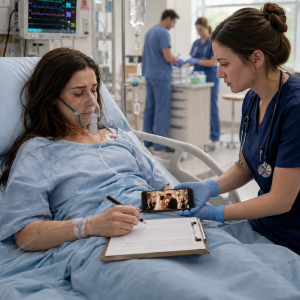
At the hospital, Wren slowly became more alert.
The staff told me she had been exhausted, cold, dehydrated, and overwhelmed, but she was stable.
That word—stable—felt like oxygen.
I sat beside her for nearly an hour.
She barely spoke.
Whenever I mentioned her father’s house, her eyes moved toward the wall.
Finally, she whispered,
“Mom, can we just go home?”
I squeezed her hand.
“As soon as they say we can.”
Her backpack had been brought in with us and left near the chair.
Everything inside was soaked.
A notebook.
Two textbooks.
A folder.
Her pencil case.
A crumpled sweatshirt.
I began laying everything out on a spare chair so it could dry.
That was when a folded piece of notebook paper slipped from between two books.
At first, I assumed it was homework.
Then I saw my name.
MOM
Written in black marker.