The Anniversary Message

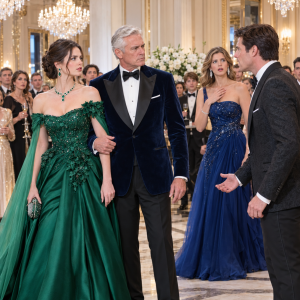
My phone vibrated just as the string quartet began playing near the marble staircase, and for one hopeful second, as I stood beneath the crystal lights of the Hawthorne Hotel in Boston with a gift tucked inside my handbag, I thought my husband had somehow sensed that I was near him.
The message was from him.
“Still tied up at the conference. I hate missing our anniversary. I love you, Em.”
A smile began to form before I lifted my eyes, but it vanished so quickly that my face felt numb.
Less than twenty feet away, beneath an arrangement of white orchids and pale blue hydrangeas, my husband slipped his phone into the inside pocket of his navy jacket, turned toward the tall blonde woman beside him, and kissed her.
There are moments when the mind refuses to accept what the eyes have already understood, and in that suspended instant, while waiters crossed the lobby carrying trays of champagne and guests drifted toward the ballroom in evening clothes, I tried to transform what I had seen into something innocent.
Perhaps I had mistaken the angle. Perhaps she had leaned close to whisper. Perhaps the bright lights reflected off the marble and distorted the scene.
Then his hand settled at her waist with the ease of habit, and she smoothed his lapel as though she had done it many times before.
Her name was Natalie Mercer.
She served as executive director of a prestigious arts foundation, and my husband, Grant Whitmore, had spent the past year designing its new cultural center. I had heard her name at our dinner table, usually wrapped inside sentences about donor meetings, zoning complications, or wealthy trustees who changed their minds every other week. Grant had always described her as demanding, polished, and indispensable to the project.
He had never mentioned the way she looked at him.
I had already taken several steps across the lobby when someone touched my arm.
“Please don’t go over there yet.”
I turned sharply and found a white American man in his mid-forties standing beside me, his face pale beneath carefully combed brown hair. He released my arm immediately and raised both hands, apparently realizing how alarming the gesture must have seemed.
“I’m sorry,” he said. “I shouldn’t have touched you, but if you confront them now, they’ll call it one careless moment and spend the next six months convincing us that we imagined everything else.”
I stared at him, barely able to breathe.
“Who are you?”
His gaze traveled past me to Natalie, whose fingers were still resting on my husband’s sleeve.
“Owen Mercer,” he answered. “Natalie is my wife.”
Two Strangers in the Lobby
Three weeks earlier, Grant had told me that the Boston Design Forum had invited him to participate in a private panel for architects working on civic projects. The trip would place him on the other side of the country from our home near Portland, Oregon, and directly across the date of our sixth wedding anniversary.
He had looked genuinely disappointed when he told me.
“I tried to have the panel moved,” he said while standing at our kitchen counter, “but half the trustees are flying in from different states, and Natalie says this may be the only weekend they can all attend.”
I had swallowed my own disappointment because marriage, as I understood it then, sometimes required one person to be gracious when the other person’s responsibilities became inconvenient.
“We’ll celebrate when you get home,” I told him.
He came around the counter, wrapped his arms around me, and kissed my forehead.
“I don’t deserve you.”
That sentence returned to me in the hotel lobby with such cruel clarity that I nearly laughed.
Instead of waiting for him to come home, I had arranged a surprise. My supervisor approved two personal days, my younger sister agreed to watch our aging dog, and I booked a flight to Boston without telling Grant. The plan had seemed wonderfully romantic: I would appear after his panel, give him the antique drafting compass I had restored and engraved with our wedding date, and take him to the quiet Italian restaurant where I had reserved a corner table.
The compass was still inside my handbag when Owen told me that he had been watching his wife’s behavior change for nearly five months.
Natalie’s evening meetings had become more frequent, he explained, while weekend foundation retreats appeared on her calendar with little warning. She had begun keeping her phone facedown during dinner and answering simple questions with long, elaborate explanations that sounded rehearsed.
Owen had no single piece of evidence that proved anything, only a collection of inconsistencies too small to confront separately and too persistent to ignore together. When Natalie announced that she would be traveling to Boston for a donor summit, he quietly booked a room in the same hotel.
“She thinks I’m visiting my brother in Vermont,” he said.
I looked toward Grant and Natalie. They had moved closer to the ballroom entrance, where an older couple greeted them warmly. The woman embraced Natalie, then kissed Grant’s cheek as though the four of them were old friends.
There was no surprise in her expression and no awkwardness in Grant’s.
“They know,” I whispered.
Owen’s jaw tightened.
“Some of them probably do.”
“I watched him kiss her. What else are we waiting for?”
“For them to show us whether that kiss belongs to one evening or an entire second life.”
I hated his restraint because it required me to control myself when every part of me wanted to cross the lobby, place my anniversary gift at Grant’s feet, and demand an answer.
Yet Owen was right. Grant knew how to explain things. It was one of his greatest talents. He could make an unreasonable client feel respected, an angry contractor feel heard, and a worried wife feel foolish for doubting him. If I confronted him privately, he would turn that kiss into confusion, loneliness, pressure, or some other temporary weakness that required my sympathy.
So when Grant offered Natalie his arm and led her into the ballroom, I followed Owen at a distance.
The Life I Had Never Seen

The ballroom overlooked Boston Harbor, where city lights trembled across the dark water beyond towering windows. Round tables covered in ivory linen filled the room, and hundreds of architects, donors, foundation officers, and civic leaders moved through the space with the confidence of people accustomed to being welcomed wherever they went.
Owen and I remained near the back wall.
Grant and Natalie did not behave like two colleagues struggling with a new and uncomfortable attraction. They moved together with the quiet coordination of a married couple who knew which stories the other had already told, which guests required special attention, and when to step forward or fade into the background.
Natalie rested her hand on Grant’s arm while speaking to a silver-haired trustee. Grant brought her a glass of sparkling water without asking what she wanted. When photographers gathered near the stage, Natalie adjusted his tie, and he leaned close enough to say something that made her smile.
Nobody around them appeared surprised.
I began remembering all the questions Grant had asked me during the past year.
When would my monthly library board meeting finish? Was I still planning to spend Saturday with my sister? Would I be home after my dental appointment, or did I intend to stop for groceries? Was the community literacy retreat an overnight event?
I had interpreted his interest as affection, especially because he remembered details many husbands might overlook. Now those conversations rearranged themselves into something colder.
He had not always been checking on me.
Sometimes, he had been checking whether the house would be empty.
“Emily?” Owen murmured.
I looked at him.
“How do you know my name?”
His expression softened with something resembling pity.
“Natalie mentioned you at a foundation dinner last spring. She said Grant’s wife worked for a public library system and preferred a quiet life.”
I felt a fresh humiliation spread through me. Natalie knew who I was, what I did, and the kind of life I preferred, while I had known her only as a name attached to Grant’s largest project.
At the front of the room, Grant pulled out Natalie’s chair. She sat beside him at a table reserved for senior sponsors, and several guests welcomed them as a pair.
“Perhaps everyone here thinks they’re together,” I said.
“Perhaps they’ve never corrected anyone.”
The program began with an introduction from the forum director, followed by a brief presentation honoring several contributors to the city’s restoration projects. Grant was scheduled to speak later, but I could no longer imagine sitting quietly while he accepted praise for integrity, vision, and public service.
Owen watched Natalie for another minute before straightening his jacket.
“What are you doing?” I asked.
“Making sure neither of them gets to revise this evening before we’ve even left the room.”
He walked toward the stage.
At first I assumed he intended to approach their table, but instead he spoke to an event coordinator standing beside the curtain. The woman shook her head, then listened as Owen calmly showed her something on his phone. After a brief, uneasy exchange, she handed him the microphone during a pause in the program.
Conversations faded as Owen stepped beneath the lights.
Natalie looked up.
I saw the precise moment she recognized him, because her smile disappeared and both hands tightened around the edge of the table.
“Good evening,” Owen began, his voice remarkably composed. “I apologize for interrupting, but there seems to be some confusion in this room, and I believe four people deserve the courtesy of having it corrected.”
Grant turned toward Natalie, then followed her frightened gaze to the stage.