Part 1 – The Fall Everyone Thought Was Theater
When my legs gave out on the concrete walkway behind our house, I was carrying a tray of smoked brisket for my husband’s birthday party. The aluminum tray struck the pavement first, the serving tongs bounced once, and then my knees hit hard enough to make the world flash white while everything below my hips seemed to disappear.
My name is Hannah Mercer, I was thirty-two years old, and I worked as a billing coordinator for a regional chain of veterinary clinics in Columbus, Ohio.
That Saturday in June was my husband Evan’s birthday, and his mother, Diane Mercer, had turned our modest three-bedroom house into an elaborate backyard celebration with banners, rented tables, decorative lights, and a football-shaped cake even though Evan’s favorite sport had always been bowling.
For five months, tingling in my feet had progressed into crushing fatigue, blurred vision, and episodes when my legs suddenly lost strength without warning.
Every time I mentioned those symptoms, Evan responded with the same patient irritation. “You are exhausted because you worry about everything, so drink some water, sleep more, and stop convincing yourself something is seriously wrong.”
Diane was even less gentle. “Women your age have no stamina anymore, because every inconvenience somehow becomes a medical emergency.”
I tried to ignore them until I collapsed in front of fourteen people. Evan heard the crash from the grill and walked toward me instead of running, then looked at the grease on my shirt and sighed as though I had interrupted something important.
“Hannah, seriously, get up because everybody is staring at you.”
My voice shook when I answered, “I cannot feel my legs, Evan, and I cannot make them move.”
His expression did not become frightened; instead, it became irritated. One of his coworkers stepped forward instinctively, but Evan raised a hand and waved him back.
“She has been doing this for months, so give her a minute and she will be fine.”
Diane came closer, planted both hands on her hips, and announced loudly enough for half the backyard to hear, “She cannot let one day be about somebody else. Evan gets one birthday party, and suddenly Hannah has to collapse.”
I pressed my cheek against the hot concrete because I could not lift myself properly, and while I lay there terrified by the complete silence in my lower body, my mind jumped unexpectedly to money. Twelve hundred dollars had disappeared from our savings account the previous month, supposedly for repairs to our Mazda, although the warning light had remained on afterward.
Then I remembered the credit-card statement I had found three weeks earlier, showing a balance of seventy-four hundred dollars on an account I had never seen. Evan had called it a bank mistake and promised to investigate, yet he never made the call.
The sirens arrived before anyone else at the party found the courage to move. I still do not know who called emergency services, but one person looked at a woman unable to move and decided her words deserved to be believed.
Part 2 – Five Months of Symptoms
The collapse had begun long before that afternoon, although I did not recognize the pattern until later. I met Evan five years earlier through a coworker who described him as dependable, patient, and “the kind of man who actually listens.”
He worked as a warehouse manager for a large automotive-parts distributor outside Columbus, with a stable schedule and the reassuring habits of someone who seemed grounded. We married after fourteen months, and I initially treated Diane’s constant presence as merely annoying rather than dangerous.
She had a key to our house and used it freely, reorganizing my kitchen cabinets, criticizing the way I folded towels, and correcting recipes while I cooked them. Whenever I objected, Evan gave me a practiced smile and said, “That is just Mom being Mom. She means well, so please do not turn everything into a confrontation.”
For years, I became excellent at avoiding confrontation. Two years after the wedding, Evan persuaded me to combine our accounts because married people, he said, should operate like a single team. I earned $42,600 a year, yet our balances repeatedly fell below what my calculations predicted, and Evan joked that I was simply bad at household math.
When I finally tried to schedule a doctor’s appointment, I discovered Evan had never added me to his health insurance after changing jobs four months earlier. He called it an administrative oversight and promised, “I will fix it Monday morning, so do not waste money out of pocket when this is obviously temporary.”
Several Mondays passed without anything changing, so I used a private emergency account my grandmother had advised me to keep when I was nineteen. I paid $285 for an appointment myself, and the doctor ordered blood work that had not returned before my collapse. Another detail also bothered me: my evening chamomile tea had started tasting different.
About five months earlier, it developed a faint bitter edge that had never been there before, and Evan explained that he had switched brands because the old one had become more expensive. The explanation sounded ordinary enough, except that he also began preparing my tea every single night.
He forgot groceries and anniversaries, yet somehow never forgot the tea, and I mistook that consistency for tenderness.
Part 3 – The Paramedic Who Refused the Script

The ambulance arrived at 4:47 in the afternoon, and the paramedic who knelt beside me introduced herself as Rebecca Sloan. She had short brown hair, a steady voice, and the calm of someone who had spent fourteen years entering other people’s worst moments.
Rebecca tested sensation in both legs, checked my reflexes, examined my eyes, and asked questions with an attention that made me feel human again. I had no sensation below my hips, and my reflexes were absent rather than merely weak.
Her expression remained neutral while her notes became increasingly detailed. “When did these symptoms begin, and have you changed medications, supplements, food, drinks, or anything else in your daily routine?”
I told her about the tingling, fatigue, blurred vision, and nighttime tea, noticing that her pen slowed slightly when I said Evan prepared it every evening. She did not react dramatically; she simply kept asking questions.
Evan returned from the backyard and immediately began answering for me. “She has been anxious for months, and honestly I think stress is the main issue because she focuses on symptoms until they become bigger in her head.”
Rebecca looked directly at him. “I need to hear the medical history from my patient, so please give us some space.”
Evan crossed his arms and replied, “This is my property, and she is my wife, so I know what has been going on.”
Rebecca repeated the instruction with enough firmness to end the argument, and later I learned she requested police assistance because a family member was interfering with patient care and becoming verbally aggressive. Evan eventually backed away, and when they loaded me onto the stretcher, he said he needed to stay behind to deal with the guests and clean up the party.
Inside the ambulance, Rebecca checked my vital signs again and said something that was not medical at all. “You are not imagining this, Hannah, and I want you to understand that clearly.”
That sentence nearly broke me because I had spent months being told that my body was exaggerating, my mind was anxious, and my instincts were unreliable. A stranger who had known me for less than twenty minutes gave me permission to trust my own experience.
Part 4 – What the Hospital Found
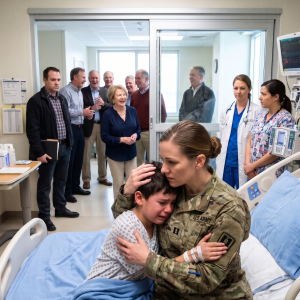
At the hospital, the emergency physician ordered imaging and expanded blood testing after Rebecca privately explained what she had observed. Evan arrived almost three hours later and, instead of asking what doctors had found, asked when I would be discharged because the house was a disaster after the party. Then he sat in the corner looking at his phone while a nurse asked the standard safety question.
“Do you feel safe at home?”
I answered yes automatically, but the question remained lodged inside me afterward. While Evan scrolled through messages, I opened our bank account and noticed repeated sixty-dollar ATM withdrawals from a neighborhood in Dayton, a place where we neither lived nor shopped.
The twelve-hundred-dollar withdrawal was still labeled vehicle repair, yet those smaller withdrawals appeared with the regularity of someone maintaining another routine. I did not sleep that night, and shortly after six the next morning, the emergency physician returned with a patient advocate and Detective Marissa Cole.
The physician pulled a chair close to my bed and explained that imaging showed progressive damage to my peripheral nervous system. The pattern did not fit the common neurological disorders they initially considered, while toxicology showed evidence of prolonged exposure to an industrial solvent.