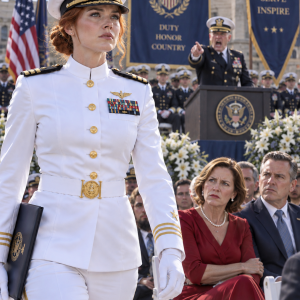
My father told two hundred Army families that I had been dishonorably discharged.
He did it with a microphone in his hand.
“My daughter left the Army under circumstances she still refuses to talk about,” he said. “Some people call that privacy. I call it avoiding accountability.”
A few people laughed because they thought he was making one of his dry retired-colonel jokes.
Then he added:
“She was dishonorably discharged.”
Nobody laughed after that.
I was sitting near the back of the pavilion at Fort Huachuca with a paper plate of barbecue in front of me. My father, retired Colonel Robert Miller, stood beneath an American flag while my mother stared down at her water glass.
My younger brother, Eric, was sitting three tables away in his Major’s uniform.
He didn’t look at me.
I was forty-one years old, and my father had just announced to a crowd of military families that the career I had spent nearly two decades building had ended in disgrace.
The strange part was that he looked relieved.
Like he had finally solved me.
The Thing My Father Never Understood
My name is Laura Miller.
I had spent most of my Army career working around communications systems, network integration, and specialized operational programs. That’s the simplest way I can describe it.
Even inside the Army, people outside my field often didn’t understand exactly what I did.
My father hated that.
He had retired after a long conventional career in which rank, assignments, commands, and accomplishments were things you could put neatly into a biography. Eric followed a similar path.
Mine didn’t work that way.
When Dad asked where I was going, sometimes I couldn’t tell him.
When he asked who I worked for, sometimes the answer had to stay vague.
When he asked why I had spent six months somewhere and came home without photographs or stories, I usually said:
“It was work.”
He interpreted that as disrespect.
At the pavilion, Dad handed the microphone back to the event organizer and stepped down as if nothing unusual had happened.
I stayed seated.
My mother finally looked at me.
“Laura,” she said quietly when she reached my table, “don’t make this worse.”
I looked at her.
“I haven’t said anything.”
“Exactly. Just keep it that way.”
Dad walked over behind her.
“You could clear this up anytime you wanted.”
“Clear up what?”
“Why you left.”
“I’ve told you why I left.”
“You gave us a sentence.”
“Because that’s all you’re entitled to.”
His jaw tightened.
That was the sentence he hated most.
Not because it was cruel.
Because it was true.
I had received an honorable discharge. There was nothing ambiguous about it. I had the paperwork at home.
Dad had never asked to see it.
He had decided my refusal to explain every detail meant there had to be something shameful underneath.
Eric finally came over.
“Dad, maybe we shouldn’t do this here.”
Dad turned toward him.
“I’m tired of everybody protecting her.”
“I’m not protecting anybody.”
“Then ask her.”
Eric looked at me.
I waited.
He didn’t ask.
That bothered me more than I expected.
Then someone behind my father said my name.
“Laura Miller?”
I turned.
Brigadier General David Brooks was walking toward us.
I hadn’t seen him in nearly four years.
Dad immediately straightened.
Eric did too.
General Brooks shook Eric’s hand first, then my father’s. When he reached me, his eyes dropped briefly to the small pin on my collar.
His expression changed.
“I haven’t seen one of those in a while.”
I touched it without thinking.
“Old habit, sir.”
Dad looked between us.
“You two know each other?”
General Brooks gave me the kind of look people use when they’re deciding how much they’re allowed to say.
“Yes.”
Dad smiled.
“Then perhaps you can settle something. Laura has never been particularly forthcoming about the end of her career.”
General Brooks glanced at me again.
“What exactly needs settling?”
Dad crossed his arms.
“Whether she was discharged honorably.”
The pavilion hadn’t gone completely quiet, but the people closest to us were listening.
General Brooks stopped smiling.
“Colonel Miller, your daughter separated honorably.”
Dad’s face didn’t move.
“You’re certain?”
“Yes.”
“She told you that?”
“No.”
General Brooks paused.
“I know.”
Eric stared at me.
Dad looked irritated rather than embarrassed.
“Then perhaps you know why she was so secretive.”
General Brooks shifted his weight.
“Robert, there are careers in the Army that don’t look like yours.”
Dad said nothing.
“Laura worked in one of them.”
Eric looked at the pin on my collar.
Then at me.
“What program?”
I shook my head slightly.
General Brooks noticed.
“That’s probably enough.”
But Eric wasn’t finished.
“Were you working communications integration?”
I didn’t answer.
His expression changed.
“Laura.”
“Eric.”
“The systems we used overseas—”
General Brooks interrupted him.
“Major, this isn’t the place.”
Eric stopped.
But I could see the connection forming anyway.
Years earlier, during one of his deployments, his unit had suffered repeated communications failures. A specialized support team had worked remotely with technical personnel to stabilize parts of their network architecture.
Eric had told that story at Thanksgiving.
Dad had praised the unnamed people who kept the system running.
I had been sitting three seats away.
Eric stared at me.
“Were you involved in that?”
I looked toward General Brooks.
He gave the smallest nod.
“My team supported part of it.”
Eric’s mouth opened slightly.
Dad frowned.
“You never said that.”
I looked at him.
“I couldn’t.”
For once, he had no immediate response.
Two Promotions I Never Received
The humiliation at Fort Huachuca should have been the end of it.
Instead, it made me look at something I had spent years avoiding.
I had been passed over for promotion to Major twice.
There were legitimate reasons that could happen. My assignments were unusual. My evaluations sometimes had to describe highly technical work in language broad enough for people outside the program. I had also accepted assignments that were good for the mission but not necessarily good for promotion.
I knew all of that.
What I didn’t know was why my father’s name had appeared in a conversation about my career years earlier.
Three days after the pavilion incident, Mom came to my apartment carrying a cardboard file box.
She set it on my kitchen table.
“Your father doesn’t know I have this.”
I didn’t touch it.
“What is it?”
She pulled out a chair.
“Things he kept.”
Inside were old printed emails, handwritten notes, contact information, retirement paperwork, and pages Dad had collected over the years.
Most of it meant nothing.
Then I found my name.
Beside it was the name of an officer I recognized.
There was a phone number underneath.
Then another name.
And another.
I looked at Mom.
“Why does Dad have these?”
She rubbed her thumb against the edge of the table.
“He was worried about you.”
“That isn’t an answer.”
She looked toward the window.
“He called people.”
I sat down.
“What people?”
“People he knew. People who knew people you worked with.”