PART 1
My Mother-in-Law Threw My Suitcase Into the Rain the Morning After We Buried Her Son
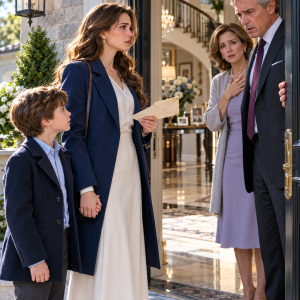
My mother-in-law threw my suitcase down the front steps less than twenty-four hours after we buried her son.
It hit the wet stone hard enough to burst open, sending my clothes across the lawn. My navy nursing scrubs landed in a puddle, one shoe disappeared beneath a hedge, and the sweater Terrence had given me our first Christmas together slid through the mud.
Then our wedding album fell out.
That was the only thing that made me stop.
Eleanor Washington stood beneath the covered entrance of the house in a cream-colored robe, perfectly dry, while I knelt in the rain wearing the same black dress I had worn to my husband’s funeral.
“You need to leave, Audrey.”
Behind her, my sister-in-law Chloe held up her phone.
She was recording me.
I picked up the wedding album and wiped mud from the plastic sleeve covering the first photograph. Terrence was supposed to be looking at the camera in that picture, but he wasn’t.
He was looking at me.
He always did that.
“Are you actually filming this?” I asked.
Chloe lowered the phone slightly and gave me the kind of smile people use when they want cruelty to sound reasonable.
“Please don’t make this more embarrassing than it already is.”
For one second, I considered asking which part embarrassed her—the widow on her knees in the rain, or the woman recording her.
Instead, I stood and pressed the album against my chest.
Eleanor folded her arms.
“You may take your personal belongings. Nothing belonging to this family leaves the property.”
“Terrence belonged to this family too.”
Something moved across her face.
“Don’t do this, Audrey.”
As though I had dragged the suitcase outside.
As though I had turned on the camera.
As though I had chosen the morning after Terrence’s funeral to decide who counted as family.
The House I Wasn’t Allowed to Enter
Terrence and I had been married seven years.
I was a pediatric nurse when we met, and I remained one after I became Audrey Washington. His surname changed the restaurants where people suddenly found us a table and the charity invitations arriving in our mailbox, but it never changed what happened when I clocked into the hospital.
Children still cried when I approached with a needle.
Parents still wanted straight answers.
At work, nobody cared that Washington Shipping had been in my husband’s family for three generations.
Eleanor cared very much.
I grew up outside Baltimore with a school secretary for a mother and an electrician for a father. The first evening Terrence brought me home, Eleanor asked which nursing school I had attended before she asked where I grew up.
When I answered, she smiled.
“How practical.”
Terrence heard her. Under the table, he placed his hand over mine and kept it there until dessert.
That was how he handled his family. He rarely made speeches or started fights. He simply positioned himself beside me and made it clear that anyone drawing a line between the Washingtons and Audrey would have to draw it through him too.
Now Terrence was gone.
Howard Washington came outside while I was pushing my wet clothes back into the suitcase. My father-in-law looked exhausted, with gray shadows beneath his eyes and yesterday’s grief still sitting heavily across his shoulders.
For one hopeful second, I thought he had come to stop Eleanor.
Instead, he handed me an envelope.
“Your copy of the prenuptial agreement.”
I stared at him. “Why would I need this this morning?”
Howard glanced toward the rain before answering.
“Because grief makes people confused about practical matters, Audrey. I don’t want misunderstandings later.”
His tone was gentle.
That somehow made it worse.
“Terrence’s personal effects will be reviewed by the family attorney. Anything you’re legally entitled to will be forwarded to you.”
Chloe lowered her phone.
“Which isn’t going to be much.”
Howard frowned at her. “Chloe.”
“What? She should know before she starts expecting things.”
Eleanor stepped closer to the doorway.
“Terrence protected this family before he married you. The agreement is very clear.”
I knew exactly what the prenup said because, unlike the Washingtons apparently believed, I had read it before signing.
Three weeks before our wedding, I had taken it to my own attorney. I had never objected to Terrence protecting assets he owned before our marriage.
I had not married Washington Shipping.
I had married Terrence.
But standing in the rain, I understood what Eleanor thought the agreement meant.
Terrence dies.
Audrey gets nothing.
Audrey leaves.
I put the envelope into the suitcase.
“Is my car still in the garage?”
Howard hesitated.
“The Range Rover is titled through the company. We’ll arrange transportation to wherever you’re staying.”
“I meant my Honda.”
Nobody spoke for a moment.
My twelve-year-old Accord had been sitting in the rear garage because I had refused to sell it after marrying Terrence. He teased me constantly about it.
That thing is going to outlive both of us.
The memory almost made me lose my composure.
Howard cleared his throat.
“Yes. The Honda is yours.”
I picked up my suitcase.
Nobody offered to help.
The Envelope Terrence Told Me Not to Open
For the next three nights, I stayed at a hotel near the hospital.
Going back to work was easier than sitting alone. I could administer medication, explain procedures and reassure frightened parents without anyone asking about Washington Shipping or the funeral.
At work, I was Audrey again.
On the fourth evening, I returned to my hotel room and found a voicemail from Nathan Vance.
I recognized the name immediately.
Terrence had introduced us once at a Christmas party.
Nathan was an estate attorney.
But he was not the Washington family attorney.
He was Terrence’s.
His message was brief.
“Mrs. Washington, I’m sorry to contact you so soon after Terrence’s death. He left instructions that I speak with you privately. Please call when you’re ready.”
I sat on the edge of the bed for several minutes before dialing.
Nathan answered himself.
After offering his condolences, he asked an unexpected question.
“Did Terrence ever give you a sealed envelope?”
My eyes moved toward the suitcase beside the dresser.
Two months before he died, Terrence had handed me an envelope while I was making coffee. My name was written across the front in his handwriting.
I had laughed.
“What’s this?”
“Something boring.”
“Then why are you being mysterious about it?”
Terrence had taken the coffee mug from my hand, set it on the counter and kissed my forehead.
“Put it somewhere safe. Vance will tell you if you ever need to open it.”
I had forgotten about it.
Now I pulled open the suitcase Eleanor had thrown down the steps and reached beneath the lining.
The envelope was still there.
One corner was wrinkled from the rain.
The seal remained intact.
“I have it.”
Nathan exhaled.
“Good. Don’t open it tonight. Bring it to my office tomorrow.”
The next morning, I sat across from him in a Manhattan conference room while rain tapped against the windows.
Nathan pushed a letter opener toward me.
Inside was one handwritten page.
Audrey,
If Vance told you to open this, then I didn’t get the chance to explain it myself.
Trust him.
Don’t sign, surrender, transfer, waive, or agree to anything my family puts in front of you until you understand what I left you.
I know you’ll hate me for making this sound dramatic.
Do it anyway.
T.
I read it twice before placing it carefully on the table.
“What did Terrence leave me?”
Nathan did not answer immediately.
Instead, he opened a black folder.
“Have you signed anything since his death?”
“No.”
“Transferred anything?”
“No.”
“Waived any estate rights?”
“No.”
He nodded.
“Good.”
Then he turned the first document toward me.
Terrence’s signature appeared near the bottom.
Above it was a number.
51%.
I looked at Nathan.
“What am I looking at?”
“Terrence owned fifty-one percent of Washington Shipping.”
I almost laughed because the statement seemed so obviously wrong.
“Howard owns the company.”
“Howard runs the company. That’s different.”
Nathan tapped the document.
Terrence’s grandfather had transferred his controlling shares to Terrence years earlier. Howard served as CEO and managed daily operations, but Terrence quietly remained the controlling shareholder.
Those shares were Terrence’s separate property.
His final will transferred them to me.
“The prenup?” I asked.
“Protects premarital property during divorce. It doesn’t prevent Terrence from leaving his separately owned property to his wife.”
I stared again at the number.
“Does his family know?”
Nathan chose his words carefully.
“They knew Terrence held the controlling shares.”
“Do they know he left them to me?”
“No.”
The image that came to me was not a boardroom.
It was my suitcase lying open in the rain.
Terrence Had Been Looking at Something Before He Died
I did not call Eleanor.
I did not call Howard.
And I certainly did not call Chloe.
Owning fifty-one percent of a company did not mean I understood how to run a shipping business, and Terrence had apparently known me well enough to anticipate that I would not pretend otherwise.
So I asked Nathan to teach me what I needed to know.
During the following months, I worked my hospital shifts and spent my days off reading reports. Nathan introduced me to the company’s governance structure, voting rights and financial records without trying to turn me into something I wasn’t.
Washington Shipping was profitable.
But money was leaving it in ways that troubled me.
Private travel appeared as corporate travel. Renovations to properties used almost exclusively by the Washington family were charged to the company. Consulting expenses lacked clear deliverables. Budgets for foundation events repeatedly doubled after approval.
Howard’s authorization appeared again and again.
One afternoon, I pushed a report toward Nathan.
“Did Terrence know about this?”
“He had concerns.”
“How long?”
Nathan paused.
“At least a year.”
I leaned back.
“Why didn’t he tell me?”
“I can’t answer that for him.”