The Christmas Chair

By the time I pulled into my driveway on Christmas Eve, snow had begun gathering along the edges of the sidewalk, softening the neighborhood beneath a thin white layer, and from the street everything about my house looked exactly as I had left it three hours earlier: the wreath hanging crookedly on the front door, the small white lights glowing around the porch railing, and the paper stars my eleven-year-old daughter, Lily, had taped to the living-room windows because she said store-bought decorations made houses look as though they were trying too hard.
What I did not expect was to see the kitchen light on.
Lily was supposed to be spending Christmas Eve with my parents.
I had dropped her off at their house outside Columbus that afternoon because I was working a late shift at the rehabilitation center where I coordinated patient services, and my mother had assured me several times that Lily should come early, that everyone would be there, and that there would be more food than twenty people could possibly finish.
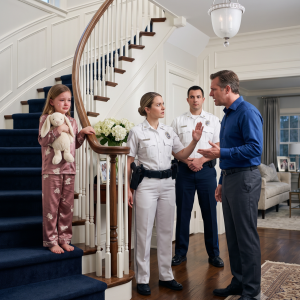
Yet when I opened my front door, the first thing I saw was Lily’s winter coat hanging over a dining chair.
The second was four gift bags lined neatly against the wall.
Then I smelled something burned.
I found her at the kitchen table wearing the burgundy dress she had been so excited to show her grandmother, her blond hair still pinned back with the little pearl clips she had chosen that morning, while a blackened saucepan rested in the sink and a bowl of badly cooked macaroni sat untouched beside her.
For several seconds I simply stared at her.
“Lily?”
She looked up.
Her face told me everything before her words did.
“Why are you home?”
She lowered her eyes.
“Grandma said they didn’t have room.”
I put my purse down very slowly.
“What do you mean, they didn’t have room?”
“There were too many people.”
My parents lived in a six-bedroom house with a dining room large enough for Thanksgiving dinners, graduation parties, anniversary gatherings, and nearly every family celebration of my childhood. The idea that there had been no room for one eleven-year-old child made so little sense that my mind kept trying to rearrange the sentence into something more reasonable.
“Did Grandma tell you to come home?”
Lily nodded.
“Grandpa said it wasn’t very far.”
I felt something tighten behind my ribs.
My house was a little more than a mile away. To an adult driving a warm car, perhaps that felt close. To a child walking through December cold with four gift bags and a phone whose battery had run out, it was something else entirely.
“Why didn’t you use their phone?”
Her expression changed.
That was when I knew there was more.
“I asked.”
“And?”
“Grandma said calling you would make everything into a big problem.”
I sat across from her because suddenly I did not trust my knees.
She told me the rest in pieces.
My younger sister, Melissa, had arrived unexpectedly with her husband and two children. Several family friends had come too. My mother, Diane, had opened the door when Lily rang the bell, looked behind her as though expecting someone else, and then said the table was already full.
My nephew Tyler, who was eighteen and had recently discovered the particular arrogance available only to teenage boys who think sarcasm is a personality, had laughed at Lily’s dress and said she looked like an old Christmas curtain.
Lily had pretended not to care.
Then she had offered my mother a handmade ornament, a small wooden house she had painted herself, with tiny gold letters spelling GRANDMA across the roof.
My mother had not taken it.
“She said, ‘Not now, honey.’”
Lily’s voice became smaller.
“Then Grandpa said I should head home before it got colder.”
I looked toward the gift bags.
“You carried all those back?”
She nodded.
Then I pointed toward the saucepan.
“And you tried to make dinner?”
Her cheeks turned pink.
“I got hungry.”
She paused.
“I thought if I made something and turned on the Christmas music, it wouldn’t feel so weird.”
That sentence came closer to breaking me than anything else she had said.
My daughter had been sent away from a house full of relatives, walked home alone on Christmas Eve, entered a dark kitchen, and tried to manufacture Christmas for herself with macaroni and a playlist.
I moved around the table and pulled her against me.
She held herself stiffly for perhaps three seconds before folding into my arms.
Then she whispered something I will never forget.
“I’m sorry I ruined everything.”
I leaned back and held her face between my hands.
“Listen to me. You didn’t ruin anything.”
“But everybody was fine until I got there.”
“Then they weren’t fine, sweetheart. They were just comfortable.”
I wanted to get back into my car.
I wanted to drive straight to my parents’ house, walk into that dining room, and ask every adult sitting there which one of them had watched an eleven-year-old leave with her presents and decided continuing dinner was acceptable.
But Lily did not need a louder Christmas.
She needed a safer one.
So I stayed.
I made hot chocolate, added far too many marshmallows, ordered pizza because neither of us trusted my cooking after seeing what she had done to the saucepan, and wrapped her in the old knitted blanket we kept on the couch.
Then my phone rang.
It was my grandmother.
The Woman Who Remembered the House
My grandmother, Evelyn Harper, was eighty-one years old and lived in a retirement community forty minutes away, although the word retirement had never suited her because she remained busier than almost everyone I knew.
Lily adored her.
I answered on video, expecting the usual Christmas greeting.
Instead, Grandma Evelyn took one look at Lily and frowned.
“What happened to my girl?”
Lily looked at me.
I nodded.
So she told her.
She explained the doorway, the full table, the refused phone call, the walk home and the ornament.
Grandma listened without interrupting.
When Lily finished, my grandmother became so quiet that I wondered whether the connection had frozen.
Finally she said, “Sweetheart, you did absolutely nothing wrong.”
Lily wiped her cheek.
“Grandma said there weren’t enough chairs.”
My grandmother’s expression changed.
“There are always enough chairs.”
Then she looked at me.
“Claire, go to the cabinet above your refrigerator.”
I stared at her.
“What?”
“The cabinet nobody uses.”
“How do you know I have a cabinet nobody uses?”
“Because every kitchen has one. Go.”
Under different circumstances, I might have laughed.
Instead, I climbed onto a chair and began moving old cookbooks, serving platters and a ceramic turkey I had not used in ten years.
Behind them was a large cream envelope.
My name was written across it in my grandmother’s handwriting.
I looked back at the screen.
“How did this get here?”
“I put it there when you moved into that house.”
“That was seven years ago.”
“I know how calendars work, Claire.”
Even Lily smiled.
Inside were photocopies of property documents, several letters and a photograph of my grandparents standing in front of my parents’ house when they were young.
I recognized my grandfather immediately.
He had been a high-school shop teacher, the sort of man who could repair a porch railing, explain fractions to a frustrated child and make pancakes shaped like rabbits, all before eight in the morning.
He had been gone for many years, but seeing his face still made me miss him with surprising force.
I turned the photograph over.
Three names were written there.
Evelyn Harper.
Walter Harper.
Claire Bennett.
Mine.
“Why is my name here?”
Grandma Evelyn exhaled.
“Because your parents don’t own that house the way you think they do.”
I sat down.
Lily leaned closer.
Grandma explained that my grandfather had built much of the house himself and, years later, when my parents needed a larger home, he and Grandma had allowed them to live there under a family property arrangement.
They could maintain it, improve it and remain there for as long as they honored certain conditions.
But the house had never been intended simply as an asset.
My grandfather had written something into the arrangement that sounded almost absurdly sentimental for a legal document: the property was to remain available as a gathering place for descendants of the family, and eventually its stewardship would pass to me.
“Why me?” I asked.
Grandma’s face softened.
“Because Walter trusted you to understand what the house was for.”
I almost laughed.
“Apparently I didn’t even understand who owned it.”
“Neither did your mother, eventually.”
That sentence carried thirty years of history.
My mother and grandmother had always loved each other badly.
There had been affection, certainly, but also competition, old resentments and a stubborn need to prove who was right. My mother believed Grandma favored me. Grandma believed my mother measured affection according to who received what.
And somewhere along the way, the house had stopped being a family home and become evidence of status.
Grandma asked me to send photographs of the documents to her attorney, Martin Cole.
Before I could finish, my phone started ringing.
Mom.
Then Dad.
Then Melissa.
A message appeared.
WHAT DID YOU TELL EVELYN?
Another followed.
CALL ME NOW.
I stared at the screen.
For the first time that evening, I understood something clearly.