The Breakfast I Could No Longer Explain Airways

The first thing I heard was my youngest son crying.
Not the impatient little cry he sometimes made when his brother took a toy or when he was overtired, but the wounded, confused sound of a four-year-old who had been made to feel that he had done something wrong without understanding what the offense was.
I dropped the gardening gloves I had been wearing and hurried through the back door of my in-laws’ farmhouse outside Lancaster, Pennsylvania.
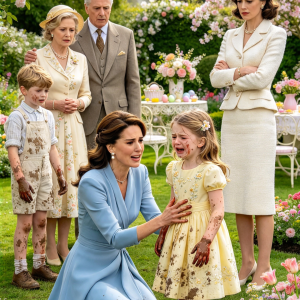
When I reached the kitchen, my mother-in-law, Diane Mercer, was standing beside the breakfast table with a dish towel clenched in one hand, while my son Owen stood near the refrigerator holding half a pancake. His cheeks were wet, and his older brother, Caleb, had wrapped one protective arm around his shoulders.
Across the table, Diane’s daughter’s twin girls were eating pancakes covered with strawberry preserves.
“I already told you,” Diane said sharply. “Those were made for my real granddaughters. I can fix something for you boys later.”
For several seconds, I honestly believed I must have misunderstood her.
My name is Rachel Bennett. I was thirty-five then, married to Diane’s son, Eric, and until that Saturday morning I would have described my relationship with his parents as polite, sometimes strained, but basically manageable.
That description seems ridiculous to me now.
Eric had suggested spending the weekend at his parents’ place because his father, Walter, needed help repairing part of an old storage shed. Eric’s sister, Melissa, was bringing her six-year-old twins, and he had sold the trip to me as a chance to get out of town.
“Dad and I will handle the repairs,” he had said. “You can relax with the kids.”
Instead, within five minutes of our arrival, Diane had handed me gardening gloves and asked me to help stake tomato plants behind the greenhouse.
The boys had barely eaten that morning, but when I mentioned breakfast, she waved me away.
“We’ll eat later. Melissa needs to stay with the girls because they’re still little.”
Caleb was seven. Owen was four.
Apparently, my children had crossed some invisible line into self-sufficiency that Melissa’s six-year-olds had not.
I gave the boys the crackers and fruit I had packed for the drive, then followed Diane outside because, back then, I was still very good at convincing myself that uncomfortable things were too small to confront.
Two hours later, I heard Owen crying.
Now I stood in the kitchen looking at my mother-in-law, trying to understand what she meant by the words real granddaughters.
“Diane,” I said, keeping my voice remarkably steady, “what exactly does ‘real’ mean?”
She looked directly at me.
There was no embarrassment in her face.
“A daughter’s children are different,” she said. “A mother always knows those children belong to her family. With a son’s children, well, you only know what you’re told.”
The kitchen became so quiet that I could hear the old refrigerator humming.
Then she looked at Caleb and Owen as though she were comparing photographs.
“Besides, neither of them looks much like a Mercer.”
Something inside me shifted.
I knelt and wiped Owen’s face, then took the pancake gently from his hand and set it on the counter.
That was when footsteps sounded behind me.
Eric had entered the kitchen.
His father was right behind him.
They had heard enough.
I looked at my husband and waited.
I was certain he would defend our children.
I expected anger, disbelief, even one simple sentence telling his mother she had crossed a line.
Instead, Walter chuckled.
“Come on, Rachel. Don’t make a federal case out of breakfast. People have wondered about family resemblance since the beginning of time.”
And then Eric smiled.
It was barely a smile, almost reflexive, but I saw it.
More importantly, Caleb saw it.
My seven-year-old looked from his grandmother to his father with the expression children wear when the adults they trust suddenly stop making sense.
That expression did something to me.
For years, I had swallowed small insults because I wanted peace. I had ignored Diane favoring Melissa, ignored the holidays arranged around her daughter’s schedule, ignored the little remarks about my parenting, my work, my clothes, even the way my sons looked.
But watching my husband smile while our child stood there humiliated stripped away every excuse I had made for him.
Walter was still grinning when I turned toward him.
“That’s interesting,” I said. “People who are unusually suspicious about parentage sometimes have reasons for being sensitive about it.”
Diane stiffened.
“What is that supposed to mean?”
“Nothing more than what you just suggested about me.”
Eric stepped forward.
“Rachel, enough.”
I pulled my arm away when he reached for me.
“No. It stopped being ‘enough’ when your mother decided our children needed to prove they belonged here.”
Then I remembered something Eric had told me years earlier, a family story that had always been treated as a joke.
I looked at Diane.
“Actually, since family resemblance matters so much to you, I’ve always wondered about something. Eric told me he was supposedly born almost two months early.”
Walter’s smile disappeared.
Diane’s face changed.
I continued.
“He also told me he weighed more than nine pounds.”
Walter slowly turned toward his wife.
The silence that followed felt different from the one before it.
This one had history inside it.
The Question Nobody Wanted Asked
Diane recovered first.
“Doctors got dates wrong all the time back then.”
“Of course,” I said. “I’m sure there’s an explanation.”
Walter was no longer looking at me.
“Diane,” he said quietly, “what is she talking about?”
Eric stepped between them.
“Dad, stop. Rachel is angry about pancakes and now she’s dragging up nonsense from forty years ago.”
That was the moment I understood that my marriage had changed, although the truth was probably that I was finally seeing it clearly.
I took Caleb’s hand and lifted Owen into my arms.
“We’re leaving.”
Eric stared at me.
“Don’t turn this into some huge drama.”
I almost laughed.
“Your mother questioned whether you are the father of your own children while one of them was standing here crying. Your father laughed about it, and you smiled.”
“Mom made a stupid comment.”
“Then you should have told her it was stupid.”
His jaw tightened.
“You’re overreacting.”
There it was, the sentence I had heard in different forms for years.
Whenever someone hurt me, my reaction became the problem.
I picked up our overnight bag, put the boys in the car and drove home without Eric.
For the first forty minutes, neither child said much. Caleb watched the road. Owen fell asleep holding the sleeve of his brother’s sweatshirt.
I cried quietly behind my sunglasses.