The Winter My Daughter Learned Where She Belonged

Part One: The Little Girl on the Snowy Road
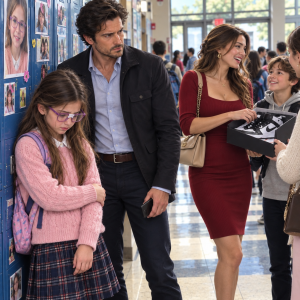
There are certain moments in a mother’s life that never grow faint with time, no matter how many ordinary mornings and peaceful evenings come afterward, and for me, one of those moments will always be the sight of a little girl in a lavender winter hat struggling along a snow-covered road in western New York.
It was a Thursday afternoon in December, and I was driving home from a difficult meeting with a commercial client in Buffalo when I noticed a small figure moving against the wind along the shoulder of a rural highway. At first, I assumed someone had stopped nearby and that the child was simply walking toward a house, but as I drew closer, I recognized the pink backpack, the purple scarf, and the familiar way she tucked her chin into her coat whenever she was cold.
It was my nine-year-old daughter, Sophie.
I pulled over immediately, barely remembering to put the car in park before hurrying toward her, and when she lifted her face, I saw that her cheeks were wet with tears, her lips were trembling, and her thin gloves had become so damp that she could hardly bend her fingers.
“Mommy?” she whispered, looking at me with an expression of such exhausted relief that I felt something tighten painfully in my chest.
“Oh, sweetheart, what are you doing out here? Where’s Grandpa?”
She tried to answer, but her teeth were chattering, so I guided her into the passenger seat, wrapped my wool coat around her shoulders, and turned the heater higher while rubbing her cold hands between my palms.
She was supposed to have spent the afternoon with my father, Walter Whitmore, who had promised to drive her and her two cousins to their after-school activities while I finished my meeting.
Instead, she had been walking for nearly three miles.
“Grandpa said there wasn’t enough room,” she finally managed.
I stared at her, thinking I must have misunderstood, because my father drove a large luxury SUV with three rows of seats, and I knew perfectly well that there had been more than enough space for three children.
“What do you mean, honey? Where were Oliver and Mason?”
“They were in the back, watching their tablets. Uncle Brandon was sitting in front, and when I asked Grandpa if I could come too, Uncle Brandon laughed and said I needed to stop expecting everyone to do things for me.”
She lowered her eyes toward her lap, carefully pulling at a loose thread on her scarf.
“Grandpa told me I should know my place. Then he drove away.”
For several seconds, I could not speak.
My daughter had never been a demanding child, and although she had experienced her share of disappointments since her father and I separated, she still believed that family members were supposed to look after one another.
“Did you try calling me?” I asked.
“My phone was in my schoolbag, but the battery was empty. I thought I could walk home if I followed the road.”
I looked through the windshield at the snow drifting across the pavement and felt an anger unlike anything I had experienced before, not because my father had embarrassed me or questioned my judgment, as he had done countless times, but because he had allowed a little girl to believe that her safety mattered less than her cousins’ comfort.
A few minutes later, his SUV passed us on the opposite side of the road.
Through the window, I could see my brother laughing beside him while the boys sat comfortably in the back.
Neither man stopped.
Sophie watched the vehicle disappear into the falling snow before asking a question I would remember for years.
“Mom, why doesn’t Grandpa love me the way he loves them?”
I brushed a damp strand of hair from her forehead and kissed her temple.
“Sweetheart, you haven’t done anything to deserve being treated this way, and I promise you that you will never have to earn your place in this family.”
At that moment, I knew the arrangement I had spent six years protecting was about to change.
Part Two: The Business I Had Been Quietly Saving
When we reached home, I helped Sophie out of her damp clothes, wrapped her in warm blankets, and contacted our family doctor, who advised me to bring her in for an examination because of how long she had been exposed to the cold.
Fortunately, after being checked and carefully warmed, she was allowed to return home, where I made her favorite chicken noodle soup and settled her on the sofa with a cup of cocoa.
She was nearly asleep when she looked up at me.
“Are you going to be mad at Grandpa?”
“I’m going to make sure he understands that what happened today was unacceptable.”
“Uncle Brandon says you think you’re better than everybody because you have a nice house.”
I sat beside her, feeling a familiar sadness settle over me.
“Having a nice house doesn’t make anybody better than someone else, Sophie, and having less money doesn’t make anybody less important. What matters is how we treat people, especially when they need our help.”
Once she had fallen asleep, I went into my study and opened the financial records of Whitmore Industrial Services, the regional equipment and infrastructure company my parents had established more than forty years earlier.
My mother, Margaret, had been the true foundation of that business.
A gifted project engineer with a remarkable understanding of both people and numbers, she had developed its earliest contracts, negotiated financing, and earned the trust of contractors throughout western New York, while my father became the public face of the company.
When she passed away seven years earlier, my father took complete control of daily operations and appointed Brandon, my older brother, as executive vice president.
Unfortunately, neither possessed my mother’s discipline.
Expensive equipment purchases, questionable investments, and poorly managed contracts gradually weakened the company until my father came to me for financial assistance.
At the time, I was rebuilding my own life after a difficult divorce while raising Sophie alone, and my career as a financial restructuring consultant had finally begun providing the stability I wanted for us.
Still, when Dad asked me to help preserve the business my mother had devoted her life to creating, I agreed.
I arranged a restructuring of its $7.6 million credit facility, pledged a portion of my investment portfolio as security, and began contributing $8,400 every month toward its financing obligations.
Over six years, those payments amounted to more than $600,000.
My father never publicly acknowledged them.
Instead, he praised Brandon’s leadership at business dinners and repeatedly suggested that I was fortunate to have a successful family company behind me.
Whenever I questioned an unusual expense, he reminded me that my brother understood the business better than I did.
“You handle your paperwork, Natalie,” he would say. “Let Brandon and me handle the real decisions.”
I tolerated those remarks because I believed keeping my mother’s company alive was more important than receiving recognition.
But that evening, as Sophie slept beneath her favorite quilt, my phone displayed a message from Dad.
You’re making too much of this. The girl had a coat. Walking a little won’t hurt her.
A second message arrived from Brandon.
Stop acting like we did something terrible. We’ll see you Sunday.
I read both messages, then opened the banking portal connected to my investment account.
For years, I had continued those payments automatically, even when the company had failed to provide the financial information I was entitled to receive.
That night, I canceled the next scheduled transfer and formally notified the lender that I would no longer provide additional voluntary funding.
Then I called my longtime banking adviser, Daniel Foster.
“Natalie, are you certain?” he asked after reviewing the notice. “Without that contribution, the company’s existing credit problems will require an immediate review.”
“I’m certain, Daniel. I won’t keep financing decisions I have no meaningful authority to supervise.”
“Your father won’t take this well.”
I glanced toward the hallway where Sophie was sleeping.
“Then he’ll have to learn to live with a decision he doesn’t control.”
Part Three: Fourteen Calls Before Breakfast

By eight the following morning, my phone had begun ringing.
The lender had placed temporary restrictions on certain discretionary advances while reviewing the company’s deteriorating financial position, and apparently my father had discovered that the monthly contribution he considered permanent was no longer coming.
He called repeatedly.
Brandon called several times as well.
By nine o’clock, I had fourteen missed calls from Dad and a collection of increasingly frantic messages.
I was making Sophie scrambled eggs when I heard a familiar engine outside.
My father’s SUV pulled into the driveway, followed moments later by the sound of two car doors closing.
He entered through the unlocked front door with Brandon close behind him.
“Natalie, what have you done?” he demanded.
I quietly closed the kitchen door so Sophie would not have to hear the conversation.
“Good morning, Dad. Please lower your voice.”
Related Posts
😡 “I’M TAKING THE HOUSE, BOTH CARS, AND EVERY DOLLAR WE HAVE. YOU CAN KEEP THE KID—I DON’T WANT THE RESPONSIBILITY!” My Husband Said After 11 Years Of Marriage. Our 9-Year-Old Son Was Upstairs Doing Homework While His Own Father Was Bargaining Him Away Like An Unwanted Piece Of Furniture. 💔 When I Asked, “IS THAT REALLY ALL OUR SON MEANS TO YOU?” He Rolled His Eyes. “DON’T MAKE THIS DRAMATIC. YOU WANTED TO BE A MOTHER.” I Didn’t Argue. I Simply Said, “FINE,” And Took My Old Blue Folder To My Lawyer. Weeks Later, He Was Still Smirking Across The Settlement Table—Until His Attorney Opened The Financial Attachment, Went Pale, And Asked, “MARK… WHAT EXACTLY DID YOU THINK YOU WERE SIGNING?” 😱

“In This Family, A Wife Learns To Obey Her Husband.” My Husband Said Forty-Eight Hours After Our Wedding, Right Before He Overturned The Marble Dinner Table Toward Me. He Thought Fear Would Make Me Sign Away My Financial Independence. What He Didn’t Know Was That My Family Controlled The Credit Support Keeping His Company Alive.

😱 “PLEASE DON’T TELL DANIEL I’VE BEEN COMING HERE,” I Heard My Mother Whisper To My Ex-Wife At A Fruit Stand. I Froze. Two Years Earlier, I’d Divorced My Wife After My Best Friend Showed Me Photos Of Her Entering A Hotel With Another Man. 💔 Now My Own Mother Was Secretly Visiting Her—and Hugging Her Like Nothing Had Happened. I Stayed Out Of Sight And Watched Them. But Later That Day, When My Best Friend Handed Me A Folder At Work, I Saw My Ex-Wife’s Name Inside. Then He Said, “DAN, I REALLY DON’T THINK YOU SHOULD SEE HER AGAIN.” 😨 Why Was He So Worried?

At Family Dinner, My Husband Peeled Four Shrimp for His Brother’s Wife Right in Front of Me and Said, “Eat Them Before They Get Cold.” I Quietly Put Down My Fork. He Thought I Was Just Jealous—Until I Discovered He’d Secretly Sent Her Over $9,000 From Our Joint Account for Nearly Two Years. Even His Mother Had Known for Months. I Said Nothing and Agreed to One More Family Dinner… Because His Brother Was Coming Home That Saturday, and I Had Divorce Papers Ready