The Porch at Midnight

The Glass Booth
At 11:52 on New Year’s Eve, I sat in a glass-walled operations room at a Des Moines roadside-assistance center, routing service trucks to stranded drivers across Iowa. My colleague Tessa pressed notes against the window while the dispatch screens blinked around me.
I’m Lydia Mercer, a forty-year-old mother of two and an overnight dispatch coordinator. We were a white Midwestern family, rooted in Iowa and the ordinary rituals of church suppers, school concerts, and Sunday dinners. Years of handling late-night calls had taught me that a calm voice could steady a frightened person faster than a dozen instructions. That night, I thought the dispatch board was all I had to manage.
Across town, my children were supposed to be at my older brother Dean’s house. Dean had spent weeks planning a New Year’s gathering for his wife’s relatives, promising our parents that it would be a warm family evening with plenty of food and room for everyone. My father, Howard, had agreed to watch my son, Owen, who was twelve, and my daughter, Lily, who had just turned nine. My husband, Peter, had dropped them off before starting his overnight shift as a security supervisor at a distribution warehouse.
At 7:41, he sent me a message: They’re inside with Grandpa. I’m off to work. Love you. I glanced at it between calls and returned to the dispatch board without giving it another thought.
At 10:48, Tessa held up a note: Unknown number called twice. I shrugged at my phone, face down beside the dispatch console; personal calls could wait while I was coordinating trucks. At 11:59, I was still confirming a tow assignment on the interstate as the city celebrated outside. I did not know my children were counting the same seconds on my brother’s porch.
The rest of the shift passed with the ordinary late-night calls: a nurse whose car would not start after work and a truck driver who needed help near the western edge of the state. At six, I handed the dispatch board to the morning crew. Tessa zipped her coat and nodded toward my phone.
You should listen to that voicemail before you leave, she said. Two calls from the same number usually mean somebody has a reason.
I turned the phone over. A message had arrived at 10:48, just over a minute long. The caller was an older man whose voice I recognized from the neighborhood around Dean’s house.
Lydia, this is Mr. Bell across the street from Dean. Owen gave me your number and asked me to call. The kids are inside with me now, wrapped in blankets and warming up. They’ve been outside since a little before eight. I thought their ride was coming, but it never did. They’re safe. Come get them as soon as you can.
For a moment, the operations room seemed to tilt. The red indicators on the dispatch screens blurred, and the last six hours of calls felt suddenly unreal. I called Mr. Bell, then my father, then Peter’s warehouse, and drove to Dad’s house with both hands tight on the steering wheel.
Three Hours on the Steps
At Dad’s house, Owen and Lily sat in their party clothes, tired but warmed by Mr. Bell’s quilts and hot chocolate. Their coats hung from the backs of the kitchen chairs.
Lily saw me first. She slid off her chair and came across the room in her socks, wrapping both arms around my waist without saying a word. Owen rose more slowly, holding himself stiffly, as though he were trying to keep a brave face in place by force of habit.
Tell me what happened, I said. Start wherever you need to.
He took a breath. Dad dropped us off at seven-forty-five. Uncle Dean opened the door, but he came outside and closed it behind him. He said Paige and her friends wanted the house to themselves and didn’t want little kids around. He said Grandpa was on his way, so we should wait.
My father stared at his hands. His old pickup had failed to start that evening, and he had called Dean to explain that he would be late. Dean told him the children were already inside and having a good time with their cousins. Dad believed him and called for a ride, but the driver took nearly an hour to arrive in the holiday traffic.
Did you knock again? I asked Owen.
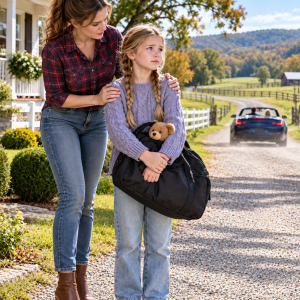
Once. Around eight-thirty. The music was loud, and nobody came. His eyes stayed on the table. We talked about walking home, but it was too far, and Lily’s boot had a crack in it. Mr. Bell saw us on the porch swing and came over when he realized we weren’t waiting for anybody anymore.
Lily lifted her face from my sweater. Mom, there was a chocolate fountain in the dining room. I could see it through the window. People kept dipping strawberries in it. I counted them so we’d know how long we’d been there.
I held her close. Dad spread butter over a piece of toast, then did it again as if he had forgotten.
I should have called another driver and checked the door myself, he said. Dean told me they were inside. I believed him. I’m sorry, sweetheart.
I squeezed his shoulder. Peter texted that he was finishing his shift and would sleep before we talked. I told him the children were safe, then opened the family account on my phone.
I had opened the family fund for birthdays, holiday meals, and emergencies, depositing a hundred dollars each month while Mom and Dad added what they could. I made Dean an authorized signer so he could pay vendors while I worked. He joked that the card made him keeper of the treasury; I missed how seriously he took the privilege.
The ledger showed $1,200 for tires, $350 toward a weekend getaway, and $2,070 in party bills, totaling $3,620. Dean had made four deposits of $150, despite often describing himself as the fund’s main supporter. I locked his card, removed his access, and moved the remaining balance into a new account.
At 7:30, I sent Mom a short message: The children were left outside Dean’s house for three hours last night. The party was paid for with money from the family account, including yours. I’ve secured what remains and can show you the statements.
Her answer arrived a few minutes later: I’m calling him now.
A Doorstep Conversation

At home, Peter had fallen asleep in his work clothes, and Owen and Lily curled beneath quilts with our old golden retriever, Maple. I made tea and considered calling the county’s non-emergency number, but the children were safe. I wanted a clear record of the money and a consequence Dean could not talk his way out of.
At 8:12, our doorbell began playing the opening notes of a Christmas song the children had chosen in December. It rang again, then again, and soon someone was pounding on the door hard enough to wake Peter.
Lydia! Open up! Dean shouted from the porch.
Peter called from upstairs, his voice rough with sleep. Is that the mailman having a personal crisis?
Something like that, I answered. Go back to bed. I’ll handle it.
Dean was standing outside in an expensive vest and pajama pants, his breath clouding in the cold. His SUV was still running at the curb, and the driver’s door had been left open.
What did you tell Mom? he demanded.
What happened. The children were outside, and the party was paid for with her money.
He shook his head as if I had made an absurd accusation. Paige wanted a party with her friends. It was my house, my guest list. The kids were fine. They were on the porch.
It was below freezing, and Dad wasn’t there. You told him the children were inside.