PART 1 — THE MORNING AFTER MY WEDDING
“Stop making a scene, Clara. My mother was trying to teach you some respect.”
My husband said that while I sat in a Pittsburgh emergency room, barely able to open my eyes. Less than twenty-four hours earlier, he’d stood beside me in front of 140 wedding guests and promised to protect me for the rest of our lives. Now he was telling a nurse that I’d accidentally gotten cleaning solution in my own eyes.
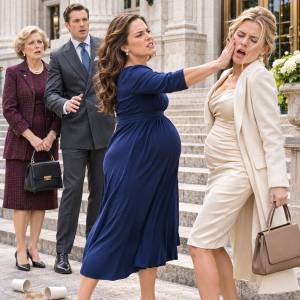
I was twenty-nine, still wearing the ivory dress I’d worn to our wedding reception. My mother-in-law had sprayed a cleaning product toward my face during an argument, and Andrew had held my arms when I tried to move away.
But the most frightening thing wasn’t what had happened in that dining room.
It was the way my husband looked at me afterward, as though he was waiting for me to agree with his version of events.
Then my father arrived, carrying a burgundy leather folder.
He listened to Andrew’s explanation without interrupting. When Andrew finished, Dad asked a question that made my husband’s expression change.
“Andrew, why were you and your mother inside Clara’s apartment last night?”
Andrew went completely still.
“What are you talking about?”
Dad placed the folder on the counter.
“I’m talking about the security camera. And the documents you carried out.”
That was the first time I saw fear cross my husband’s face.
The family I thought I was marrying
I met Andrew Melnik two years earlier at a charity dinner in downtown Pittsburgh. He was thirty-two, handsome in an understated way, and worked for his family’s boutique hotel company. I was a freelance graphic designer, the daughter of a retired attorney and a commercial investor who preferred mowing his own lawn to attending business functions.
Andrew asked about my work instead of talking about himself. He remembered that I liked lemon cake, brought coffee when I worked late, and once drove forty minutes to help me change a flat tire.
For a long time, I thought those small kindnesses told me everything I needed to know.
His mother, Valerie, was considerably harder to please.
The Melnik family owned three hotels across western Pennsylvania. Valerie treated the family name as though it were a title, and she seemed offended that my parents weren’t particularly impressed by it.
At our first dinner, she examined my plain gold necklace.
“Is that costume jewelry, dear?”
“No. I bought it with my first paycheck from a design project.”
She gave me a tight smile.
“How sentimental. Andrew usually appreciates women with more sophisticated taste.”
Andrew squeezed my hand beneath the table.
“Mom means well.”
That became his favorite explanation.
When Valerie criticized my apartment, she meant well. When she suggested my parents must have struggled to afford my education, she was making conversation. When she told me to lose a few pounds before the wedding, she was concerned about the photographs.
I didn’t enjoy those remarks, but I loved Andrew. I believed marriage would give us a home of our own, away from his mother’s constant opinions.
My parents weren’t convinced.
Three months before the wedding, Mom asked whether Andrew ever defended me when Valerie became unpleasant.
“He doesn’t like confrontation,” I told her.
She considered that.
“There’s a difference between disliking confrontation and letting somebody else bear the cost of avoiding it.”
I thought she was being unfair.
On our wedding day, Andrew looked at me with tears in his eyes as I walked down the aisle. He promised to be my partner, my closest friend, and the person I could always depend on.
I believed every word.
The next morning, Valerie insisted that we come to the Melnik estate for breakfast before leaving for our honeymoon.
Gold ribbons still decorated the staircase. Flowers from the reception filled the entrance hall, and someone had arranged the wedding favors on a silver tray beside the dining-room door.
I was tired but happy.
Then Valerie looked at my dress.
“Surely you brought something more suitable than that.”
I glanced down at the ivory fabric.
“It’s comfortable, and we’re going straight to the airport.”
“You’re a Melnik now, Clara. People will notice how you present yourself.”
Andrew poured himself another cup of coffee.
“Mom, can we not do this today?”
For a moment, I thought he was defending me.
Then he added, “Clara’s exhausted. She doesn’t need another lecture.”
Valerie folded her arms.
“Apparently, she does. Her parents clearly never taught her how to behave in a proper home.”
Something in me finally gave way.
“Please don’t speak about my parents that way.”
She stared at me.
“Excuse me?”
“They’ve always treated Andrew kindly. I expect you to show them the same respect.”
Andrew put down his cup.
“Clara, don’t start an argument.”
“I’m not starting one. I’m asking your mother to stop insulting my family.”
Valerie laughed.
“Well, isn’t this something? One day of marriage, and she already thinks she runs the house.”
I picked up my purse.
“Andrew, I’m ready to leave.”
He stepped in front of me.
“Sit down. We can finish breakfast like adults.”
“I don’t want breakfast. I want to go.”
Valerie reached for a small spray bottle she’d been using to clean fingerprints from a glass cabinet. I noticed the red nozzle because it was the only bright thing in her hand.
“Maybe somebody ought to clean up that attitude,” she said.
I thought she was making another unpleasant joke.
Then she stepped toward me.
“Valerie, please put that down.”
I moved backward, but Andrew caught my arms.
“Clara, stop.”
“Let go of me.”
Valerie raised the bottle.
The spray reached my face before I could turn away. I shut my eyes and tried to pull free, frightened by the stinging and unable to see where I was going.
“Andrew, please! I need water!”
He released me only after I stumbled against a chair.
“It’s a household cleaner,” he said. “Calm down.”
Valerie set the bottle on the sideboard.
“Honestly, Clara. Must everything be so dramatic?”
I could hear her walking away while I stood beside the dining table, trying to find my way toward the sink.
Andrew finally helped me rinse my eyes. When I insisted on going to the hospital, he complained that we’d miss our flight.
I remember sitting in the passenger seat, holding a damp towel against my face, while he called the airline.
He never once called my parents.
The first lie
At the emergency department, a nurse immediately arranged for my eyes to be irrigated. The doctor asked what product had been involved, but Andrew hadn’t brought the bottle and couldn’t tell her its exact name.
When she asked how the exposure happened, he answered before I could.
“We had a disagreement at breakfast. Clara grabbed the cleaner, and it accidentally sprayed toward her face.”
I turned toward his voice.
“That’s not true.”
Andrew sighed.
“She’s upset. It’s been a stressful morning.”
The doctor asked him to wait outside while she continued examining me.
After he left, I told her what had happened, including the fact that Andrew had held my arms. She documented my account and explained that the chemical exposure had injured the surface of both eyes. I needed further evaluation by an ophthalmologist, and recovery would depend on how the injuries responded to treatment.
I asked the nurse to call my mother.
When my parents arrived, Mom came straight to my bedside.
“Oh, sweetheart.”
I tried to tell her everything, but my voice broke halfway through.
Dad stood quietly near the foot of the bed. He didn’t interrupt, even when I explained what Andrew had done.
Then he asked the nurse whether my statement had been recorded separately from my husband’s.
She assured him it had.
Andrew returned a few minutes later.
“Clara, your parents are making this worse.”
Mom turned toward him.
“She’s receiving medical care. How exactly are we making that worse?”
“By acting as though my mother deliberately hurt her.”
“Did your mother spray the cleaner?” Dad asked.
Andrew shifted his weight.
“There was an argument.”
“That wasn’t my question.”
“Look, Mr. Bennett, my family’s dealt with enough problems lately. We don’t need a ridiculous accusation on top of everything else.”
Dad watched him for a moment.
“Then tell the truth about what happened.”
Andrew gave a humorless laugh.
“You don’t understand my family. You’re retired. You have no idea what’s involved in running a business like ours.”
My father said nothing.
He reached into his briefcase and removed a burgundy leather folder.
I’d seen that folder on his desk for years. He used it for contracts and other important documents, and I’d always associated it with his habit of reading every page before signing anything.
He placed it on the counter.
“Andrew, why were you inside Clara’s apartment last night?”
My husband looked startled.
“I stopped by to collect some things.”
“With your mother?”
Andrew’s face tightened.
“How do you know that?”
“Clara’s security camera recorded you entering.”
I lifted my head.
“You went to my apartment?”
Andrew looked toward me.
“I needed paperwork for after the wedding. You were busy, so I handled it.”
“What paperwork?”
He didn’t answer.
Dad opened the folder.
“I received a call yesterday from someone who works for your family’s hotel company. She had concerns about documents involving my daughter.”
Andrew stared at him.
“Who called you?”
“That’s not important right now.”
“It is to me.”
Dad closed the folder.
“Then perhaps you should explain why your mother carried a folder out of Clara’s apartment.”
Andrew’s mouth opened, but no answer came.
He left the room a moment later, saying he needed to speak with his attorney.
I lay there listening to his footsteps disappear.
“Dad,” I whispered, “what’s happening?”
He pulled a chair beside me.
“I don’t know everything yet. But I know enough to be concerned.”
Mom took my hand.
“Clara, did Andrew ask you to sign any financial papers before the wedding?”
I hesitated.
“Last Tuesday. He said they were routine documents for the hotels.”
“Did you sign?”
“No. I wanted a lawyer to look at them.”
Mom let out a breath.
“I’m glad.”
“Why?”
Dad looked at her before answering.
“Because the woman who contacted me says someone prepared a personal guarantee with your name on it.”
I frowned.
“A guarantee for what?”
“The hotels’ debt.”
I couldn’t understand why Andrew’s business obligations would have anything to do with me.
Then I remembered the way he’d tapped the contract on my kitchen table.
“It’s nothing complicated, Clara. You’re going to be my wife. We shouldn’t need lawyers to trust each other.”
I’d told him I’d read it after the honeymoon.
He’d become unusually quiet.
Now I wondered what would have happened if I’d signed.
The woman who kept the records
The next afternoon, my parents arranged for me to speak with an independent attorney. I also asked the hospital social worker about reporting the incident at Valerie’s house.
My vision was still blurry, but I could follow conversations and make decisions. I wanted my own account documented before anyone had another opportunity to speak for me.
That evening, a woman named Irene Walsh came to the hospital.
She was in her late fifties and had worked as the Melnik company’s controller for nearly fifteen years. She carried a canvas bag and looked as though she hadn’t slept properly in days.
“Clara, I’m sorry to meet you like this,” she said.