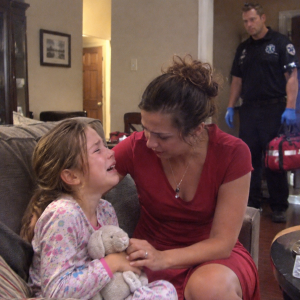
The Night the Nurse Came Back

My husband waited until the home nurse had driven away before he pushed my head toward the kitchen trash can. I had been sick again after dinner, and he spoke as if the mess were an inconvenience I had created for him.
“Tell the nurse it’s the illness,” he said. “That’s what you tell her if she asks.”
Then he pressed a finger against the tender place beneath my surgical dressing. Pain tightened across my body, and a fresh mark appeared on the gauze. I looked toward the clock, trying to steady my breathing. The nurse had forgotten her bag. Her car was still in the driveway.
The front doorknob turned before I could answer. My husband heard it too. His hand lifted away from my dressing, and the expression on his face changed in an instant. By the time the door opened, he looked concerned.
Marissa Bell, the nurse, stepped back inside with an apologetic smile. “I’m sorry. I left my bag by the door.” Then she saw me beside the trash can. Her eyes moved to the new mark on my dressing.
“What happened?”
My husband answered before I could. “She got sick again. It’s the illness.”
Marissa looked at me. “I asked her.”
He stood close enough that his leg touched the side of my chair. I knew what he expected: that I would repeat his explanation, let the moment pass, and thank him later for helping me through another difficult evening. For eleven years, I had learned to make his version of events sound more convincing than my own.
I looked at Marissa, then at the bag beside the doorway, and finally at my husband’s hand hanging at his side.
“He pushed my head toward the trash can,” I said. My voice trembled, but the words belonged to me. “And he pressed on my surgery after you left.”
He gave a short, disbelieving laugh. “She’s in pain. She doesn’t know what she’s saying.”
Marissa crouched near me, careful not to touch the dressing. “When I checked this a few minutes ago, it was clean.”
He began explaining. Dinner had upset my stomach, he said. The last several weeks had been hard on both of us. He had only been trying to help. He spoke calmly, the same way he spoke to my doctors, leaving just enough space between his sentences for everyone else to doubt what they had seen.
Marissa let him finish. Then she asked me, “Do you want me to stay?”
“Yes.”
My husband’s jaw tightened.
“Do you want to be alone with him right now?”
“No.”
He stepped forward. “This is getting blown out of proportion.”
Marissa stood and moved my forgotten bag farther from him, nearer to me. “Would you like to leave the room with me?”
For weeks after surgery, I had measured my days by small, practical questions. Could I keep food down? Could I shower without pulling at the dressing? Could I make it through the night without waking from pain? My body had taught me to think one hour at a time, but I had forgotten that a small decision could still change what happened next.
“Yes,” I said. “I want to go with you.”
He stared at me as if I had broken a private agreement. “You’re really doing this?”
“She answered you,” Marissa said.
I braced one hand on the chair and tried to stand. The movement pulled at the tender area, stopping me halfway. Marissa offered her arm, then waited for me to decide whether I wanted it. I took it.
My husband moved first, but not toward me. He went to the kitchen counter.
For one frightened moment, I thought of the knife block. Instead, he reached past it and picked up the weekly medication organizer Marissa had filled for me. The small lids were marked with the days of the week. He lifted it as if he were clearing away a plate.
“She’ll need these wherever she’s going,” he said, his voice suddenly mild. “I’ll pack a bag.”
“Leave the organizer on the counter,” Marissa told him.
He smiled. “I’m her husband.”
“I know who you are, Mr. Mercer. Put it back, please.”
He slipped it into the pocket of his gray cardigan and crossed his arms. “Fine. Take her for a drive. When she calms down, she’ll call me, and she’ll be embarrassed. That’s what marriage is.”
Marissa didn’t argue. She took out her phone and called for help, giving our address and identifying herself as a home health nurse. She explained that I had a fresh mark on a surgical dressing she had checked moments earlier, and that I had told her my husband had hurt me.
He sat at the kitchen table, hands folded, as if we were waiting for an appointment.
A Story That Was Ready
The officers arrived eleven minutes later. I watched the microwave clock change while they came through the door. Officer Nathan Cole had a gray mustache and patient eyes; his partner, Officer Tessa Grant, was younger and quiet, and seemed to notice everything.
My husband stood to greet them and shook their hands. He told them I had undergone surgery for a breast condition four weeks earlier, that pain medication had made me confused, and that I had been sick all evening. He had only been trying to help me reach the trash can, he said.
“She’s under a lot of stress,” he added. “The doctors told us that could happen.”
Officer Grant walked me into the living room and asked Marissa to stay nearby. She sat at eye level with me and said I could take my time.
I told her about the trash can, the pressure against my surgical area, and his instruction to blame my illness. When she asked whether anything similar had happened before, I almost said no. The word was familiar and easy, polished smooth by years of use.
“Yes,” I said instead.
In the kitchen, Officer Cole asked my husband about the medication organizer. My husband denied knowing what she meant. Then Officer Cole asked him to empty his pockets. The organizer appeared beside his keys and a roll of antacids.
Marissa examined the compartments. “I filled this on Sunday,” she said quietly. “Those two white tablets in Thursday’s slot weren’t there when I set it up.”
My husband laughed. “I put in something for her stomach.”
“She hasn’t been cleared to take that after surgery,” Marissa replied.
Officer Cole looked at the organizer for a long moment before asking his partner to secure it. My husband left the house in a patrol car that night, still calling the situation a misunderstanding. He did not look at me as they walked him past. He looked at Marissa, and she placed a steadying hand on my shoulder.
She drove me to St. Catherine’s Hospital. In the emergency department, Dr. Elise Navarro carefully examined the stained dressing. She noticed a pattern of bruising around the tender area and arranged for photographs and tests. She also found that I was dehydrated.
“I’ve been throwing up for three weeks,” I told her. “They said it might be anxiety, or the illness.”
She wrote something down without answering. Near one in the morning, she returned, drew the curtain, and sat beside my bed.
“Who prepares your meals at home?”
“My husband. He insists on cooking while I recover. Sometimes a friend brings soup.”
Dr. Navarro nodded slowly. “I don’t think the nausea you’ve been having is coming from your diagnosis.”
She explained that my test results showed a substance that could cause repeated vomiting. It was not part of my prescriptions, and the amount in my system suggested I had been exposed more than once.
“It isn’t something you would take by accident,” she said. “I’ve checked your records carefully.”
My husband had cooked dinner every night since my surgery. He had said he wanted me to rest, that he could take care of the details while I concentrated on getting better. I had thanked him for the soup, the mashed potatoes, the ginger tea he brewed himself. I had thanked him even on nights when I could not keep the food down.
Marissa closed her eyes. Dr. Navarro told me she had to report the findings and that I would stay overnight for fluids and observation. Then she asked whether there was someone I wanted to call.
For a moment, habit nearly made me ask for my husband. Instead, I gave her my sister’s number.
Her name was Tessa, and we had not spoken in eight months.
She answered on the fourth ring, her voice heavy with sleep. “Who is this?”
“It’s me. I’m at St. Catherine’s. Nolan was arrested tonight. Tessa, I’m sorry. I’m sorry for whatever I said.”
There was a brief silence.
“I’m coming,” she said, and hung up.
She arrived forty minutes later in pajama pants and a winter coat, her hair tied in a loose knot. At first, she only stood at the foot of my bed, looking at the IV, the new dressing, and how much weight I had lost. Then she sat beside me and rested her forehead against my hand.
When she looked up, she asked, “What did I do? I’ve spent eight months trying to figure out why you stopped talking to me.”
“You said I was being dramatic about the diagnosis,” I told her. “That Mom had been through worse and never complained. Nolan said you called while I was asleep.”
Tessa stared at me. “I never said that. I would never say that to you.”
I asked why she had stopped calling. She opened her phone and showed me a message sent from my number in March, the week I received my diagnosis. It said I needed peace, that she made everything harder, and that Nolan was all I needed.
I read it more than once.
“I didn’t write this.”
“I know that now,” she said. “I came to the hospital the day of your surgery. Nolan told me you saw me arrive and asked him to send me away. He said I was upsetting you.”
Marissa, who had remained by the window, spoke softly. “Keeping someone away from family is one way a controlling person makes it harder for them to get help.”
Neither of us asked whom she meant.
The News I Should Have Heard

Tessa fell asleep in the chair sometime after four in the morning, still wearing her coat. Marissa eventually went home after asking the floor nurses to check my dressing regularly. I lay awake beneath the hospital blanket, thinking of every meal Nolan had prepared and every time I had told him he was kind to care for me.
At six fifteen, a nurse told me he had posted bond and had been released with an order not to contact me. At eight thirty, a woman in a navy blazer knocked at the open door. She introduced herself as Detective Judith Hale, who handled family safety cases for the county.
She pulled a chair closer to the bed but didn’t open her notebook right away.
“I want to be direct with you,” she said. “Your husband’s attorney called my office early this morning. He claims you’ve been making yourself sick for attention and that you’re accusing Nolan to cover it up.”
For a few seconds, I believed him. Eleven years of being told I remembered things incorrectly, that I was too sensitive, that I misunderstood, had left a small room inside my mind where his voice still sounded reasonable. Maybe I had done something wrong. Maybe the medication had made me confused. Maybe I was the problem.