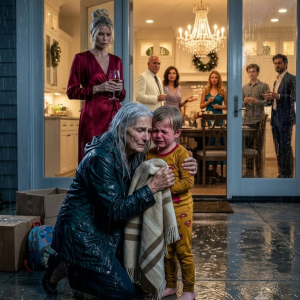
The evidence continued growing.
Former employees described Harrison humiliating Madeline during company meetings, taking credit for her systems, and demanding that staff report whenever she accessed financial records. One technician remembered repairing a broken door after Harrison threw a chair during an argument.
Madeline’s physician produced earlier medical notes documenting unexplained bruises and repeated signs of stress. She had denied abuse during those visits, but the records demonstrated a pattern consistent with coercive control.
Harrison’s public reputation collapsed.
The neighborhood association removed Lorraine from every committee after members learned she helped falsify the kitchen scene. The country club suspended the family’s membership when financial investigators connected payments to fraudulent company expenses.
Madeline felt no satisfaction.
Social exclusion was temporary and often performative. The meaningful consequences came through court orders, financial restitution, permanent records, and the loss of authority over people who had once feared speaking.
The criminal cases ended with negotiated resolutions after the court admitted the emergency recording and key financial evidence.
Harrison pleaded guilty to aggravated assault, coercive control-related offenses recognized under applicable charges, identity fraud, conspiracy, and bank fraud. He received a substantial prison sentence, restitution obligations, and a long-term protective order.
Gordon received a shorter custodial sentence after cooperation but remained liable for restitution and tax penalties.
Lorraine received incarceration followed by supervised release for conspiracy, financial fraud, witness manipulation, and participation in the assault’s concealment.
None of them retained ownership or management authority in the refrigeration company.
An employee-led investment group purchased the operating business with financing from an independent regional fund. Madeline licensed her software under transparent terms and received compensation without controlling daily operations.
The company was renamed Southern Climate Services.
The name no longer belonged to Harrison’s family.
The house entered a separate civil proceeding.
The trust contribution, forged loan, diverted equity, and documented abuse allowed the court to award Madeline exclusive possession while financial claims were resolved. After restitution and refinancing adjustments, she retained most of the net value.
She chose to sell.
The property looked beautiful after repairs, but beauty could not make its rooms neutral again.
Every polished surface carried a memory of permission, surveillance, or fear.
Part 5 – Learning What Safety Felt Like

Madeline moved into a smaller craftsman home in Athens, Georgia, where magnolia branches shaded the front porch and the kitchen windows opened toward a community garden.
The first evening, she stood before the stove for nearly twenty minutes without turning it on.
Her hand had healed sufficiently for ordinary movement, although scar tissue restricted two fingers and required daily exercises. The smell of heated oil still tightened her chest, while the sound of a football game from a neighboring apartment once caused her to drop a glass.
Trauma did not disappear when the people responsible entered prison.
It remained inside ordinary sounds, smells, and movements.
Madeline began therapy with a clinician specializing in coercive control and financial abuse. She also attended occupational therapy to rebuild strength in her hand.
Dana encouraged her to rest before making public commitments.
For several months, Madeline did exactly that.
She planted herbs, walked through the university botanical garden, and relearned how to purchase groceries without calculating whether Harrison would accuse her of wasting money.
She reconnected with her younger brother, whom Harrison had gradually removed from her life by claiming every visit created conflict. She wrote letters to former friends without describing herself as foolish for staying.
The question “Why did you not leave earlier?” became less powerful once she understood how control had altered the practical meaning of leaving.
Harrison controlled accounts, transportation, passwords, credit records, and access to the house. He also trained Madeline to doubt whether each incident deserved a response.
Abuse did not rely entirely upon locked doors.
It relied upon making every door seem too expensive, humiliating, or dangerous to open.
One year after the assault, Madeline joined Dana and Sergeant Ruiz in creating the Harbor Signal Project, a nonprofit program teaching survivors how to preserve financial documents, secure digital accounts, create lawful emergency recordings, and establish safety plans with trained professionals.
The organization did not distribute secret cameras casually or suggest that technology could replace emergency services.
Every participant received legal guidance specific to local recording laws, cybersecurity support, and access to shelters, medical care, and financial counseling.
At the opening workshop, Madeline placed the small green emergency sensor inside a glass display.
A reporter asked whether the device saved her life.
“People saved my life,” she answered. “The device helped them hear me before the people inside my house could rewrite what happened.”
Sergeant Ruiz stood nearby.
“Technology matters only when someone is prepared to respond,” she added.
The project’s first major grant funded secure document storage for survivors whose partners monitored household devices. Another program helped women identify fraudulent debts opened in their names.
Madeline never presented herself as fearless.
She described preparation, fear, evidence, and the moment she decided survival deserved to become visible.
Part 6 – The Meal She Was Allowed to Ruin
On the second anniversary of Harrison’s arrest, Madeline invited Dana, Sergeant Ruiz, her occupational therapist, and several friends to dinner.
She chose the menu herself.
Rosemary chicken, roasted vegetables, bread, and peach pie.
The decision made her nervous for reasons she did not explain. Dana noticed but did not offer to take over.
Madeline placed the chicken inside the oven and checked the temperature twice. The familiar scent gradually filled the kitchen.
When the timer rang, the meat had cooked longer than intended.
The edges were dry.
For several seconds, Madeline stood completely still.
Her injured hand began trembling.
The old kitchen returned through memory: Harrison’s fingers around her wrist, Lorraine’s contemptuous voice, Gordon increasing the television volume, and the burning metal beneath her skin.
Dana remained near the dining table.
“Would you like help?”
The question contained no judgment and no command.
Madeline breathed slowly.
“Please open the window.”
Sergeant Ruiz crossed the room and lifted it. Cool evening air moved through the kitchen.
Madeline looked at the tray.
Then she laughed.
Not because the memory had become harmless, but because the food had become ordinary again.
“The chicken is overcooked,” she announced.
Her friends waited.
“We can order pizza,” Dana said.
“No. We are eating it.”
Madeline carried the tray to the table using both hands.
Nobody criticized her. Nobody demanded an apology. Nobody treated a failed meal as evidence of her value.
They ate dry chicken, excellent vegetables, and too much peach pie.
Later, after everyone left, Madeline cleaned the kitchen without rushing. A small green light glowed beneath the window from the security system installed by the new homeowner.
It was not hidden.
Nothing in the house required secrecy from her.
She opened the glass display containing the original emergency sensor and removed it for the first time since the nonprofit launch.
The device had represented rescue, but she no longer wanted the most important object in her story to remain a concealed alarm.
She replaced it with a simple printed sentence.
Evidence can interrupt a lie, but safety begins when the person being harmed is believed.
The sensor went into a secure archive with the legal records.
Madeline turned off the kitchen light and stepped onto the porch.
The houses along the street were modest, their lawns imperfect, and their windows filled with ordinary life. Somewhere nearby, a television carried the sound of another football game.
Her body noticed the noise but did not command her to hide.
Harrison had believed fear guaranteed obedience. Lorraine believed family reputation would make witnesses cooperate. Gordon believed silence could be manufactured by increasing the volume around suffering.
They were all wrong.
Silence was not always surrender.
Sometimes it was preparation.
Sometimes it was a person waiting until evidence, support, and opportunity aligned.
However, Madeline no longer intended to build her life around waiting quietly.
She had work, friends, financial independence, and a kitchen where mistakes remained mistakes.
Before going inside, she looked through the open window at the overcooked chicken resting in the refrigerator.
Tomorrow, she would probably turn it into soup.
The possibility made her smile.
THE END