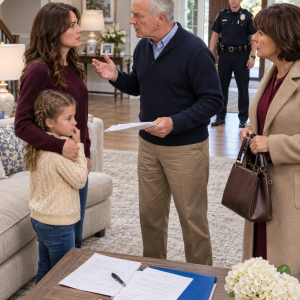
Preston pointed toward me.
“You are choosing an outsider over your own child.”
“Laura is Jonathan’s wife and Caleb’s mother. You made family into a transaction and expected love to protect you from consequences.”
The contractor near the door received a message, looked toward Preston, and slowly raised his hands.
Sirens sounded outside.
Preston grabbed Caleb by the shoulder.
“You brought police.”
Caleb reacted exactly as we had practiced during safety drills. He dropped his weight, drove the chair backward into Preston’s legs, and twisted free as the loose restraint slipped from one wrist.
He ran toward me.
I caught him and pulled him behind a steel support column as armed officers entered.
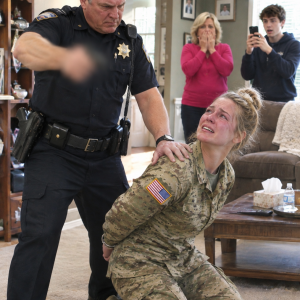
“Sheriff’s Office! Show your hands immediately!”
Preston stared at Margaret while officers forced him to the floor and secured his wrists.
“How could you do this to me?”
Margaret cried without moving closer.
“Because I want to remember that you were once capable of becoming better than this.”
Part 5: The Crimes Beneath The Company Name

The investigation that followed dismantled Whitaker Coastal Transport more thoroughly than any market failure could have done.
Federal agents seized servers, accounting files, and maintenance records from the company headquarters. They uncovered insurance fraud, tax evasion, money laundering, bribery, and decades of concealed safety violations.
The mechanic, Anthony Bell, admitted that Preston paid him sixty thousand dollars to weaken Jonathan’s braking system. He had been instructed to ensure failure occurred along a steep section of coastal highway where heavy rain would make the crash appear accidental.
Evidence from Harrison’s poisoning included security footage showing Preston entering the medication room, search history involving cardiac dosages, and fingerprints on the altered pill container.
Harrison survived, although the overdose left him with permanent neurological damage. During a federal hearing, he gave testimony from a wheelchair.
“I did not sabotage vehicles or threaten witnesses,” he said, “but my silence created the world where my son believed every crime could be solved with money and fear.”
He admitted destroying records after the chemical spill and allowing Lawrence Cole to accept blame for falsified inspections. Benjamin Reyes testified that he disappeared only after receiving photographs of his children accompanied by threats.
Lawrence’s conviction was reviewed and eventually vacated. Benjamin’s ownership interest was restored through a settlement, while Samuel Ortega’s surviving family received compensation from assets recovered during the restructuring.
Preston faced charges including murder, attempted murder, kidnapping, insurance fraud, financial conspiracy, witness intimidation, and child endangerment. The security contractor cooperated after proving Preston misled him about the plan.
During trial, Preston’s attorneys argued that he had inherited an unstable company and acted from fear of losing the business his family built.
The prosecution answered with recordings of him discussing Jonathan’s brakes, ordering false reports against me, and describing Caleb as an obstacle to corporate control.
The jury convicted him on every major count.
Before sentencing, Preston spoke directly to Harrison.
“You taught me that the company came before everything.”
Harrison closed his eyes.
“Then teaching you that was the worst thing I ever did.”
Preston received life imprisonment without the possibility of parole.
Part 6: The Inheritance I Chose To Protect
The company could not continue in its previous form. A court-appointed administrator separated legitimate operations from criminal entities and sold several divisions to protect employees who had no knowledge of the fraud.
Caleb’s shares were transferred into an independently supervised trust managed by a national fiduciary institution. I remained his legal guardian and retained protective authority, but no member of the Whitaker family could access the assets without judicial approval.
The arrangement removed the company from our daily lives, which mattered more to me than preserving every dollar.
Months later, Caleb and I visited Harrison at a rehabilitation center near Savannah. He looked smaller than the man who once dominated every family gathering.
“I am sorry,” he said. “I should have given you Jonathan’s evidence immediately.”
“I cannot forgive you on behalf of Jonathan, Lawrence, Benjamin, Samuel, or everyone else who suffered,” I replied. “You can only decide whether the truth will guide whatever remains of your life.”
He nodded with tears gathering in his eyes.
Margaret walked us to the parking lot and held Caleb for a long time.
“Your father would be proud of your courage,” she told him.
Caleb did not answer immediately.
“I think he would be proud of Mom too.”
Margaret looked at me, and for once there was no calculation, defense, or expectation in her expression.
“Yes,” she said. “He would.”
Julian and Benjamin returned to a public life after years of hiding. Julian became part of the legal team overseeing restitution for former employees and affected families.
I asked him once why he had risked approaching me on the bus.
“Jonathan saved my father from disappearing completely,” he said. “Warning you was the smallest part of what we owed him.”
“You did not owe us your safety.”
“Perhaps not, but truth survives only when someone carries it to the next person.”
That sentence remained with me.
Part 7: What Caleb Truly Inherited

A year after Preston’s conviction, Caleb and I returned to Atlanta. I resumed work, sold the home where grief had become too heavy, and moved into a brighter house near his school.
Caleb attended counseling and gradually stopped checking every unfamiliar vehicle outside the building. He kept the gray handkerchief Julian had given me inside a wooden box with Jonathan’s watch and a photograph from our last family vacation.
One autumn morning, we visited Jonathan’s grave.
Caleb placed a small model freight truck beside the headstone.
“Dad, Mom found everything you left for us,” he said. “She kept me safe too.”
I rested my fingers against the cold stone.
“I chose the truth, Jonathan. Caleb is safe, and nobody will use his future to protect that company again.”
Wind moved through the trees, carrying the dry sound of leaves across the cemetery path.
For a long time, I believed Caleb’s inheritance consisted of voting shares, trust assets, and a name connected to a powerful family business. Those things had nearly made him a target.
What Jonathan truly left him was something less visible and more valuable: the proof that love sometimes requires exposing the institution carrying your own name.
Caleb inherited his father’s refusal to remain silent.
He inherited the right to grow without becoming responsible for crimes committed before his birth.
He inherited the understanding that family loyalty cannot demand the surrender of conscience.
When people later asked whether I regretted traveling to St. Marys, I always answered carefully. The trip placed us in danger, but it also ended the uncertainty that had governed our lives since Jonathan’s death.
We learned who sabotaged his truck.
We learned why the trust had been protected so carefully.
We learned that Harrison’s remorse was real but incomplete, Margaret’s love had been weakened by denial, and Preston’s devotion to the company had destroyed every relationship he claimed to defend.
Most importantly, Caleb learned that courage was not the absence of fear. Courage was remembering what to do while fear was still present.
The stranger on the bus had warned me that signing those documents could cost me my son’s future.
He was right, although not only because of the shares.
Had I signed, I would have taught Caleb that powerful people deserve control whenever they call coercion protection. By refusing, I showed him that legal papers, family titles, and inherited wealth do not determine who has the right to decide his life.
The gray handkerchief remains inside our home.
I keep it not because I enjoy remembering danger, but because it reminds me how survival sometimes begins with a warning delivered by someone who has nothing to gain.
Jonathan once asked me to choose between peace and truth.
For a while, I believed those choices could never exist together.
I understand now that false peace disappears the moment someone stops obeying, while truth may hurt before it creates anything safe.
I chose truth.
Years later, it finally gave us peace.
THE END