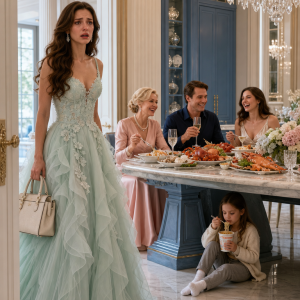
Madison persisted.
“You said the apartment was yours, and you said Tahoe was yours too.”
Katherine finally looked directly at the younger woman.
“The Manhattan apartment is leased through a company subsidiary, while the Tahoe property secures one of the facilities currently under review.”
Madison blinked rapidly.
“So can we still use them?”
Katherine answered evenly.
“That question belongs to Daniel’s lawyers and lenders.”
The silence following her response was more humiliating than anything Katherine could have deliberately said.
Madison had entered the relationship believing Daniel’s wealth existed as an endless collection of houses, cars, cards, and accounts under his personal command.
She was discovering that much of his luxurious world rested on corporate permissions, financing structures, investor confidence, and agreements created long before she met him.
Daniel was discovering the same thing.
Part 8 — The Signature That Mattered Most
Two days later, Daniel’s attorneys sought an emergency order preventing further alterations to the estate.
The judge temporarily paused additional structural work while ownership documents were reviewed, but the hearing produced none of the victory Daniel expected.
Alder Ridge demonstrated that Katherine’s company had long held the relevant construction assets and that Daniel had personally signed the operating agreements years earlier with independent legal counsel.
More damagingly, forensic accountants uncovered evidence that Daniel had authorized a corporate officer to reproduce Katherine’s digital approval mark on at least two financial documents.
Daniel insisted he believed the approvals were administrative formalities.
The board did not accept that explanation.
Neither did the lenders.
Within three weeks, Daniel resigned from the venture capital firm rather than face a formal removal vote. Several personal credit lines were suspended, company-paid benefits disappeared, and assets tied to disputed guarantees remained restricted while lawyers determined which obligations were valid.
He was not literally penniless, because years of compensation had left him with protected personal assets.
However, the billionaire image he had cultivated collapsed almost overnight because much of the apparent empire depended on leverage, corporate access, and valuations rather than unrestricted cash.
For a man who had built his identity around controlling every room he entered, the distinction felt devastating.
Part 9 — Madison Learns What Was Never Hers

Madison remained with Daniel for eleven more days.
Their final argument occurred inside a furnished executive apartment his attorneys arranged while the estate dispute continued.
She accused him of lying about his wealth, while Daniel accused her of caring more about properties than their relationship.
The irony would have amused Katherine if she had cared enough to hear about it.
Madison finally packed two suitcases and left after learning that Daniel could no longer guarantee her position at the venture capital firm because he no longer worked there himself.
The company terminated her internship several weeks later after an internal review concluded that her relationship with Daniel created serious professional conflicts, although investigators found no evidence that she had participated in his financial decisions.
Katherine never contacted her.
Madison had behaved selfishly and knowingly entered an affair with a married executive, but Katherine understood that Daniel had been the senior employee, the married partner, and the person with institutional power.
He had made his choices without needing assistance.
Part 10 — What Katherine Actually Took
The divorce lasted eleven months, considerably longer than the dramatic morning that had made their separation public.
Katherine did not receive every asset Daniel owned, and she never asked for such a result. Their attorneys divided marital property according to Connecticut law while separately respecting the corporations and ownership arrangements that predated or existed independently from the marriage.
Katherine retained control of Alder Ridge Design Holdings, the architectural rights she had created, and the development assets documented under the company.
Daniel retained personal property and investments legally belonging to him, although his financial position was dramatically weaker after resolving claims connected to unauthorized corporate guarantees.
The Greenwich residence was never completely demolished.
After the court confirmed Alder Ridge’s rights to the improvements, Katherine redesigned the remaining structure into a smaller sustainable residence and transferred part of the surrounding acreage into a conservation arrangement.
She did not move back.
Instead, she sold her interest in the completed project and invested the proceeds into a new architecture initiative focused on adaptive housing for communities rebuilding after natural disasters.
For the first time in fifteen years, Katherine designed something without asking whether Daniel considered it prestigious enough.
Part 11 — A Different Foundation
Eighteen months after the morning the excavators arrived, Katherine stood inside a newly completed community center near Portland, Oregon, watching sunlight move across a timber roof assembled from locally reclaimed materials.
Her grandfather had worked in Oregon’s lumber industry for most of his life, and the project felt connected to the inheritance that had once saved her marriage before money eventually exposed what the marriage had become.
Melissa Grant joined her near the entrance after the final inspection.
“Do you ever regret tearing into the Greenwich house so quickly?”
Katherine considered the question before answering.
“I regret that I spent so many years believing protecting someone’s future meant allowing him to forget who helped build it.”
Melissa smiled.
“That sounds considerably more expensive than architecture.”
Katherine laughed quietly.
“Most structural failures are expensive when people ignore the warning signs long enough.”
Outside, construction workers removed the last temporary barriers while families began arriving for the opening ceremony.
Katherine watched them through the glass.
Daniel had once treated the Greenwich estate as proof that he had created something permanent, yet the house had always depended on hidden supports he rarely bothered to understand. His career had functioned similarly, because confidence and reputation had concealed risks until one disputed document forced everyone to inspect what stood underneath.
Katherine no longer needed to watch his downfall.
She had heard through attorneys that Daniel eventually joined a smaller investment advisory company after completing regulatory reviews and settling several civil disputes. His life had not ended, but the effortless authority surrounding him had disappeared.
That seemed appropriate.
Consequences did not need to destroy a person completely in order to matter.
Katherine walked toward the main doors as afternoon light filled the building she had designed.
Fifteen years earlier, she had used her inheritance, professional knowledge, and corporate structure to protect a frightened young husband who promised never to forget what she had done. Years later, that same structure protected her when he decided she had become disposable.
Daniel had believed the expensive house was his because everyone associated his name with it.
He had believed the company influence was his because employees stood whenever he entered conference rooms.
He had believed Katherine could be removed from both because he mistook visibility for ownership and power for permanence.
The demolition morning had taught him otherwise.
Katherine had learned something different.
A strong foundation was never valuable because it trapped someone inside a building. Its real value came from knowing exactly what could be removed, what deserved to remain, and when the safest decision was to stop repairing a structure that had already failed.
She stepped outside into the cool Oregon afternoon without looking behind her.
The next building was waiting to be designed.
And this time, Katherine intended to build it entirely for the future rather than for a man who had mistaken her foundation for his throne.
THE END