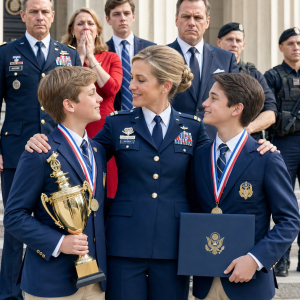
Megan greeted me at the door.
“You look like somebody forced you to negotiate with Congress and your ex-husband on the same day.”
“Only one of those happened, and surprisingly it was not the worst conversation.”
She told me the boys wanted to see Grant again.
I admitted something I had avoided for thirteen years.
Grant knew I was pregnant when he left, but I never told him afterward that I had delivered twins.
“I wanted one part of my life that he could not ruin after choosing to leave,” I told Megan.
She did not excuse me or condemn me.
“You made that decision with the strength and information you had then. Now the boys are old enough that the decision belongs partly to them.”
The next morning, Caleb and Owen asked directly.
“If we get to know him, are you going to feel like we chose him over you?” Owen asked.
My throat tightened.
“No relationship you build with your father will ever count as betrayal against me.”
Caleb studied me.
“Even if we end up liking him?”
“Even then, because you are not responsible for managing my feelings about a marriage that ended before you were born.”
That answer hurt.
It was also the only answer I wanted my sons to remember.
Part 5 — The Letters Nobody Delivered

We met Grant at a café overlooking the Potomac.
During breakfast, the boys asked about his childhood, his interests, and his mother, Eleanor.
When Grant said Eleanor had died five years earlier, I felt an unexpected grief.
I had loved her once.
After my divorce, several letters arrived from her, then suddenly stopped.
I had assumed Grant asked her to leave me alone.
Grant frowned when I mentioned that.
“My mother kept writing to you for years, Natalie.”
“I never received those letters after my transfer.”
“She told me you stopped responding.”
Something in the conversation shifted.
Later, Grant admitted that two years after leaving, he had attempted to contact me through my father.
According to Grant, my father told him I wanted no contact and referred to “the boy” as though I had delivered only one child.
That made no sense.
My father had known about the twins from the delivery room.
That evening, Megan and I searched boxes of his archived correspondence.
Shortly before midnight, we found an unopened letter from Eleanor.
The address was correct.
Someone had marked it RETURNED — WRONG ADDRESS.
Inside, Eleanor wrote that someone claiming to represent me had told her I wanted no further communication from Grant’s family.
The last paragraph contained one disturbing question.
Had I authorized an attorney connected to Lauren Whitfield’s family to contact her on my behalf?
I had not.
The letter was dated six weeks after Caleb and Owen were born.
The next day, Grant and I called Martin Keller on speakerphone.
Eventually, he admitted that Lauren’s father, Richard Whitfield, had been concerned that continuing contact between Grant and his pregnant former wife might destabilize Grant’s new relationship with Lauren.
Richard had also worried about financial obligations and future claims.
“Claims I never made, because I waived spousal support during the divorce,” I reminded Martin.
He had no useful answer.
We requested whatever archived records remained.
Part 6 — What Lauren Knew and What She Chose Not to Know
The surviving records suggested Richard Whitfield had actively tried to discourage communication between our families.
They did not prove that Lauren personally directed every contact.
That distinction mattered.
Grant and I met Lauren at a quiet restaurant the following afternoon.
She arrived without jewelry, wearing a simple cream blouse and dark trousers, looking considerably less composed than she had during the competition.
Grant placed Eleanor’s letter and Martin’s archived memorandum on the table.
“How much did you know about what your father was doing?”
Lauren closed her eyes.
“I knew he wanted Natalie completely outside your life, but I did not know he was contacting your mother or interfering with correspondence.”
I asked whether she knew I was pregnant.
She looked at me.
“Yes, and I told myself it was not my responsibility because my father said your marriage had been finished long before Grant met me.”
Grant’s jaw tightened.
“Did you ever ask whether she had the baby safely?”
Lauren looked down.
“No, because asking questions might have forced me to acknowledge things I preferred believing were already settled.”
That answer was ugly.
It was also credible.
Nothing Richard had done erased Grant’s original choice to leave.
Grant understood that before I needed to say it.
“Richard may have closed doors afterward,” he said quietly, “but nobody forced me to walk through the first one.”
That mattered more than blaming Lauren’s father.
Later, Lauren asked if she could apologize directly to Caleb and Owen for what she had said at the competition.
She met them in Megan’s backyard.
“I said something unfair about both of you because I was embarrassed and angry, and neither emotion gave me the right to insult you.”
Owen asked whether she was still upset that they defeated Mason.
Lauren unexpectedly laughed.
“A little, although I am trying to become a better person about it.”
The twins accepted the apology cautiously.
Children often understand that an apology is only the beginning of evidence.
Part 7 — The Boy Who Was Supposed to Win

Mason changed too.
Without Lauren beside him, he seemed less arrogant and considerably more uncertain.
He approached Caleb and Owen outside the competition building the next day carrying a workbook.
“Can I ask how you actually study when you realize you do not understand something?”
Caleb sat beside him.
For almost forty minutes, the three boys discussed practice exams, error journals, pattern recognition, and the difference between reviewing familiar material and deliberately working on weaknesses.
Mason listened carefully.
Later, he showed them another interest nobody had encouraged seriously.
Photography.
His tablet contained photographs of bridges, train stations, old brick buildings, reflections in glass, and unusual architectural details.
Owen was impressed.
“You should submit these somewhere, because you clearly understand perspective.”
Mason hesitated.
“Mom says photography is fine as a hobby, but she wants me focused on something useful.”
Caleb frowned.
“Useful to whom?”
Mason did not answer.
Grant heard the conversation and later spoke privately with Lauren.
I never heard what he said.
The following afternoon, Mason arrived carrying his camera and announced that his mother had agreed to let him attend an architectural-photography workshop.
That small decision told me more about Lauren’s apology than her words had.
She was beginning to question the pressure she had placed on her own child.
Meanwhile, Grant met Caleb and Owen several more times under boundaries we agreed upon together.
No overnight visits.
No promises about future family arrangements.
No gifts designed to purchase closeness.
No criticism of me.
If the boys wanted to end a meeting, the meeting ended.
Grant accepted every condition.
That surprised me because thirteen years earlier he considered boundaries an insult.
Perhaps losing thirteen years teaches patience faster than getting what you want ever could.
Part 8 — What Did Not Come Back
A week after the competition, Grant and I stood beside the Potomac while the boys remained at Megan’s house.