PART 5 — The Silence After the Landing

For several moments, nobody inside the cockpit spoke. Warning tones continued, but the sounds no longer signaled an approaching disaster. Captain Hayes closed his eyes briefly before contacting the tower.
“Gander Tower, Meridian Four-Seventeen is stopped on the runway with engines operating and possible structural damage,” he reported. “Request immediate inspection and medical response.”
The controller’s answer carried unmistakable relief.
“Meridian Four-Seventeen, rescue teams are approaching, and you are instructed to remain stationary until further notice.”
Evelyn kept her hands near the controls while airport crews inspected the aircraft for fire, fuel leakage, and landing-gear damage. Hayes did not release the passengers until emergency teams confirmed that evacuation slides were unnecessary and portable stairs could be positioned safely.
Behind the cockpit door, applause began in one section of the cabin before spreading through every row. The sound carried crying, laughter, and the uncontrolled relief of people who had prepared themselves for a different ending.
Hayes removed his headset and looked toward Evelyn.
“You helped keep this aircraft controllable when I could no longer complete the emergency procedures alone,” he said. “Nearly three hundred people will leave tonight because you answered an impossible announcement.”
Evelyn shook her head before accepting his outstretched hand.
“You remained the aircraft commander, your crew secured the cabin, the controllers created a path, and emergency teams prepared the runway,” she replied. “Nobody saved this flight alone.”
The medical team removed First Officer Turner once stairs reached the aircraft. He was conscious enough to thank Evelyn, although pain medication and exhaustion blurred his words.
Passengers began disembarking into the cold Newfoundland night. Many paused when they recognized the quiet woman from row seven standing near the cockpit entrance. Some thanked her, while others could only touch her arm or nod through tears.
The mother who had held her toddler during the announcement stopped beside Evelyn.
“My daughter slept through most of the landing, and someday I will tell her that a stranger stood up when everyone needed her,” she said.
“Tell her an entire crew brought her safely to the ground,” Evelyn answered. “That is the more truthful story.”
Investigators later determined that high-altitude debris had struck the aircraft near the right wing and forward fuselage. The exact source required further analysis, but preliminary inspection confirmed substantial damage to control surfaces and hydraulic components.
News crews gathered inside the terminal before passengers had completed processing. Evelyn declined interviews because the event did not belong to her alone, and she had no desire to convert another frightening night into personal spectacle.
Captain Hayes joined her near a quiet gate after completing preliminary reports.
“You tried to disappear into seat 7A, but I suspect the passengers will remember you for the rest of their lives,” he said.
Evelyn looked through the terminal windows at the wounded aircraft surrounded by floodlights.
“I spent years believing my training belonged only to the part of my life I wanted to leave behind,” she replied. “Tonight reminded me that skills do not carry moral meaning until somebody chooses how to use them.”
PART 6 — What Captain Reed Carried Home
Meridian Airways arranged lodging and replacement travel for the passengers, although Evelyn remained in Gander long enough to provide statements to aviation investigators. She described every control change, warning indication, and physical response without exaggerating her authority inside the cockpit.
The official report credited Captain Hayes with commanding the emergency, the cabin crew with preparing passengers, controllers with coordinating the diversion, and Evelyn with providing essential manual-control assistance after the first officer became incapacitated.
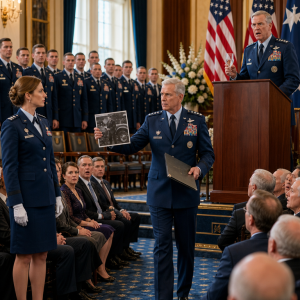
Several weeks later, the Air Force invited her to speak with flight trainees about transferring combat-developed skills into civilian crisis response. Evelyn initially declined because returning to a military setting reopened memories she had spent years avoiding.
Captain Hayes contacted her after hearing about the invitation.
“You do not owe anyone a heroic performance, but your experience could help young pilots understand that leaving active service does not make their training meaningless,” he said.
Evelyn eventually accepted under one condition: the presentation would focus on teamwork, limits, and disciplined decision-making rather than portraying her as a lone savior.
During the lecture, she explained that courage had not erased uncertainty inside the cockpit. She had understood the enormous differences between an F-16 and a commercial airliner, which was precisely why she remained under the captain’s direction and communicated every action.
“Confidence without humility would have made me dangerous aboard that aircraft,” she told the trainees. “Training mattered because it taught me how to contribute without pretending I possessed knowledge that belonged to other professionals.”
The night over the Atlantic changed how Evelyn understood her military past. Combat memories did not disappear, and she did not romanticize the missions that had exhausted her. However, the same discipline once associated with warfare had protected sleeping children, elderly travelers, students, businesspeople, and families returning home.
Months afterward, Evelyn received a package containing a photograph signed by members of the flight crew. Captain Hayes had written beneath the image:
“Captain Reed, thank you for taking the controls when the sky demanded everything we had.”
The mother from the flight also sent a drawing made by her daughter. It showed a large airplane beneath a blue sky, with several smiling figures inside the cockpit. The child had written that many people helped the airplane find the ground.
Evelyn framed both items beside an old photograph of herself standing near an F-16. For years, that military photograph represented a life she believed she needed to bury before moving forward. Now it reminded her that experience could be carried without allowing it to control every future destination.
She returned to civilian routines and continued traveling without expecting recognition. Airports remained airports, night flights remained tiring, and most journeys ended exactly as planned.
Occasionally, another passenger recognized her from news coverage and asked whether she had truly saved three hundred people. Evelyn always corrected the question.
“A captain, an injured first officer, a trained cabin crew, controllers, emergency teams, and one former military pilot worked together,” she explained. “The safe landing belonged to all of them.”
Before Flight 417, Evelyn believed leaving the Air Force meant closing the cockpit door permanently. The emergency taught her that identity did not disappear simply because uniforms, ranks, and assignments changed.
She had boarded in Boston hoping to remain unnoticed and reached Newfoundland surrounded by people who knew her name. Yet the most important discovery had nothing to do with public recognition.
At twenty-four thousand feet above the North Atlantic, Evelyn realized that she had not abandoned the person she once was. She had only been waiting to learn that the strongest parts of that person could serve a different purpose.
The fighter pilot inside her no longer belonged exclusively to combat.
On that night, she belonged to everyone behind the cockpit door.
THE END