“Who is here with you?”
Laura swallowed.
“Nobody.”
Rebecca drew the curtain tightly around her bed.
“Then you have me.”
Three simple words nearly made Laura cry.
At 1:43 a.m., Matthew’s heart rate dropped.
The room filled with staff, oxygen, instructions, and the possibility of emergency intervention.
During one violent contraction, Laura screamed Graham’s name even though part of her already understood he would not come.
Matthew was born at 2:14 a.m.
For several terrifying seconds, he made no sound.
Then he cried.
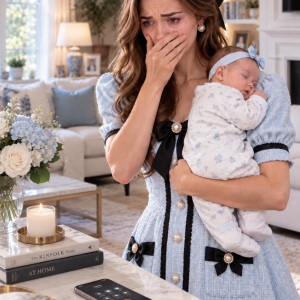
Rebecca placed him against Laura’s chest.
“He is here, Mama.”
That word changed something inside Laura.
Mama.
Not Mrs. Whitaker.
Not Graham’s socially unsuitable wife.
Not the compliance analyst from the legal division whom Margaret considered beneath the family.
Mama.
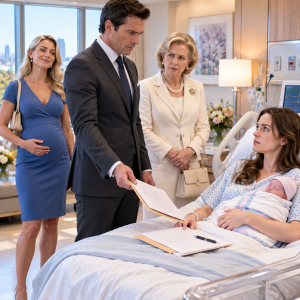
Six hours later, Margaret arrived carrying documents.
After Rebecca forced her out, Laura finally understood the structure surrounding her marriage.
Graham had abandoned her.
Margaret had come to secure control over whatever remained.
Sloane had not stolen a decent husband.
She had merely entered a system already designed to remove inconvenient women.
Rebecca helped Laura contact attorney Monica Grant in Burlington, Vermont, whom Laura had met years earlier during a maternity-care compliance audit.
Monica had once told her, “If you ever need a lawyer who is not afraid of the Whitaker name, keep my number.”
Laura had kept it.
By the next morning, emergency petitions were being prepared. Every threat, unanswered call, attempted authorization, and medical interaction was documented.
Fifteen days after giving birth, Laura left New York with Matthew against her chest.
She moved temporarily into a small Vermont cottage arranged through Monica.
For the first time, she was surrounded by people who did not work for Graham.
That mattered more than comfort.
Part 4 – Graham Begins Removing the Foundation
After watching the videos, Graham hired independent counsel from Chicago rather than using any firm connected to his family.
He ordered audits of hospital communications, family trust records, medical access requests, household systems, and every legal arrangement prepared during Laura’s pregnancy.
The results were worse than betrayal.
They revealed infrastructure.
Margaret had arranged for a psychiatrist connected to Whitaker Family Foundation to remain available for an emergency postpartum evaluation if Laura resisted the proposed guardianship structure.
Sloane had received monthly payments through a consulting company indirectly controlled by a Whitaker subsidiary.
Emails repeatedly used phrases such as maternal instability, heir continuity, reputation containment, and emergency custody strategy.
Some had been created before Graham went to Barbados.
Nothing about the plan had been improvised.
He confronted Margaret inside her Fifth Avenue apartment.
“How long were you planning to take Laura’s child?”
Margaret did not flinch.
“Our child. Matthew is a Whitaker.”
“He is Laura’s son.”
She stood.
“Do not become sentimental. Laura has no family status, no proper resources, and no instincts for power.”
“Thank God.”
Margaret slapped him.
The sound echoed beneath the chandelier.
Graham touched his cheek.
Then he placed a document on the table.
“You are suspended from every Whitaker family-office role involving trusts, healthcare organizations, and child-related foundations pending independent investigation.”
For the first time, Margaret looked afraid.
Graham also confronted Sloane.
She cried.
She claimed Margaret had convinced her Laura was unstable.
She insisted she loved him.
Graham finally understood the similarity between them.
Sloane liked winning against another woman.
He liked believing admiration was love.
“Laura nearly lost our son while we were posting photographs from your villa.”
Sloane stood angrily.
“You told me your marriage was finished.”
“I told myself many things because they were convenient.”
When she demanded to know whether he was choosing Laura again, Graham shook his head.
“Laura has not offered me anything to choose.”
Then he ended their relationship.
Part 5 – The Custody Hearing

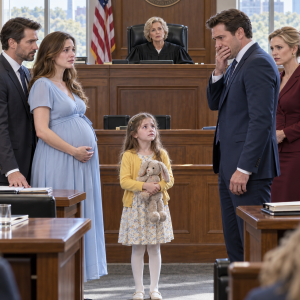
The emergency custody hearing took place in Burlington beneath a gray Vermont sky.
Graham arrived without security and, against his attorney’s advice, refused to demand immediate custody.
Across the courthouse, Laura held Matthew against her shoulder.
Her wedding ring was gone.
Graham looked away when her hand automatically moved protectively across Matthew’s back as he approached.
That reflex belonged to him now.
He had created it.
Monica presented hospital records, calls, videos, financial transfers, proposed guardianship papers, and communications between Margaret and Sloane.
Daniel testified that he had given Margaret administrative access because he had prioritized his salary and employer over a woman who had almost no institutional power.
Rebecca testified next.
When Margaret’s lawyer suggested she had become emotionally involved, Rebecca adjusted her glasses.
“I have worked maternity care for thirty-one years. If stopping someone from pressuring a woman in active labor to sign custody papers is inappropriate emotional involvement, hospitals should hire more emotional nurses.”
Then Laura testified.
Monica asked why she left New York.
“Because I had just delivered a child, and my mother-in-law was trying to make me sign custody arrangements before I had properly slept, eaten, or held my son without someone discussing ownership.”
“Were you afraid of Margaret Whitaker?”
“Yes.”
Then came the harder question.
“Were you afraid of Graham Whitaker?”
Laura looked at him.
Graham’s entire body wanted her to say no.
She told the truth.
“Yes.”
The courtroom became still.
“Why?”
Laura looked down at Matthew.
“Because he taught me that needing him could become something I was punished for.”
Graham lowered his head.
The judge awarded Laura temporary sole physical custody and sole decision-making authority.
Margaret received no contact.
Graham was permitted supervised visits contingent upon parenting education, therapy, court compliance, and a formal written acknowledgment of the circumstances surrounding Matthew’s birth.
The judge addressed him directly.
“Do you intend to contest these conditions?”
Graham stood.
“No, Your Honor. Laura protected our son when I did not. I will comply with every requirement.”
Outside, reporters shouted questions.
One asked whether Laura had kidnapped his son.
Graham stopped.
“No. Laura Hayes did not kidnap my son. She protected him from a family structure that I enabled through arrogance, absence, and silence.”
He looked toward the cameras.
“She did not betray me. I betrayed her.”
It cost him investors, sponsors, and several board relationships.
Laura sent no gratitude.
Her attorney sent only one sentence.
Ms. Hayes acknowledges your public correction.
For Graham, that was enough.
Part 6 – Learning to Be a Father Without Owning Anything
Graham’s first supervised visit with Matthew occurred inside a county family-services room.
He arrived twenty minutes early.
When Laura eventually handed him the six-week-old baby, Graham forgot every intelligent sentence he had ever spoken.
Matthew opened unfocused newborn eyes.
Graham whispered, “Hello.”
The baby sneezed.
Laura almost smiled.