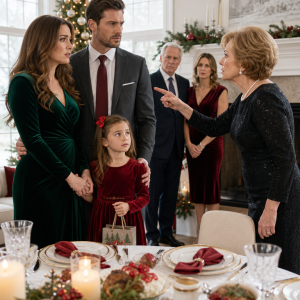
Walter began laughing again.
Marlene ignored him.
“You gave up coffee.”
She pointed toward me.
“Nora gave up the housekeeper, lawn service, grocery delivery, and half of most household income.”
Caleb looked increasingly uncomfortable.
His mother continued.
“And you still expected her to cook restaurant-quality Sunday meals for us while funding your sister’s lifestyle?”
Caleb defended Tessa.
“She is exhausted.”
Marlene nodded.
“Then family should offer childcare.”
She counted on her fingers.
“Transportation. Meals. Practical help.”
Then she added,
“Not unlimited access to somebody else’s paycheck.”
That evening, Marlene called Tessa.
She demanded a complete monthly budget.
The conversation became uncomfortable very quickly.
Tessa and Jordan were leasing two luxury vehicles.
They paid for several organic meal subscriptions.
Professional newborn photography.
And an expensive infant sensory class that neither parent could explain clearly.
Marlene asked over speakerphone,
“What exactly does this class teach the babies?”
Tessa began crying.
“It stimulates their development.”
Marlene responded without hesitation.
“So does adequate sleep, a clean blanket, and parents who are not drowning beneath unnecessary bills.”
By the end of the conversation, Marlene offered to provide childcare twice every week.
Walter agreed to handle transportation.
I agreed to a modest monthly financial contribution.
But Caleb and I would determine the amount together.
It would be fixed.
Temporary.
Documented.
No one would ever again receive unrestricted access to my income.
Part 5: The Agreement That Stayed

For the next month, Caleb and I continued operating under the strict fifty-fifty system.
He paid half the mortgage.
Half the utilities.
Insurance.
Groceries.
Repairs.
He vacuumed.
Cleaned bathrooms.
Washed dishes.
Ironed his own shirts.
And discovered that laundry did not magically travel from a hamper into a closet.
Nothing about the arrangement was cruel.
It simply made labor visible.
By the third week, Caleb sat on the living-room sofa staring at his banking app.
His shoulders had collapsed.
“I have eighty-four dollars left until Friday.”
I nodded.
“That sounds difficult.”
He looked at me.
“I had to turn down lunch with a client because I cannot casually spend twenty dollars anymore.”
I answered,
“Pack lunch from home.”
He glanced toward the kitchen.
A container of leftovers waited beside the ordinary supermarket coffee.
Caleb sighed.
“I am deeply tired of that coffee.”
“That is unfortunate.”
Then he lowered his phone.
His expression was different.
Less defensive.
“How did you manage all of this every month?”
I answered plainly.
“I planned.”
He listened.
“I worked long hours.”
Then I added,
“And I understood that comfort required constant labor.”
Caleb rubbed his forehead.
“I never realized how much you were paying.”
I looked at him.
“You understood the numbers when you wanted half my salary.”
Silence remained between us for several seconds.
The following Sunday, Marlene arrived carrying groceries.
Not expectations.
She placed a discounted pork roast on the counter.
Ordinary potatoes.
Supermarket bread.
Canned vegetables.
Then she announced proudly,
“I purchased everything myself.”
Walter leaned toward me.
“She argued with the butcher about price comparisons for forty minutes.”
Marlene ignored him.
She examined the potatoes.
“Ordinary potatoes are perfectly acceptable when properly prepared.”
I nodded solemnly.
“That is an extraordinary philosophical development.”
She gave me a warning look.
“Do not become sentimental.”
Caleb cooked the roast.
I intervened only when food safety required it.
The meal was not luxurious.
But he completed it without smoke.
Panic.
Or escaped animals.
At the end of the month, Caleb called Tessa.
He explained that the unrestricted transfer was ending.
Tessa accused him of abandoning his family.
Then Marlene presented the budget and reminded her of the childcare arrangement.
Jordan eventually accepted additional work hours.
Tessa canceled several unnecessary subscriptions.
Their household began stabilizing through planning rather than guilt.
Two months after Caleb first announced that half my salary belonged to someone else, we stood beside the kitchen sink washing dishes.
Our permanent fifty-fifty arrangement remained in place.
Caleb spoke quietly.
“I treated your income like extra money because I did not respect how much work was behind it.”
I handed him a plate.
“That is the first honest explanation you have given me.”
He nodded.
“I am sorry I promised away your labor before asking what you wanted.”
I looked at him.
“The apology matters.”
Then I added,
“But the agreement matters more.”
Caleb nodded.
“Then the agreement stays.”
“The agreement stays.”
We ended the emergency transfer.
In its place, we established the smaller contribution we had both approved.
Marlene and Walter continued caring for the twins twice each week.
Caleb remained responsible for half the work at home.
Eventually, the housekeeper returned.
The lawn service resumed.
Premium coffee reappeared in the pantry.
But our household comfort no longer depended upon one person quietly carrying everyone else.
Part 6: What Comfort Really Means
Several months later, Sunday lunches returned.
They were different.
Marlene brought one inexpensive side dish every week.
She also developed a remarkable loyalty to ordinary potatoes.
If anyone described them as unsophisticated, she defended them immediately.
She never requested lobster again.
Whenever Walter mentioned seafood, she announced,
“I have reconsidered bottom-dwelling armored insects.”
No one reminded her that she once described lobster as “poetry from the Atlantic.”
Denise eventually printed a photograph from the kitchen disaster.
Marlene hated public embarrassment.
So she decided the only way to control the story was to embrace it.
She ordered an enlarged copy for herself.
At Christmas, she gave Caleb an emergency bread-making manual.
And a pair of industrial kitchen tongs.
Walter added a heavy-duty lobster cracker.
Nobody understood exactly why.
I gave Caleb a six-month subscription to a premium coffee roaster.
The gift felt different now.
Generosity was pleasant when it was chosen freely.
Not demanded through guilt.
Marlene gave me something too.
A framed photograph from the day she climbed onto the marble island.
In the picture, she stood barefoot on one side of the kitchen.
Caleb held his defeated salad tongs.
A lobster crawled beneath the refrigerator.
Beneath the photograph was an inscription.
“The day our family finally learned what comfort costs.”
I placed the frame beside the coffee machine.
Caleb saw it every morning.
He never again announced that my salary was available to another person.
Whenever Tessa needed help, he spoke with me first.
We reviewed the actual expenses.
Considered practical assistance.
Then decided together whether money was necessary.
That had always been the real purpose of my household audit.
I was not trying to punish Caleb.
Although watching Marlene fight a lobster had provided unforgettable entertainment.
I wanted the labor surrounding our comfortable life to become visible.
Visible enough that nobody could continue pretending it appeared by magic.
Comfort was not the absence of work.
Comfort was what work created.
Planning.
Cooperation.
Effort.
And mutual consent.
Once Caleb finally understood that, our marriage became slightly less effortless.
But far more honest.
And the difference was worth every canceled subscription.
Every terrible cup of coffee.
And every escaped lobster.
THE END