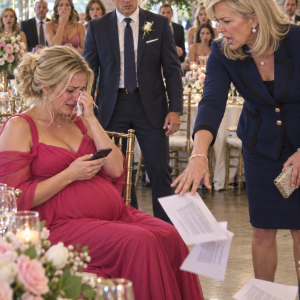
“You could have told me the truth before we married.”
“Yes,” I answered. “I could have.”
She seemed almost disappointed that I did not argue.
“My father gave you an opportunity most people would have been grateful to receive.”
I looked around the room, at the expensive furniture, the paintings chosen by decorators, and the dining table where we had hosted dozens of people whose approval I once considered essential.
“He did,” I said. “And I spent years convincing myself that keeping it justified almost anything.”
Victoria gathered her papers.
“I don’t think you ever loved me.”
It would have been easy to blame her, to remind her that she had loved the public image of our marriage as much as I had, but there was no comfort left in that kind of argument.
“I don’t think I knew how to love anyone properly back then,” I admitted.
She left the room without answering.
Over the following months, I resigned from my position while the board completed its review, sold several properties to meet financial obligations, and moved into a small rented apartment near the edge of the city.
The legal proceedings continued, and eventually a negotiated settlement recognized Rebecca’s ownership interests in important portions of the original research, providing compensation and revised licensing arrangements for future use.
I also faced personal financial consequences related to the representations I had made during the company’s early years.
Yet the hardest part of those months had little to do with money.
It was learning about my daughters from newspaper articles.
Evelyn and Clara were invited to participate in a summer research program at a university in Massachusetts. Their work attracted attention from scientists studying efficient computing systems, and several educational organizations offered support for their future studies.
Every article mentioned Rebecca.
She had continued working at a public research laboratory while raising the girls, eventually completing an advanced degree through a combination of evening study, grants, and years of disciplined effort.
I read about the modest house they had lived in, the school science fairs they had entered, and the teachers who remembered Rebecca arriving after long workdays to help organize experiments and prepare presentations.
I learned that Evelyn loved classical music and built small mechanical devices in her spare time, while Clara preferred literature and had once organized a neighborhood tutoring program for younger children.
These were details a father should have known without reading them in a newspaper.
Twice, I wrote letters.
In the first, I apologized and offered financial assistance.
In the second, I tried to explain why I had left, although after reading it several times, I realized that most of the pages were devoted to defending decisions that required no further explanation.
I discarded both letters.
Eventually, I sent a short note through Rebecca’s attorney, acknowledging what I had done and asking whether the girls would ever consider meeting me.
Several weeks later, I received a response.
Rebecca had not written it.
Evelyn and Clara had.
“Mr. Brooks, we appreciate your acknowledgment of the past, but we’re not ready to establish a relationship. We have a good life, and we would like you to respect our decision. We wish you well.”
I read those words repeatedly.
There was no cruelty in them.
There was also no invitation.
For the first time, I understood that respecting my daughters might mean accepting a boundary I had no power to change.
Part Five: The Measure of a Life

Six months after the competition, I traveled to Cambridge, Massachusetts, for a meeting with an attorney who was helping finalize several remaining financial arrangements.
The morning was cool and overcast, and after leaving his office, I wandered through the streets near the university campus, where students hurried between buildings carrying backpacks, coffee cups, and the comfortable certainty that the future still held countless possibilities.
I stopped near a public garden across from a large auditorium.
A banner above the entrance announced a symposium on emerging computational research, and beneath the title were the names of two featured student presenters.
Evelyn Bennett and Clara Bennett.
A smaller line acknowledged the research contributions of Dr. Rebecca Bennett.
I stood beneath the trees for several minutes, uncertain whether I should leave.
Eventually, a silver sedan pulled up near the entrance, and Rebecca stepped out, followed by the girls.
They wore simple dark jackets over neatly pressed clothes, and although they looked older than they had at the competition, they still moved with the easy familiarity of sisters who understood each other without needing many words.
Rebecca adjusted Evelyn’s collar before Clara gently moved her mother’s hand away.
“Mom, we’re presenting research, not getting married,” Clara said, laughing.
“I know,” Rebecca replied. “But I still get to make sure you look presentable.”
Evelyn slipped an arm around her mother’s shoulders.
“You realize you’re the one everybody wants to meet, right?”
Rebecca shook her head.
“They’re here for your work.”
“Our work,” Clara corrected.
I could hear them because they had stopped near the sidewalk, only a short distance from the bench where I stood.
For one brief moment, I considered approaching them.
I imagined introducing myself again, offering congratulations, perhaps asking whether they might someday be willing to have coffee with me.
But then I remembered their letter.
They had asked me to respect their decision.
For thirteen years, I had placed my wishes ahead of theirs without ever knowing them, and I did not want my first meaningful act of fatherhood to become another example of the same selfishness.
So I remained where I was.
A small group of reporters approached the three women near the auditorium entrance, asking about the girls’ recent research and the unusual path that had brought them to such a prestigious gathering.
One reporter turned toward Rebecca.
“Dr. Bennett, what do you think made the greatest difference in your daughters’ success?”
Rebecca glanced at the girls before answering.
“They worked hard, and they had wonderful teachers. But I think the most important thing was that they learned not to measure their worth by somebody else’s approval.”
Clara smiled.
“Mom also taught us that being smart doesn’t mean much if you forget to be kind.”
Evelyn nodded.
“And that taking credit for somebody else’s work doesn’t make you successful. It just means you haven’t learned to value your own.”
The reporter thanked them, and the three women continued toward the entrance, where several colleagues were waiting to greet Rebecca.
I watched her embrace an older professor, laugh at something one of the girls whispered, and walk through the doors with a quiet happiness that seemed entirely unaffected by my presence.
As they disappeared inside, I thought about the first time Rebecca had shown me her research.
We had been sitting on the floor of our apartment because we could not afford a proper dining table, and she had spread her calculations across the carpet while explaining, with infectious enthusiasm, how her ideas might someday help computers solve difficult problems more efficiently.
I had barely listened.
At the time, I was too busy worrying about whether the right people would ever notice me.
I remembered telling her that intelligence meant little unless someone knew how to turn it into money.
She had smiled and replied that some things were worth doing simply because they made the world better.
For years, I had mistaken that belief for a lack of ambition.
Now, watching the auditorium doors close behind her, I finally understood that Rebecca had never lacked ambition at all.
She had simply chosen a different measure of success.
I sat on the bench until the first light rain began to fall, thinking about all the birthdays I had missed, the school concerts I had never attended, and the ordinary evenings when my daughters must have come home carrying stories they were eager to share.
There would have been scraped knees, difficult homework, arguments over borrowed sweaters, and countless small victories that never appeared in newspapers.
Rebecca had been there for all of them.
I had been somewhere else, building a reputation that eventually proved far less durable than the relationships I had neglected.
I could not reclaim those years, and I knew that no apology, however sincere, could require my daughters to make room for me in their lives.
Perhaps one day they would change their minds.
Perhaps they would not.
For the first time, I was learning that love could not be demonstrated through ownership, influence, or the promise of expensive gifts. Sometimes it began with accepting another person’s freedom to choose.
Across the street, applause rose from inside the auditorium, followed by the distant sound of a young woman’s voice beginning her presentation.
I could not tell which daughter was speaking.
That realization brought a familiar ache, but I remained seated, listening anyway.
Thirteen years earlier, I had walked away from a woman who believed in me, two children I had not yet met, and a future that would have required patience, humility, and the willingness to build something slowly.
I had chosen wealth because I thought it would give me everything I wanted.
Instead, I had spent years surrounded by things I could purchase while remaining a stranger to the people who might once have loved me simply because I was there.
When the rain grew heavier, I stood and turned toward the train station, carrying no trophy, no important title, and no expectation that anyone would be waiting for me.
Yet I carried something I had avoided for most of my adult life: an honest understanding of the man I had been, and the responsibility to become someone better without expecting forgiveness as a reward.
Behind me, the applause continued.
My daughters were beginning their own lives, guided by the woman who had never stopped believing in them.
And although I would always regret the place I had surrendered in their story, I finally understood that their happiness did not depend on my return.
It never had.