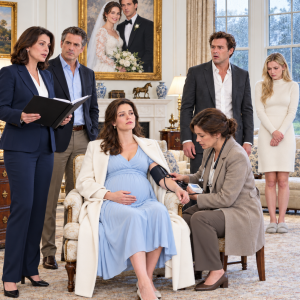
“You should be lying down.”
His concern sounded perfect.
That made it almost unbearable.
I looked at him.
“You were at my funeral this morning.”
He said nothing.
“You stood beside my casket with Vanessa while discussing my inheritance.”
Harrison shook his head.
“That’s not what happened.”
I kept my gaze on him.
“Your mistress wore cream silk to my funeral and carried one of my old handbags.”
Vanessa folded her arms.
“You’re alive. That changes everything.”
I turned toward her.
“Yes. It changes what happens next.”
Daniel closed the conference-room door behind them.
Then he spoke.
“Nobody is leaving until we understand these beneficiary documents.”
Harrison immediately began threatening Daniel’s professional reputation.
Daniel did not raise his voice.
“You should be much more concerned about the possible criminal implications of the documents you brought here.”
Natalie looked directly at Harrison.
“Tell her about Eleanor.”
He froze.
That was the moment I realized my husband knew more about the supposed beneficiary than he had admitted.
PART 4 — THE SISTER MY MOTHER HAD KEPT SECRET
Harrison remained standing beside the conference table.
For several seconds, he avoided looking at me.
Then he admitted that my mother had once mentioned a child who had been placed for adoption.
He learned about the secret privately.
But he never told me.
I stared at him, unable to understand how the man I had married could know something so important about my family and deliberately conceal it.
Daniel reached for another envelope.
It had arrived at his office less than an hour earlier.
The handwriting on the front belonged to my mother.
I recognized the slanted letters immediately.
Inside was an old photograph.
My mother appeared much younger, holding a dark-haired baby.
A teenage girl I had never seen stood beside her.
On the back, my mother had written:
Her name was never Eleanor Vale.
Daniel unfolded a second letter.
It explained what had happened.
Before I was born, my mother had given birth to a daughter named Anna.
She was young, frightened, and unable to imagine how she would raise the child.
Anna was placed for adoption.
My father knew.
Natalie eventually learned about the child when she was sixteen, but our mother made her promise never to tell me.
Anna was six years older than I was.
She was now forty-nine.
I looked toward Natalie.
“You knew I had another sister?”
Tears filled her eyes.
“Mom made me promise.”
I struggled to contain my anger.
“And you kept that promise all these years?”
Natalie nodded.
She looked ashamed, but she did not attempt to defend herself.
Before I could say anything more, Harrison’s phone rang.
The screen displayed a single name.
Eleanor.
I looked at it.
Then at Harrison.
Suddenly, the beneficiary documents seemed even more suspicious.
A short time later, Detective Lena Morales arrived with two officers from the financial-crimes unit.
Daniel explained the arrangements surrounding my supposed death.
He confirmed that no final death certificate had been registered and that no insurance claim had been paid.
No money had transferred because of the funeral.
The detective focused instead on the altered foundation account.
She asked Harrison about Eleanor Vale.
After a long hesitation, he admitted that a woman using that name contacted him three months earlier.
She claimed she might be my mother’s lost daughter.
Harrison had met her twice.
She wanted information about my mother’s estate and insisted that money had been promised to her.
Harrison told her about the charitable foundation.
Then he signed what he claimed to believe was an authorization allowing investigators to examine the matter.
Daniel placed the actual document on the table.
The language was much more serious.
It authorized a temporary transfer of foundation assets into an escrow account controlled by Vale Consulting.
At the bottom was Harrison’s signature.
Beside it appeared another signature.
M. Cole.
Martin.
My financial adviser.
I stared at the document.
Martin had not merely come to the meeting as a witness.
He had participated in the transaction.
Vanessa looked toward Harrison.
Her expression changed.
“You told me the foundation money was part of the estate.”
Harrison answered defensively.
“I believed it was.”
She shook her head.
“You said you’d checked everything.”
He did not respond.
For the first time, Vanessa seemed to realize that the man who had lied to his dying wife was not necessarily telling the truth to her.
I looked down at the document.
The name Eleanor Vale had appeared in an account connected to my mother’s charitable work.
A supposed daughter had suddenly surfaced.
And Martin’s signature appeared beside Harrison’s on paperwork involving millions of dollars.
I had arrived expecting to expose my husband’s greed.
Instead, I was discovering a secret that reached back decades.
PART 5 — THE WOMAN WHO WAS NEVER ELEANOR

The woman using the name Eleanor eventually agreed to come upstairs.
When she entered the conference room, she immediately corrected the name everyone had been using.
“My name is Anna Vale.”
I looked at her.
She was not the mysterious figure I had imagined during the previous hour.
She was an exhausted forty-nine-year-old woman carrying a weathered folder against her chest.
Her expression was cautious.
She seemed frightened that another conversation about her identity might end with more unanswered questions.
Anna explained that her adoptive mother, Margaret Vale, had raised her with genuine affection.
Margaret loved her deeply.
But she had never fully explained the circumstances surrounding Anna’s birth.
After Margaret died, Anna discovered adoption records and references to my mother.
She began trying to reconstruct her history.
For years, she had wondered about the family she came from.
Eventually, someone directed her toward Harrison.
That person was Martin Cole.
My stomach tightened.
Anna continued.
Martin told her that my family had deliberately excluded her from the estate.
He claimed our mother had established financial resources intended for Anna, but that others were preventing her from receiving them.
Then Martin approached Harrison with a different explanation.
He claimed Anna was threatening to expose family secrets unless certain foundation money was transferred into escrow.
Martin had told each person enough truth to make his lies believable.
Anna believed she was trying to recover information and resources that might rightfully belong to her.
Harrison believed he was dealing with a financial threat to the estate.
Neither understood that Martin was using both of them.
Anna opened her folder.
She removed a message Martin had sent the previous day.
It said my supposed death created the perfect opportunity to move the money without resistance.
I stared at the words.
Martin had known about the funeral.
More disturbingly, he had obtained my medical records.
Trust documents.
Photographs of Harrison and Vanessa leaving a hotel.
And pictures of me walking out of Dr. Bell’s clinic.
Somebody had been monitoring all of us.
Detective Morales began photographing the documents.
Then she looked toward Daniel.
“Where is Martin now?”
Daniel contacted his associate and asked for the building’s security records to be checked.
The answer came quickly.
Martin had left through the stairwell only minutes earlier.
Officers immediately began searching the parking garage.
The investigation that followed revealed a scheme far larger than anything involving my family alone.
Martin had spent years identifying vulnerable financial arrangements.
Dormant accounts.
Poorly monitored trusts.
Charitable entities with limited oversight.
Disputed inheritances.
And assets connected to relatives who had been estranged for decades.
He looked for families whose members did not communicate.
He searched for secrets people were ashamed to discuss.
He identified situations where death, illness, or financial uncertainty made documentation difficult to challenge.
Then he exploited the existing divisions.
Martin did not create every fracture.
He found the fractures and discovered ways to make money from them.
He used secrets as leverage.
Grief as camouflage.
And greed as a means of obtaining access.
Harrison’s fear of losing wealth made him vulnerable to manipulation.
Anna’s longing to understand her origins made her vulnerable.
Vanessa’s belief that Harrison would eventually build a future with her made her vulnerable.
Even my illness became useful to Martin.
He assumed I would die before anyone examined the documents closely enough to expose the inconsistencies.
The scheme worked because each person was encouraged to believe the version of events they most wanted to be true.
Harrison wanted the estate.
Anna wanted an explanation for her past.
Vanessa wanted the future Harrison had promised.
And Martin wanted the money.
Standing there, I understood that my husband had not only betrayed me emotionally.
His greed had helped create an opportunity for someone else to exploit the people and causes my mother cared about.
PART 6 — THE APOLOGY THAT COULD NOT SAVE OUR MARRIAGE
After Harrison gave his statement, he approached me near the conference-room window.
He no longer looked like the confident man who had stood beside my casket earlier that morning.
His posture was different.
His voice was quieter.
For once, he seemed uncertain of what to say.
Finally, he spoke.
“I’m sorry.”
It was the first apology he had offered without immediately trying to explain himself.
I folded my arms.
“For what?”
He swallowed.
“For leaving you alone while you were dying.”
I shook my head.
“That’s not specific enough.”
Harrison looked toward the floor.
Then he tried again.