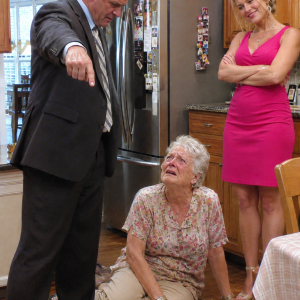
Raymond nodded slowly.
Judith wiped her eyes.
Brandon looked exhausted.
I continued by offering to help his parents search for an affordable apartment, provided they disclosed the necessary information and handled their own financial obligations honestly.
Raymond thanked me immediately.
Judith struggled to speak.
Eventually, she apologized for treating my belongings as though they no longer belonged to me.
I accepted that she’d said the words, but I wasn’t ready to pretend the previous week hadn’t happened.
The following morning, Brandon found me drinking coffee on the back porch.
He sat beside me without speaking for several minutes.
Then he apologized.
“I was wrong to make that promise without consulting you, and I was even more wrong to expect you to accept it simply because my mother wanted something.”
I asked whether he understood why I’d contacted an attorney.
He nodded.
“You needed someone to confirm that your rights mattered because I wasn’t behaving like a partner who respected them.”
That answer was more meaningful than any apology he’d offered during our marriage.
I told him that the problem extended beyond the house.
For years, Judith had criticized me while Brandon dismissed her comments as harmless.
His desire to avoid disappointing his mother had repeatedly become permission to disappoint his wife.
“I love you, Brandon, but I cannot build a marriage with someone who treats my consent as an inconvenience whenever his mother wants something.”
He admitted that he’d never considered how deeply his behavior affected me.
I told him that understanding was only the beginning.
If our marriage was going to continue, he would need to demonstrate genuine changes.
We agreed to seek marriage counseling.
Then I handed him a box containing the wedding china his mother had packed.
“You can begin by putting everything back where it belongs, and please make sure every plate returns to the correct cabinet.”
He accepted the box without protesting.
Watching him return my belongings didn’t solve our marriage.
But it was the first time he’d taken responsibility for something he’d previously expected me to endure quietly.
Chapter 7 — Finding a Home Without Taking Mine

During the following two weeks, Raymond and I visited several rental communities around Columbus.
He carefully compared monthly costs, transportation access, and the practical needs of two retired adults.
Eventually, we found a comfortable two-bedroom apartment near a neighborhood shopping center.
It had generous natural light, an accessible entrance, and enough space for their furniture.
More importantly, the monthly rent fit a realistic budget that Raymond had reviewed himself.
Before signing the lease, he read every section and asked the property manager to explain the terms he didn’t understand.
“I should have been asking these questions from the beginning, Lauren. You’ve reminded me that avoiding a difficult conversation never makes the problem disappear.”
Judith was quieter during the move.
One afternoon, while we were packing dishes from her old apartment, she stopped beside me.
“I’ve treated you unfairly for years, Lauren. I convinced myself that criticizing you made me a protective mother, but I was really refusing to respect my son’s marriage.”
She looked genuinely embarrassed.
“I’m sorry for trying to take your home and for making you feel unwelcome in this family.”
I appreciated her honesty.
I also explained that rebuilding trust would require consistent respect, not merely one emotional conversation.
She agreed.
Meanwhile, Brandon and I began attending marriage counseling.
During one session, he admitted that he’d spent much of his life believing disagreement with his mother was equivalent to abandoning her.
Our counselor asked what happened when his mother’s wishes conflicted with mine.
Brandon looked at me.
“I usually expected Lauren to compromise because I knew she was more willing to listen than my mother.”
The admission was painful but important.
“So instead of disappointing your mother, you repeatedly chose to disappoint your wife,” I answered.
He nodded.
Our relationship didn’t improve immediately.
But he began asking questions, sharing decisions, and accepting that protecting our marriage required boundaries with his parents.
For the first time, I could see the possibility of genuine change.
Chapter 8 — The Curtains That Made Everyone Laugh
Three months later, Judith and Raymond invited us to dinner at their new apartment.
The rooms were comfortable, the kitchen was bright, and Raymond appeared more relaxed than I’d seen him in years.
Judith had arranged her furniture beautifully without borrowing against our home or demanding that anyone surrender their property.
As I entered the living room, something caught my attention.
Gray blackout curtains hung neatly beside the windows.
They looked remarkably similar to the ones she’d repeatedly criticized in my house.
I turned toward her with a smile.
“Judith, those curtains look familiar. I thought you said gray window coverings made a living room feel gloomy.”
She laughed.
“Apparently, I’ve discovered that your decorating advice is considerably better than I once believed.”
Raymond smiled, and Brandon laughed beside me.
Later, Judith raised her glass.
“I’d like to thank Lauren for insisting that we face the truth, even when the rest of us were determined to avoid it.”
Raymond added that the apartment had given them a fresh beginning without damaging their son’s marriage.
Driving home that evening, Brandon reached for my hand.
“Thank you for giving us a chance to rebuild what I nearly destroyed.”
I looked at him thoughtfully.
“I’m willing to keep working on our marriage, Brandon, but I expect us to make important decisions together from now on.”
He promised that he understood.
I wanted to believe him, and his actions over the previous months had given me reasons to hope.
When we reached home, I stood briefly on the porch, looking toward the garden we’d restored together.
The house was still ours.
Our marriage was still a work in progress.
And the blue folder containing the deed, legal advice, and lease information remained safely inside my office drawer.
I didn’t keep it because I expected another confrontation.
I kept it because the experience had taught me that boundaries were easier to protect when supported by facts.
My husband once believed that promising our house to his parents made the decision final, but a few carefully chosen questions proved that love never gives anyone the right to make another person’s choices.
THE END