“If your account is accurate, we’ll suspend this transaction immediately and refer the entire file to our legal department.”
She left after obtaining Susan’s contact details.
Derek struck the gate and threatened to make me regret interfering.
I returned to the locked office and called the authorities.
When a deputy arrived, I provided messages and security footage.
There was no dramatic arrest that evening, only a formal report and the beginning of an investigation I intended to see through.
Part 6 — Eight Months of Evidence and Consequences
The following months brought more paperwork than I’d handled during eight years managing Dad’s business records.
The lender conducted a fraud investigation, and an independent document examination identified significant evidence that the loan signatures had been forged.
My credit dispute remained active while the financial institution reviewed its underwriting records.
Meanwhile, investigators traced the money received by Derek’s company.
Some payments had gone toward Trevor’s restaurant suppliers, others toward Barbara’s personal bills and Derek’s expensive pickup truck.
Part of Hillcrest’s deposit had even been used to service the disputed loan.
Trevor maintained that he’d never understood where the money originated.
Investigators reviewed his business records rather than accepting or rejecting that explanation without evidence.
Derek alternated between begging for reconciliation and threatening that exposing the scheme would devastate his mother.
He offered to assume responsibility for the $250,000 loan if I withdrew my complaints.
I refused to acknowledge a debt created through misuse of my identity.
Susan reminded me that financial disputes, divorce proceedings, and possible criminal charges were separate legal matters.
I filed for divorce and preserved every threatening message.
Eight months after the funeral, the fraudulent debt was finally removed from my credit records.
Our divorce was completed.
The financial investigation had advanced to prosecutors for consideration of identity theft and fraud charges against Derek.
Hillcrest pursued recovery of its $75,000 deposit through legal action.
Trevor’s restaurant filed for bankruptcy and closed permanently, while Barbara sold her existing home to address her debts.
The luxury house she’d planned to purchase never became hers.
I didn’t celebrate those outcomes.
I’d lost my father, my marriage, and the belief that the person sleeping beside me had ever respected my independence.
But I’d kept the property Dad had spent forty years developing.
More importantly, I’d stopped allowing other people to decide what I owed them simply because we were related.
One morning, Susan handed me the final documents confirming my authority over the remaining estate assets.
“Your father took extraordinary care to preserve these records, Olivia, but you’re the person who chose to act when the evidence revealed what was happening.”
I looked at his signature.
For the first time since the funeral, I could think about the future without imagining Derek standing beside me demanding a share of it.
Part 7 — Building Something They Couldn’t Take Away

Hillcrest eventually approached me about negotiating directly for the property.
Its representatives were still interested in the location, but I wasn’t interested in selling my father’s entire life’s work.
After consulting an architect, local business owners, and my accountant, I decided to sell only a narrow strip of road-facing land.
The proceeds helped finance improvements to the repair facilities while preserving the main acreage.
Working alongside our longtime neighbor, Patricia Owens, who owned an auto-parts store across the road, I developed a plan for six independent repair bays.
We also established a practical automotive training center for young people interested in becoming skilled mechanics.
Securing environmental permits, ventilation improvements, and construction approvals took months.
The opening day was far from perfect.
An aging air compressor stopped working just as our first students arrived, forcing the instructors to borrow equipment from another workshop.
Then a nineteen-year-old girl named Grace walked through the entrance wearing a faded denim jacket.
“Do you accept women in the training program? Somebody told me this place teaches people who haven’t had an opportunity to learn professionally.”
I smiled.
“We accept anyone willing to work hard and learn the trade, Grace. Engines don’t care whether the person repairing them is a man or a woman.”
Within a week, she diagnosed an electrical problem that had frustrated several older students.
Watching her confidence grow reminded me of Dad’s belief that practical knowledge was a form of independence nobody could steal.
The workshop began providing affordable space to local mechanics, while the training center offered a path toward stable employment.
I placed Dad’s old red toolbox on the instructor’s table.
Inside its lid, he’d scratched a sentence decades earlier.
What you learn to build with your mind and hands can never truly be taken away.
I ran my fingers across the uneven lettering.
Dad had left me valuable land.
But he’d also left something worth considerably more: the confidence to decide what that land should become.
Part 8 — The Inheritance My Father Actually Wanted Me to Have
On the afternoon we installed the dedication plaque for the Harold Bennett Automotive Training Center, I stood outside the workshop watching students move between the newly equipped repair bays.
The familiar sounds of tools, engines, and conversation filled the building.
For a moment, I imagined Dad walking around the corner with his coffee mug, checking whether everybody had remembered to organize their equipment.
I still missed him every morning.
I sometimes missed the husband I thought Derek had been, too.
But I no longer confused missing somebody with wanting that person back.
Derek eventually sent a handwritten apology through our attorneys.
I chose not to open it.
I understood that financial desperation could make people frightened, but it didn’t excuse using someone else’s identity, forging documents, or attempting to steal an inheritance.
Some acquaintances suggested I’d been unnecessarily harsh.
They believed I should have settled privately to spare Derek’s family public embarrassment.
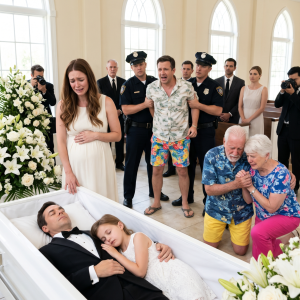
Whenever those comments unsettled me, I remembered his fingers tightening around my wrist beside Dad’s coffin.
I remembered the forged signature and the recording in which he confidently predicted I’d sign anything he placed before me.
Most of all, I remembered my father’s words.
He hadn’t wanted me to seek revenge.
He’d wanted me to know the truth before deciding my own future.
That afternoon, Grace approached me with an application from another young woman interested in joining the next training group.
I accepted it and walked back into the workshop.
My inheritance hadn’t purchased Barbara’s mansion or rescued Trevor’s failing restaurant.
Instead, it was helping people learn a trade, supporting local businesses, and preserving the work Dad had loved.
My husband believed my father’s death would make his family wealthy, but the evidence Dad left behind protected everything he’d built. In the end, the greatest inheritance wasn’t the land worth millions of dollars; it was the freedom to decide that nobody would ever again use my trust as permission to control my life.
THE END