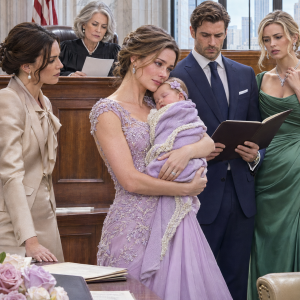
Margaret remained behind, furious that I had embarrassed her son in front of his supervisor.
When she finished complaining, I asked whether any court correspondence addressed to me had arrived at her house.
Her face changed immediately.
“I have absolutely no idea what you’re suggesting, and I think your exhausting job has finally affected your judgment.”
Ethan quickly encouraged her to leave.
Once we were alone, he began questioning me about the bank appointment.
I told him the inheritance required an attorney and considerable paperwork.
He offered to handle everything himself.
For the first time in our marriage, I declined without explaining why.
That night, I slept in the guest bedroom, listening to Ethan moving through the house.
The next morning, after he left for the gym, I packed my important documents and checked into a hotel.
Then I called a divorce attorney.
Part 4: The House He Had Already Taken
My attorney, Rebecca Hayes, was a family-law specialist in her early fifties with an office in Minneapolis.
She examined the divorce judgment for nearly twenty minutes before speaking.
“Someone represented to the court that you voluntarily participated in these proceedings, although your account suggests you never received proper notice.”
She explained that we needed to examine the signatures, service documents, financial disclosures, and property records before seeking relief.
Together, we discovered an even more disturbing transaction.
Two months after the supposed divorce, a quitclaim deed had transferred my ownership interest in our house entirely to Ethan.
The signature on that deed contained the same incorrectly written capital N.
I had never signed it.
“The recorded deed makes Ethan appear to be the sole owner, but we can challenge its validity using the evidence you’ve brought me.”
Rebecca continued searching the property records.
A title inquiry suggested Ethan was preparing a cash-out mortgage refinancing.
The proposed new loan totaled approximately $410,000, while the existing mortgage balance was around $290,000.
The transaction could potentially release approximately $120,000 in equity before closing costs and other adjustments.
I stared at the figures.
“I’ve paid almost every mortgage installment for five years, and he’s preparing to withdraw the equity while pretending the house belongs only to him.”
Rebecca began preparing the appropriate court filings to challenge the divorce judgment and protect the disputed property.
Then she uncovered a financial transaction Ethan had never disclosed.
His software company had been acquired by a larger corporation the previous September.
Ethan received approximately $386,000 from employee stock benefits connected to the acquisition.
He deposited the money into an account I had never seen.
Two months later, Margaret purchased a condominium for $240,000 in cash.
The timing raised questions that required bank records and further investigation.
I remembered Ethan repeatedly claiming that his commissions were delayed while I paid our household expenses.
“We need to trace where that money went and determine whether the transactions were designed to conceal assets or defeat your financial claims,” Rebecca explained.
She sought court protection against further property transfers and recommended referring the suspected document fraud to investigators.
I agreed.
That evening, alone in my hotel room, I finally opened a letter my uncle had left with his estate attorney.
He described a summer when I was twelve years old and spent a week at his transportation warehouse.
While reviewing inventory sheets, I discovered forty-one missing tires that experienced employees had repeatedly overlooked.
My uncle investigated and uncovered a long-running theft scheme.
In his letter, he explained that he had never forgotten my refusal to accept numbers simply because an adult told me they were correct.
“Never allow anyone to count your life for you, Natalie, because the truth deserves to be checked even when everybody insists the numbers are right.”
I cried for nearly an hour after reading those words.
For years, I had trusted Ethan’s financial explanations without checking them.
My uncle had left me a fortune, but his most valuable gift was reminding me who I had been before my marriage.
Part 5: The Woman Who Copied My Signature

Ethan called repeatedly after discovering that I had left home.
Eventually, I answered and asked him a single question.
“Who is Martin Wells, Ethan, and why does his name appear as the attorney who handled our divorce last year?”
The silence lasted several seconds.
Then Ethan began claiming that I had misunderstood an administrative arrangement intended to protect our assets.
He said his mother had suggested temporarily separating property interests because of potential business liabilities.
“It was only paperwork, Natalie, and I was trying to make sure you wouldn’t lose everything if something happened to my career.”
I reminded him that a judge had signed an actual divorce judgment.
Then I described the forged signatures and the hospital records proving that I could not have appeared before the notary.
“Who wrote my name on those documents while I was lying in a hospital bed, Ethan?”
He initially denied knowing anything.
When I repeated the question, his voice became almost inaudible.
“Please don’t destroy my mother’s life over something she believed she was doing to help us.”
That sentence told me more than all his previous explanations.
Margaret had spent years practicing decorative handwriting through community calligraphy classes.
Her handwriting was elegant, carefully structured, and completely different from mine.
Rebecca arranged for the relevant documents and handwriting samples to be examined through the legal process.
Investigators subsequently questioned Helen Morris, the notary who had certified the disputed settlement.
Helen acknowledged that Margaret had brought documents bearing my supposed signature and claimed I was too ill to attend personally.
Helen had accepted that explanation without following the required identification and witnessing procedures.
Her admission helped establish how the fraudulent paperwork had entered the legal system.
Meanwhile, Rebecca informed me that the pending refinancing could no longer proceed as planned while the ownership dispute remained unresolved.
For the first time, Ethan could not simply move money or property without scrutiny.
Then his behavior changed dramatically.
Through his new attorney, he requested a private settlement meeting.
He arrived wearing his finest suit, looking exhausted and unusually emotional.
“I made a terrible mistake, Natalie, but I still love you, and I want us to repair what happened between us.”
His attorney proposed cooperating to undo the original divorce judgment, followed by marital counseling and reconciliation.
I understood the timing immediately.
Margaret had learned the actual value of my inheritance after speaking with my mother.
Ethan now knew about the fifty million dollars.
Nine months earlier, he had secretly divorced me to protect money he concealed from me.
Now he wanted our marriage restored after discovering I had inherited a fortune.
“You wanted to be divorced when you received your company money, but now you want to remain married because I’ve inherited fifty million dollars.”
Ethan insisted that reconciliation was about love rather than money.
I told him that setting aside a fraudulent judgment did not mean I would resume our relationship or place inherited assets under his control.
“I intend to correct the court record, recover my property rights, and then end this marriage through an honest legal process.”
His attorney attempted another argument, but Rebecca calmly ended the meeting.
Whatever financial strategy Ethan had imagined, I would no longer participate in it.
Part 6: The Courtroom And The Wrong Letter N
The hearing challenging the divorce judgment took place several months later at the Hennepin County courthouse.
Judge Eleanor Whitmore presided over proceedings that would determine whether the original judgment had been obtained through fraud.
Ethan sat beside his attorney, visibly thinner than I remembered.
Margaret occupied the second row with her own lawyer, clutching her handbag against her chest.
Rebecca first introduced certified hospital records confirming that I had been admitted with pneumonia on June 11 and discharged on June 16.
A nurse who cared for me testified about my condition on June 14.
She remembered repeatedly reminding me to rest because I kept asking for my laptop to monitor inventory deliveries.
The testimony established that I remained hospitalized during the alleged notarization.
Next came the forensic document examiner.
He displayed my authentic signature beside the signature on the settlement agreement.
The difference was immediately apparent.
“The questioned signature resembles a deliberate imitation, but the letter formation and writing movements are inconsistent with the verified examples.”
He highlighted the capital N.
My authentic signature contained a continuous connecting movement and a distinctive lower hook.
The disputed signature was constructed through separate strokes.
Then he displayed samples of Margaret’s handwriting, which investigators had obtained for comparison.
Several characteristics corresponded with the disputed signatures.
Helen Morris testified about notarizing documents without witnessing me sign them.
She acknowledged that Margaret had personally delivered the paperwork and assured her everything was legitimate.