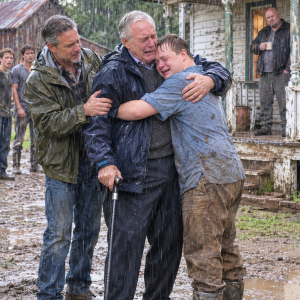
Part 1 — The Morning I Found My Son in the Doghouse
I returned from a twenty-three-day trucking assignment six days earlier than expected and discovered my eight-year-old son curled inside our dog’s wooden shelter, shivering in temperatures below freezing.
It was 5:40 on a bitter October morning outside Bozeman, Montana, where the thermometer registered twenty-eight degrees Fahrenheit.
My name is Grant Holloway, and at forty-two, I had spent years driving refrigerated tractor-trailers between the Midwest and the Pacific Northwest.
Until that morning, I believed providing financial security was the most important responsibility I could fulfill as a father.
My first wife, Emily, died from cancer four years earlier, when our son, Owen, was only four.
After her death, our little family consisted of Owen, me, and Ranger, Emily’s aging German Shepherd.
Ranger was eleven and suffered from painful hip problems, but he remained devoted to the boy he had watched grow up.
Two years earlier, I met Brianna, a woman who initially seemed patient with our grief and understanding about my demanding work schedule.
She bought Owen coloring books, prepared his favorite baked macaroni, and repeatedly assured me she would never try to replace Emily.
I married her believing Owen would finally have another dependable adult at home.
That morning, however, Ranger’s frantic barking drew me toward the old ponderosa pine beside our backyard fence.
The dog lay across the entrance to his wooden shelter, frost coating the fur along his back.
“Easy, Ranger, it’s only me, and I’ve finally made it home.”
He moved aside reluctantly.
Behind him lay a small pillow, several old sacks, and my son wearing thin pajama pants and a short-sleeved shirt.
Owen’s bare feet were pale from the cold.
When I touched his shoulder, he recoiled before recognizing me.
“I’m sorry, Daddy, but I couldn’t get to the bathroom, and I promise I didn’t wet the bed on purpose.”
I lifted him into my arms, feeling his body tremble against my chest.
Whatever had happened, I knew immediately that my marriage could never return to what it had been.
Part 2 — The Explanation That Destroyed My Marriage
I carried Owen toward the kitchen door while Ranger limped painfully behind us.
Brianna eventually appeared wearing my oversized sweatshirt, looking more irritated by the noise than concerned about the freezing child in my arms.
“You’re home already? You could have called before turning up in the middle of the night.”
I barely recognized my own voice when I asked why Owen had been sleeping outside.
She glanced at his trembling body.
“He wet his bed again, Grant, and I’ve had enough of washing sheets because he refuses to learn basic discipline.”
I stared at her.
“You put an eight-year-old child outside in freezing weather because he had an accident while sleeping?”
Brianna folded her arms.
“If the dog can sleep outside, Owen can learn to do the same, especially when you’re never here to teach him consequences.”
Owen buried his face against my neck.
I wanted to shout, but I could feel how frightened and cold he remained.
Instead, I told Brianna to move aside.
Inside, I gradually warmed Owen, helped him change into dry clothes, and wrapped him in thick blankets.
I prepared warm oatmeal and cocoa, then arranged an urgent pediatric appointment.
Once he stopped shaking, I returned to the backyard with a terrible suspicion.
Months earlier, I had installed a motion-activated trail camera on the ponderosa pine after discovering coyote tracks near our fence.
Its lens faced Ranger’s shelter.
Brianna had apparently forgotten the camera existed.
I removed its memory card and opened the files on my laptop.
The first images showed Owen crossing the dark yard carrying his pillow.
Later photographs captured him dragging a thin blanket toward the doghouse while Ranger followed.
One image showed Brianna standing at the kitchen doorway, pointing toward the shelter.
I checked the timestamps.
The first incident occurred twenty-two days earlier, shortly after I left for my trucking assignment.
The photographs documented Owen outside on twenty-two separate nights.
Then I heard quiet footsteps behind me.
Owen looked at the screen and gripped my wrist.
“Daddy, are you going to tell Brianna you found out?”
I asked why that frightened him.
“She said she’d send me where Mommy went if I told you, and Ranger wouldn’t be allowed to come with me.”
Part 3 — The Promise I Could Actually Keep

I knelt in front of Owen, fighting the urge to make promises no parent could guarantee.
For nearly a month, I had believed my son was sleeping safely at home.
Now I understood how little I actually knew about his daily life.
“You won’t be alone with Brianna today, Owen, and I’m going to listen carefully and get the help we need.”
He nodded without releasing my hand.
I called my mother, Patricia Holloway, who lived in Livingston, less than an hour away.
She arrived quickly, bringing thick wool socks and the steady reassurance Owen desperately needed.
At the pediatric clinic, the doctor found redness and irritation on his feet consistent with cold exposure, although fortunately there was no serious injury requiring hospitalization.
She advised continued warming, medical observation, and psychological support.
When she asked when Owen’s nighttime accidents had begun, I couldn’t answer.
That admission embarrassed me more than anything I had ever experienced professionally.
Owen explained that Brianna sometimes locked the back door after ordering him outside.
On other nights, she forced him into the yard immediately after discovering wet bedding.
Ranger always followed.
The doctor treated his account seriously without pressing him for unnecessary details.
Afterward, I contacted child protective services and filed reports with the county sheriff’s office.
I preserved the original camera files, made separate backups, photographed the doghouse, and recorded the relevant dates.
A social worker explained that a trained child interviewer should speak with Owen so he wouldn’t have to repeatedly recount frightening experiences.
Brianna began sending messages demanding to know why I was involving outsiders.
“You’re making this ridiculous, Grant, and you know Owen exaggerates whenever he thinks someone might feel sorry for him.”
I preserved those messages too.
That evening, Owen’s third-grade teacher told me he had frequently fallen asleep during lessons and twice arrived wearing soaked shoes.
She had contacted Brianna, whom I had listed as his emergency contact during my trips.
Brianna repeatedly claimed that Owen suffered from seasonal allergies and that I already knew about his condition.
I hadn’t known anything.
The realization that my son’s distress had been hidden in plain sight left me devastated.
Part 4 — The Money That Was Supposed to Protect My Son
After Owen fell asleep at Patricia’s house, I opened the bank statements for the account containing his Social Security survivor benefits.
Emily had worked and paid Social Security taxes before her death, so Owen received approximately fourteen hundred dollars each month.
I managed those benefits as his representative payee.
Brianna had access to a secondary debit card because I trusted her to purchase Owen’s school supplies, clothing, and medical necessities while I was away.
My trucking wages covered our other household expenses.
Related Posts
“Your Children Aren’t Welcome This Summer,” My Mother Told Me, Because My Sister Needed Our Beach House to Impress Her Wealthy In-Laws. I Didn’t Argue, But When Three Black SUVs Pulled Into the Driveway That Saturday Morning, My Sister Was About to Discover Why She Should Never Have Mistaken My Silence for Weakness. And Neither of Them Knew the Secret Behind That House Was Far More Serious Than a Family Disagreement…
My Mother-in-Law Arrived to Spend Time With Her Grandchildren, Unaware Her Son Had Left Our Family for Another Woman. But When My Eight-Year-Old Said, “Daddy Doesn’t Sleep Here Anymore,” Grandma’s Smile Faded—Then She Turned Her Phone Toward Me, and I Saw the Message He’d Sent Her…
The Night Before My Heart Surgery, I Heard My Surgeon Husband Raise A Glass At His Private Party And Say, “That $350 Million Will Soon Be Mine”—So I Secretly Started Recording, But When He Mentioned The Name Tied To My Parents’ Plane Crash, I Leaned Closer And Heard The One Thing He Never Meant Me To Know
At 2:13 A.M., I Found My Husband Weeping Beside the Baby We Had Just Adopted—Then His Mother Whispered That the Little Girl’s “Real Mom” Was Closer Than I Thought, and the Ultrasound Hidden on His Phone Made Me Ask the One Question He Wasn’t Ready to Answer