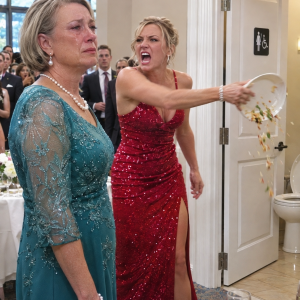
When I returned to the living room, Patricia was angrily gathering her containers.
Then she grabbed the restaurant bags.
“We’re taking the lobster and steak since nobody here seems interested in treating us like family!”
I glanced at the food.
“Take it, Patricia. But the wedding money used to pay for it will be included when our finances are reviewed.”
She turned away furiously.
Then she called her younger sister, Linda, who lived near Fort Collins.
PART 7 — THE RELATIVE WHO REFUSED TO FUND THEIR PLAN

Patricia placed her telephone on speaker.
“Linda, Brandon and I need somewhere to stay for a few weeks. Allison and her father have decided to throw us out.”
Her sister sounded confused.
“Didn’t Brandon get married yesterday? Why would you already need to move in with me?”
Patricia began complaining that wealthy people lacked compassion.
Linda interrupted.
“You can stay temporarily if there’s room, but you’ll have to help pay for groceries, utilities, and any additional expenses.”
Patricia looked offended.
“I’m your older sister! I can’t believe you’d demand money when I need family support!”
Linda remained firm.
“You’re both capable of working, Patricia. I can’t afford to support two adults who voluntarily resigned from their jobs.”
The conversation ended shortly afterward.
Brandon closed his eyes.
Patricia stared at the phone as though her sister had personally betrayed her.
For the first time, she appeared to realize that other relatives wouldn’t necessarily accept the arrangement she’d imagined.
Brandon collected his suitcase.
Before leaving, he turned toward me.
“Are you seriously going to destroy everything we’ve built because Mom and I made one mistake?”
I took a steady breath.
“I’m not destroying our future, Brandon. I’m refusing to build it on a lie you decided I didn’t deserve to know about.”
Eventually, Brandon and Patricia left voluntarily.
Dad waited until the apartment became quiet.
Then he placed a hand on my shoulder.
The anger I’d been suppressing finally collapsed into grief.
I cried for my wedding dress, the plans we’d shared, and the two years I’d spent believing I knew the man I’d married.
“I feel humiliated, Dad. Everyone celebrated our marriage yesterday, and now I’m leaving it behind.”
He embraced me.
“The shame belongs to those who deliberately deceived you, Allison. Protecting yourself isn’t something you should apologize for.”
That night, I returned with Dad to my parents’ home outside Colorado Springs.
Mom welcomed me without asking uncomfortable questions.
She simply held me before preparing chamomile tea.
I slept in my childhood bedroom, surrounded by university certificates and awards from programming competitions.
Those familiar reminders helped me remember that I’d built an identity long before Brandon entered my life.
The pain remained the following morning.
But the feeling of being trapped had disappeared.
PART 8 — THE MARRIAGE I ENDED AND THE LIFE I CHOSE INSTEAD
The next morning, I contacted a Colorado family-law attorney.
I explained everything that had happened, including the secret resignations and Patricia’s admission that the plan had begun two months before our wedding.
My attorney discussed the possibility of an annulment based on alleged fraud.
She explained that annulment involved specific legal requirements and that an unhappy marriage alone wouldn’t justify the remedy.
We reviewed whether Brandon’s concealed intentions had materially affected my decision to marry him.
Both Brandon and Patricia had acknowledged delaying their resignations because they feared I might cancel the wedding if I learned the truth beforehand.
Those admissions became important evidence during the proceedings.
Meanwhile, Brandon continued calling.
At first, he accused me of overreacting.
Then he sent apologies and promises to change.
Eventually, his messages turned into negotiations.
Allison, Mom knows she made a mistake. We can rebuild everything if your father helps with the apartment for another six months.
I stared at the message.
Even while pleading for reconciliation, Brandon continued treating my father’s financial assistance as the necessary foundation of our marriage.
I sent one final response.
When you understand that marriage requires honesty and shared responsibility rather than access to another family’s money, you’ll understand why I left.
Then I stopped responding directly.
The legal proceedings were resolved relatively quickly because of our extremely brief marriage and the documented circumstances surrounding Brandon’s concealed intentions.
The court ultimately granted the requested annulment based on the evidence presented.
I felt relieved.
But relief didn’t erase the grief of discovering that someone I’d loved had entered marriage with expectations he deliberately concealed.
Through Linda, I later learned that Brandon returned to automobile sales at a smaller dealership near Fort Collins.
Patricia found part-time employment as a supermarket cashier after discovering that her relatives wouldn’t provide permanent free housing.
I didn’t celebrate their difficulties.
They were adults rebuilding circumstances they’d voluntarily abandoned.
My only concern was ensuring that their choices no longer controlled my future.
Six months after the wedding, I purchased a beautiful one-bedroom condominium near Denver’s technology corridor.
I used my savings, strong credit history, and the income I’d earned through years of software engineering.
Dad offered to help furnish the apartment.
I thanked him and declined.
“I want to choose and pay for every chair, lamp, and piece of furniture myself, Dad. This home represents the life I’ve built.”
He smiled.
“That’s exactly the independence your mother and I always hoped you’d carry into adulthood.”
On my first evening in the condominium, the rooms were almost empty.
I sat on the polished wooden floor with a pepperoni pizza and a cold drink, watching the city lights appear beyond the windows.
I thought about the first morning of my marriage.
Brandon had believed a wedding certificate entitled him to stop working and claim the rewards of another man’s decades of labor.
Patricia had expected Dad to provide housing, transportation, holidays, and permanent financial security simply because our families were connected through marriage.
Neither had considered asking what I wanted.
Now nobody could make those decisions for me.
Some friends later asked whether I regretted ending a marriage so quickly.
I always gave the same answer.
“I’d rather explain why my marriage ended after one day than spend the rest of my life explaining why I surrendered my independence to people who planned to exploit it.”
I still believed in marriage.
I still believed spouses should support one another through illness, unemployment, and unexpected hardship.
But genuine support required informed agreement, honesty, and shared responsibility.
It couldn’t exist when one person deliberately planned to stop contributing while expecting the other to carry every financial burden.
I hadn’t objected to Brandon wanting a new career.
I would’ve helped him consider legitimate opportunities if he’d included me in the decision.
I might even have supported additional education or a carefully planned transition.
But he’d never offered me that choice.
Instead, he waited until we were legally married before revealing that he and Patricia expected my father and me to finance their new lifestyle.
They assumed I would remain silent because leaving so soon after the wedding would be embarrassing.
They were wrong.
I looked around my quiet condominium.
The walls were bare.
The furniture hadn’t arrived.
And there was no expensive dining table covered with demands I hadn’t agreed to satisfy.
But the emptiness didn’t frighten me.
For the first time since our wedding, every decision about my future belonged to me.
I could choose how to spend my income.
I could decide when to buy furniture.
I could continue developing my software engineering career without someone treating my achievements as a convenient source of money.
And if I eventually married again, I would know the importance of choosing a partner who respected honesty and mutual responsibility.
Brandon had believed marriage would provide financial freedom without requiring him to contribute.
But he’d confused partnership with entitlement.
Patricia had believed joining a wealthy family meant she no longer needed to support herself.
But she’d confused generosity with an obligation that nobody had agreed to accept.
I hadn’t abandoned my future when I left their apartment.
I’d protected it.
My marriage lasted only one day because my husband revealed a plan he’d hidden for two months.
But ending that marriage allowed me to protect the independent life I’d spent years building.
And until I found someone who genuinely valued partnership, I was perfectly capable of creating a beautiful future on my own.
THE END