PART 1 — THE WOMAN MY HUSBAND BROUGHT TO MY MOTHER’S FUNERAL
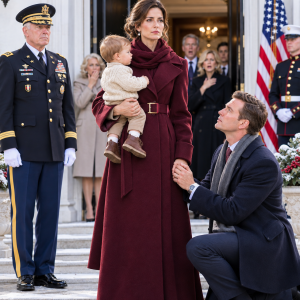
On the morning we laid my mother to rest, my husband arrived at her funeral with another woman on his arm.
He apparently believed my grief would prevent me from asking why she’d come.
My name is Caroline Lawson, and I’d spent the previous forty-eight hours struggling to comprehend that the woman who raised me was gone.
Mother had lived for forty-one years in a beautiful three-story Victorian house on a quiet street in Charleston, South Carolina.
Every room contained memories of her.
There was the brass bowl where she dropped her keys, the staircase lined with family photographs, and the porch light she always left burning whenever I visited late.
But my husband, Nathan Lawson, seemed more interested in the property than in the woman we’d lost.
That morning, while I stood in Mother’s kitchen preparing for the funeral, he asked whether she’d completed the documents concerning the house.
“Caroline, I know you’re grieving, but somebody has to deal with the property before the paperwork becomes complicated.”
I stared at him.
“My mother died two days ago, Nathan. You’ve asked about her house three times since yesterday.”
He insisted he was only trying to help.
I didn’t have the energy to argue.
At the funeral home, my younger brother Matthew stood near the refreshments while relatives shared stories about Mother’s kindness.
Then Nathan entered with a blonde woman wearing an elegant cream coat.
I recognized her immediately.
Vanessa Collins.
Two months earlier, I’d discovered a restaurant receipt bearing her name inside Nathan’s car.
He’d claimed she worked for one of his business clients.
Now his hand rested comfortably against her back.
“Caroline, this is Vanessa. She’s a friend who’s been helping me with some business matters.”
Vanessa extended her hand.
“I’m terribly sorry for your loss, Caroline. I hope you know how much everyone cares about your family.”
I shook her hand.
Then I leaned close enough that only she could hear me.
“Enjoy the house, Vanessa. I hope it gives you everything you’ve been expecting.”
She laughed quietly, apparently assuming grief had made me irrational.
Nathan looked embarrassed.
But just before he introduced her, I’d noticed a message preview on his phone.
It mentioned real estate documents.
The message was timestamped 9:17 that morning.
Later, during the reception, I overheard Vanessa asking Nathan whether I’d agreed to sign.
He assured her they’d handle everything on Monday.
I continued walking without confronting them.
I’d spent years working as an insurance claims adjuster, and experience had taught me that dates, documents, and careless conversations often revealed more than emotional arguments.
I intended to discover exactly what my husband wanted me to sign.
PART 2 — THE BLUE FOLDER MY MOTHER LEFT BEHIND
The following morning, I returned alone to Mother’s house before Nathan woke.
Her study still carried the faint scent of cedarwood and lavender hand cream.
For several minutes, I stood beside the desk where she’d written birthday cards and holiday letters for decades.
Then I opened the filing cabinet.
Mother had preserved nearly every important record connected to the property.
Insurance renewals.
Repair invoices.
Property-tax notices.
Renovation documents.
Deep inside the second drawer, I discovered a blue folder labeled with my name.
Inside was a copy of the property deed.
Mother was listed as the sole owner.
The insurance documents confirmed the same arrangement.
Beneath them lay a handwritten message dated six months earlier.
Caroline, don’t sign anything until Mr. Harrison has reviewed it.
Robert Harrison was Mother’s longtime estate attorney.
I read the note several times.
What had she known that I didn’t?
The next document was a proposed property-management authorization.
Its language granted broad powers involving contractors, insurance matters, prospective buyers, and certain real estate transactions.
The signature line intended for me remained blank.
Less than an hour later, Nathan arrived carrying a thin folder.
He placed it on Mother’s desk with an expression of practiced patience.
“These documents will allow me to handle the insurance and necessary repairs, Caroline. You won’t have to worry about every little decision.”
I opened his folder.
The language closely resembled the document I’d just discovered.
But this version explicitly authorized negotiations with potential buyers.
“Why would an insurance authorization give you permission to negotiate a sale when nobody has decided to sell the house?”
Nathan sighed.
“You’re overwhelmed by grief. I’m trying to make things easier, but you’re turning a simple arrangement into something unnecessarily complicated.”
I closed the folder.
“Mr. Harrison handled Mother’s estate planning. I’ll have him review everything before I sign.”
Nathan’s expression tightened.
He complained that attorneys charged excessive fees.
Then he collected the documents and left.
Once his car disappeared, I continued examining Mother’s records.
A property valuation estimated the Victorian house at approximately $1.3 million.
Another handwritten note described preparing the downstairs rooms for a future listing.
Two initials appeared at the bottom.
VC.
Vanessa Collins.
An insurance record showed that Nathan had been requesting information about Mother’s policy months before her death.
Yet he’d recently claimed she’d authorized him to manage the property in December.
Mother’s notes from January recorded a meeting with him.
They clearly stated that no agreement had been reached.
For the first time, I understood that Nathan’s interest in Mother’s house had begun long before the funeral.
PART 3 — THE THREAT DISGUISED AS AN OFFER TO HELP

That evening, Nathan came home unusually early.
He found me organizing property records on my laptop.
After asking whether I’d eaten, he immediately returned to the subject of the house.
I showed him the valuation document.
“Explain why Vanessa’s initials appear on paperwork preparing Mother’s property for sale when you told me she wasn’t involved.”
Nathan studied me for several seconds.
“Vanessa works in client services for a real estate company. She was simply helping me understand what the property might be worth.”
I reminded him that Mother had never authorized either of them to arrange a sale.
He leaned forward.
“Your mother owned an extremely valuable house, Caroline. Eventually, someone has to make responsible financial decisions about it.”
I asked whose responsibility he meant.
He argued that selling the property would benefit our marriage.
We could invest the proceeds and create a more comfortable future.
The confidence with which he discussed an inheritance that wasn’t his made me feel strangely cold.
Then he admitted something even more painful.
Mother had seen him with Vanessa the previous autumn.
She’d questioned their relationship.
Nathan claimed he’d dismissed her concerns.
“Your mother knew Vanessa and I were close. She understood that people sometimes need help managing complicated arrangements.”
I didn’t believe his attempt to turn Mother’s suspicions into approval.
Later, Matthew arrived with dinner.
I explained what I’d discovered.
Initially, he wondered whether Nathan had simply misunderstood Mother’s wishes.
I showed him the documents.
Then another folded page slipped from the blue folder.
It was a letter written by Robert Harrison two months before Mother’s death.
He’d recommended immediate revisions to her estate plan because of concerns about unauthorized property transactions.
Matthew’s expression changed.
“Mother knew Nathan was trying to control the house. She never told us how serious things had become.”
Before I could answer, my phone vibrated.
Nathan had sent a photograph of Mother’s house taken from across the street.
Beneath it was a message.
Related Posts
My Father’s Coffin Hadn’t Even Been Lowered Into The Ground When My Husband Started Discussing How My Inheritance Would Pay Off His Family’s Debts And Buy His Mother A $1.45 Million Mansion…
I Came Home a Day Early and Found My Exhausted Mother Cooking and Ironing Clothes While My Husband and His Mother Relaxed on the Couch. My 6-Year-Old Daughter Whispered, “Mommy, Grandma’s Hands Really Hurt.” I Didn’t Argue. I Canceled Their Credit Cards, Packed Our Things, and Took My Mother and Daughter to the Beautiful House Across the Street. The Next Morning, My Husband Threatened to Take Custody of Our Daughter—Until I Showed Him a Message From His Own Mother That He Never Knew I’d Read…
“Which Parent Do You Want to Live With?” the Judge Asked My 9-Year-Old Son. My Wealthy Husband Smiled, Certain He Would Win Custody of Our Twins After Using Nine Years of My Sacrifices Against Me in Court. But Instead of Answering, My Son Reached Inside His Jacket and Said, “Your Honor, There’s Something You Need to Hear First.” My Husband Suddenly Went Pale. In 12 Years of Marriage, I’d Never Seen Him So Afraid of Something So Small…

“Don’t Be Embarrassed If You Can’t Afford an Expensive Wedding Gift,” My Former Classmate Told Me, Inviting Me to Her Luxury Wedding After Nearly 20 Years of Looking Down on Me. I Smiled, Took the Day Off, and Showed Up. When She Proudly Introduced Her Wealthy Groom in Front of 200 Guests, He Suddenly Went Pale. I Glanced at His Silver Watch and Calmly Said One Sentence. What He Whispered to Me Moments Later Made Me Realize the Wedding Was the Least of His Secrets…