Chapter 1: The Phone Call That Changed Everything
At 3:20 on a Saturday morning in January, my phone rang while a winter storm swept through Duluth, Minnesota.
Snow covered the streets, the wind coming off Lake Superior rattled my apartment windows, and local authorities had warned residents to stay indoors.
My name is Maren Whitcomb. I spent eight years serving in the United States Army before returning home to work as a crane operator along the Duluth waterfront.
During my military service, I had learned to remain calm in difficult situations. But nothing could have prepared me for the voice on the other end of that phone call.
“Ms. Whitcomb? This is Sergeant Russell Hensley with the Duluth Police Department. We have your daughter here.”
I immediately sat up.
“Sadie? What happened? She’s supposed to be at her father’s house.”
The officer hesitated.
“Your nine-year-old daughter walked approximately three miles through the storm. She arrived pushing a shopping cart with two little boys inside.”
For a moment, I couldn’t understand what he was telling me.
“Two little boys? Is she hurt?”
“She’s extremely cold, but paramedics are taking care of her. She won’t explain where the children came from. She keeps asking for you.”
I was already pulling on my winter boots when he continued.
“There’s something else. She gave me an envelope she had hidden inside her shoe. I need you to come directly here.”
His voice became quieter.
“When you arrive, an officer will escort you into a private room. Please don’t contact anyone at your daughter’s father’s house yet.”
That final instruction frightened me more than anything else.
Chapter 2: The Question I Should Have Taken Seriously
My former husband, Everett Bellamy, and I had been divorced for nearly two years.
Because of my demanding work schedule and his more predictable office hours, Everett had been granted primary physical custody of Sadie. I had her on alternating weekends and during scheduled holidays.
He was recently engaged to a woman named Tessa Redmond, a well-known local real estate professional.
Tessa’s aunt, Beverly Redmond, had worked in county family services for thirty-one years before retiring. She was respected throughout the community, attended church regularly, and often spoke about helping disadvantaged children.
Everett and Tessa lived in a renovated farmhouse outside Duluth that belonged to Beverly.
I had never particularly liked Tessa, but I believed Sadie was safe there.
As I drove through the snowy streets, a conversation from the previous Sunday suddenly returned to me.
Sadie had been sitting in the back seat, holding her drawing book against her chest.
“Mom, can babies live in a basement?”
I glanced at her through the rearview mirror.
“What do you mean, sweetheart?”
“If you hear little kids crying under the floor, but nobody says there are kids in the house, should you tell someone?”
I had assumed she was talking about something from one of her mystery books.
“Maybe you heard the television or something outside. I’m sure there’s a reasonable explanation.”
“But what if there isn’t?”
I remembered telling her not to worry.
She hadn’t asked another question for the rest of the drive.
Now, with snow striking my windshield and my hands trembling against the steering wheel, I realized my daughter had been trying to tell me something important.
And I hadn’t listened.
Chapter 3: The Children Beneath the Winter Coat
When I arrived at the police station, Sergeant Hensley escorted me into a private interview room.
Sadie was sitting beside a paramedic, wrapped in warm blankets. Her cheeks were pale, her hair was damp, and she held a paper cup between her small hands.
The moment she saw me, her expression crumbled.
“Mom!”
I rushed forward and gathered her into my arms.
“I’m here, sweetheart. You’re safe now.”
She held on to me tightly.
“I didn’t know where else to take them.”
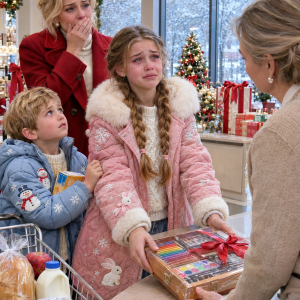
Beside her stood an old shopping cart with a damaged front wheel.
Inside were two little boys wearing matching dinosaur pajamas. Someone had wrapped them in thick blankets and covered them with a large gray winter coat.
They were exhausted, but they were safe.
“Where did you find them?” I asked gently.
Sadie looked toward the children.
“Downstairs, at Aunt Beverly’s house. I kept hearing them crying. Tessa told me it was the old heating pipes, but heating pipes don’t ask for their mommy.”
I felt my chest tighten.
“Why didn’t you tell your dad?”
“I tried. He told me not to bother Aunt Beverly because she was helping people.”
She lowered her head.
“Last night, I heard Tessa say someone was coming to take the boys away. I thought if they left, their mommy would never find them.”
Sadie had gathered blankets, taken Beverly’s winter coat, and placed the children in a shopping cart she found near the farmhouse.
Then she had made her way toward the police station through three miles of snow-covered roads.
“I remembered you said police officers help people who are lost,” she whispered.
I kissed her forehead.
“You did something incredibly brave, honey. But you should never have had to do it alone.”
Chapter 4: The Envelope Hidden Inside Her Shoe
Lieutenant Janice Mercer entered the room carrying a clear evidence bag.
Inside was the damp envelope Sadie had brought with her.
It contained two missing-child notices and paperwork Sadie had taken from the farmhouse.
The photographs showed twin boys named Owen and Miles Pritchard.
Fourteen months earlier, their twenty-four-year-old mother, Cassidy Pritchard, had been admitted to a hospital for emergency surgery.
When she returned home, her ten-month-old sons were missing.
Investigators initially believed their estranged father had taken them out of Minnesota.
Several weeks later, he lost his life in a vehicle accident in Montana. Although the children were never located, the investigation was eventually closed after authorities concluded they were unlikely to be found.
Lieutenant Mercer knelt beside the shopping cart and carefully examined one of the boys.