The Candle With My Daughter’s Name on It

My mother-in-law spent years teaching my daughter that family could come with conditions. She never said it that way, of course. She said it with the place she chose for her at the table, the photographs she left off the refrigerator, and the gifts she gave to the other grandchildren while explaining that she had “done the best she could” for the child who belonged to my husband in every way that mattered.
The Christmas she handed my seven-year-old a bargain candle with a label that read Brandon’s Girl, the room went quiet. My daughter held it in both hands and looked down at the words, trying to understand how a gift could make her feel so small. Across the room, my husband’s coffee cup crumpled slightly beneath his fingers. His mother reached for the next package as though nothing unusual had happened.
I remember that moment clearly, but the hurt had been building for a long time.
My name is Meredith, and my daughter, Sophie, was born during my first marriage. Her father was gone from her life by the time she was two, and though she was too young to remember much about him, I knew that the absence would become part of her story as she grew. I never wanted anyone to replace him. I only hoped that, one day, someone might love her with steadiness and patience, without asking her to earn it.
Two years later, I met Andrew.
He never tried to claim a place that wasn’t his, and he never treated Sophie as if she were a problem to be solved. He simply kept showing up. He learned how she liked her sandwiches cut and which stories she wanted at bedtime, and he patiently read the same one so many nights that he could recite the final page without looking. When she believed her stuffed rabbit needed to face the bedroom door to keep watch, Andrew made sure it was positioned just right.
At school events, he sat in the folding chairs even when Sophie’s part lasted only a few minutes and consisted mostly of standing in a row with her classmates. He went because she had asked him to come, and to him, that was reason enough.
His mother, Patricia, saw his affection. She simply did not believe it would last.
The first time we brought Sophie to Patricia’s house, she introduced her as “Meredith’s little girl.” After Andrew and I married, the wording changed, but not in the way I had hoped. Sophie became “Andrew’s girl.” Patricia rarely called her her granddaughter.
At family dinners, the other children were given seats close to the adults, while Sophie was placed at the far end of the children’s table. Patricia bought matching pajamas for her biological grandchildren at Christmas and told Sophie that she had not been able to find her size. On the refrigerator, school pictures and drawings crowded the doors, but somehow there was never a spot for Sophie’s picture.
If we raised it gently, Patricia became defensive.
“You’re making everything about labels,” she would say. “She knows I care about her.”
Or, “Children need to understand that families have different relationships.”
Andrew tried to believe that a clear conversation could change things. He told his mother more than once that Sophie was his daughter, and that treating her as an outsider would eventually damage their relationship with all of us. Patricia would make an effort for a few weeks. She might ask Sophie about school or include her in a photograph. Then, little by little, the old habits returned.
That Thanksgiving, the pattern became impossible to ignore. Patricia had asked for a family photograph with “all the real grandchildren.” Sophie had already joined the other children when Patricia asked her to step aside so they could take the picture.
Andrew did not raise his voice. He did not make a scene. He simply took Sophie by the hand and brought her home before dinner.
I thought the moment had ended there. I didn’t know that Andrew had spent the evening thinking about what would have to change if his mother continued to make Sophie feel unwanted.
Christmas Morning
By Christmas, we had talked with Patricia again, and she had promised to be more thoughtful. We wanted to believe her. Sophie had chosen a golden dress for the visit, and Andrew steamed it twice before we left. He even cleaned a mark from one of her black shoes with a damp cloth.
“She deserves one holiday where she feels chosen,” he said quietly.
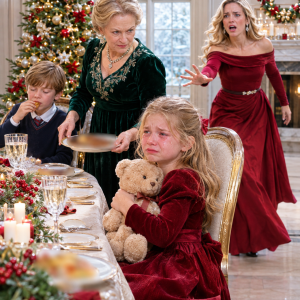
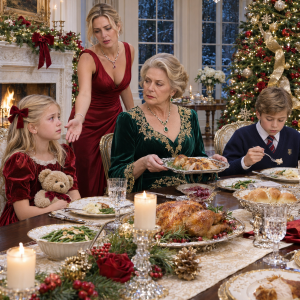
Patricia’s dining room looked lovely. Silver napkin holders gleamed beneath the chandelier, evergreen garlands rested along the mantel, and bright red candles stood in the windows. A plate of cinnamon rolls sat beside the stove, filling the house with the warm, sweet smell of Christmas morning. Everything had been arranged with care, as if the room were waiting for a family photograph.
At 8:47, Patricia began handing out gifts.
The other grandchildren opened tablets, envelopes with money, and packages that seemed to have been chosen with their particular interests in mind. Sophie sat patiently, watching the excitement around her. She didn’t complain when the gifts came one by one, though I could see her glancing at the pile beneath the tree to see if one had been missed.
Finally, Patricia picked up a small pharmacy bag and held it out to her.
“I didn’t want you to feel completely left out,” she said.
Sophie opened the bag carefully. Inside was a vanilla candle, the kind sold near the checkout counter. A paper label had been tied around it.
Brandon’s Girl.
The room fell silent. Even the children stopped moving.
Sophie touched the tag with one finger. Her face did not crumple, and she did not cry. She only looked puzzled, as though she were still searching for a way to make the words mean something kinder.
Andrew’s grip tightened around his paper cup until the side bent inward.
Patricia reached for another present.
I leaned toward Andrew and whispered his name. He looked at me, then toward Sophie, and said quietly that he had put a small red velvet box inside her overnight bag. He had prepared it after Thanksgiving, though he had not told me all the details.
“What is it?” I asked.
“Something she can give my mother, if she wants to.”
That evening, I found Sophie sitting on the guest-room bed with the candle resting across her knees. She was still wearing her golden dress, though she had taken off her shoes. The bright room lights made the little label easier to read.
“Mom, am I only Dad’s girl?”
I sat beside her, but before I could find the right words, Andrew came in and lowered himself to her eye level.
“You are my daughter,” he told her. “No tag gets to decide who you are.”
He reached into her bag and took out the red velvet box, small enough to fit in both her hands. He placed it in her lap.
“If Grandma makes you feel invisible again, you can give her this. But only if you want to.”
Sophie turned the box over, studying its soft fabric and the neat clasp.
“Will she be angry?”
“Probably,” Andrew said honestly.
Sophie looked at him for a moment.