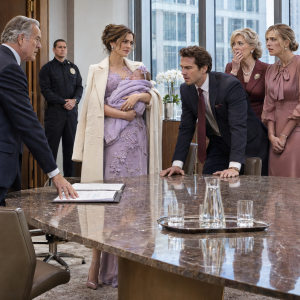
“The hotel has an unpaid portion of its annual sponsorship to the museum,” Beatrice said. “Graham promised he would cover it once the buyer’s funds cleared. We had payroll due Friday. He told me Margaret had agreed to sell.”
“I never agreed to sell,” Margaret said.
Beatrice closed her eyes for a moment. “I know that now.”
“You knew the loan terms,” I said. “You helped write them.”
“I thought we could correct it after the payment came through.”
“By correcting what? The ownership? My signature? My job?”
The hotel manager asked the courier to step away from the cart while they documented its condition. He did so at once, relieved, I thought, that the choice had been taken out of his hands. Nora took photographs of the case, its seal, and the red ribbon. The general manager wrote down the time and asked the security staff to preserve the lobby camera footage.
Graham moved closer. “Can I speak with you alone?”
I held the phone between us so Margaret could hear. “Tell me now.”
He looked past me toward Celeste, who had followed us downstairs. She removed her engagement ring and placed it on the cart beside the case.
“My father sent me the agreement you signed with him,” she said. “Evelyn can have a copy.”
For a moment, Graham seemed more concerned about where she had put the ring than about the people watching him. He picked it up without looking at her, then asked the hotel manager to bring his car. He left with the ring closed in his fist.
I stayed in the lobby until the courier signed a statement confirming that the case had not left the hotel. With Margaret’s permission, Nora and I checked the seals and the inventory list against every folder inside. The originals were all accounted for. At dawn, we arranged for Margaret to collect the case herself, accompanied by a museum registrar and the hotel manager.
Before leaving, Margaret said, “I’m sorry you had to spend the first hour of the year defending yourself.”
“You don’t have to apologize for what they did,” I told her.
She paused, then gave my hand a squeeze. “That’s not the same as wishing it hadn’t happened.”
What the Records Showed
The museum board met the following morning without Beatrice. They confirmed I had never been dismissed, temporarily restricted my access to the collections during the review, and asked Nora for copies of every document. The hotel provided its lobby recordings. Celeste’s father supplied the draft agreement, payment records, and emails exchanged with Graham.
The evidence came in pieces: a hotel notepad with practice signatures, a deposit invoice, a message about the New Year’s Day board meeting, and a record showing that the supposed email had never passed through the museum’s system. Each item narrowed the space Graham and Beatrice had left for their version of events.
Beatrice resigned before the week was over. The museum’s board issued a correction to the staff and to the lenders who had received the false press release. They confirmed that I remained chief curator and that the Mercer collection had never been sold. Graham’s hotel sale became a brief item in the local business pages a few months later. I recognized the ballroom in the photograph accompanying the story because I knew exactly which doors my children had come through.
Celeste’s father asked Graham to return the deposit, and the matter moved into the careful, unglamorous hands of lawyers and accountants. I did not follow every development. I had three small children, a museum to steady, and an exhibition to prepare. What mattered was that Margaret still had her photographs and our lenders knew the truth. In April, the exhibition opened.
The Woman at the Edge of the Frame

Margaret arrived early on opening day. She had invited a friend, a woman who walked slowly and held firmly to Margaret’s arm. They stopped in front of the photograph that had been missing from the ballroom display case. Three cannery workers stood outside a low wooden building, their lunch pails beside them. The woman pointed to the worker at the left edge, whose hair had begun to slip from its pins.
“That’s me,” she said.
For a second, no one spoke. Taken more than half a century earlier, the photograph seemed to hold a younger version of her who had waited a long time to be recognized.
“Lillian promised she’d send me a copy,” the woman said. “I gave her my address, but I forgot to put down the apartment number. I always wondered whether it ever reached her.”
Margaret’s eyes brightened. “She kept the note with the negatives. We found it when we were cataloguing the collection.”
We had made a print for the woman, and I brought it out from the office. Margaret held the envelope while her friend took a pen from her purse and wrote her complete address, including the apartment number, in careful, deliberate handwriting. She smiled as she did it, as if this small correction could reach backward and finish a conversation that had been interrupted decades earlier.
“I’ll make sure it gets to you,” I said.
“I believe you,” she replied.
After the visitors moved on, I found Peter on the museum steps with the boys. They had been practicing a question for me on the drive over, although Samuel insisted that Oliver had changed the wording twice.
Oliver asked, “Mom, can we go see your work again?”
I took them inside. Henry pressed his nose to the glass in front of the cannery photograph until I lifted him so he could see it properly. Samuel wanted to know whether the woman had received her picture. I told him we were sending it to her that afternoon. Oliver asked if she might put it on her refrigerator, and I said I hoped she would.
At home, we had three photographs from New Year’s Eve held to our refrigerator by mismatched magnets. My favorite showed Peter kneeling to tie Samuel’s shoe in the hotel lobby after nearly everyone else had gone home. Oliver leaned toward him, Henry was clinging to my skirt, and I was laughing at something just outside the frame. None of us looked polished. The boys’ jackets were wrinkled, Peter’s tie had disappeared, and my emerald dress had a faint crease at the waist where I had knelt to hug them.
I kept that picture because it reminded me that the night had not belonged to Graham, though for a few minutes he had seemed determined to make it so. It belonged to the people who had stayed, listened, and helped carry the case back where it belonged. It belonged to Margaret, who had trusted us with her grandmother’s work; to Nora, who noticed that a page was missing what mattered; to Celeste, who chose honesty at a difficult moment; and to Peter, who brought three small boys into a room where I had begun to feel alone.
Most of all, it belonged to the photographs, which had waited years through a nearly forgotten promise and an address missing one small number. The woman at the edge of the frame had not known whether anyone would ever find her there. Yet there she was, at last, standing in a bright gallery, looking at the young woman she had been.
The first time Graham and I met, he told me the future was something a person could arrange if he had enough money and the right people around him. I believed him for longer than I should have. But a life is not a hotel, and it cannot be rebuilt by deciding who gets to stay in the picture. Sometimes what saves you is not a grand gesture or a perfect answer, but the steady hand of someone who knows when to hold a door open, the honest record of what happened, and the people who run toward you when they see you need them.
That year, when the clock reached midnight, I had thought I was standing beside an empty chair. By April, I understood that the chair had never been empty at all.