Hidden Moral Stories

At My Father’s Retirement Dinner, My Brother Served My 8-Year-Old Son a Dry Hotdog on a Paper Plate While His Children Ate $120 Steaks, Certain the $6,500 Bill and His $12,000 Gift Would Be Quietly Paid—But When the Waiter Returned, I Rose From My Chair and Made One Announcement He Never Expected

The Plate at the End of the Table

The private dining room at Bellamy House in Hartford had been designed to make ordinary people feel temporarily important. Dark walnut panels covered the walls, brass lamps cast a soft glow across the long linen-covered table, and every place setting included more silverware than most people used in a week.

My family had reserved the room to celebrate my father’s retirement after thirty-eight years as an executive for a regional insurance company. Twenty relatives had come, dressed in their best clothes, raising glasses of expensive wine and praising a career most of us had heard about at every holiday gathering since childhood.

I might have enjoyed the evening if I had not looked down the table and seen what had been placed in front of my eight-year-old son.

Jamie sat beside me in a navy sweater he had chosen because his grandfather once told him that dark blue made a young man look dependable. He had spent an hour making a retirement card from construction paper, carefully drawing my father standing beside a fishing boat because he believed retirement meant Grandpa would finally have time to take him fishing.

In front of Jamie sat a plain hotdog on a thin paper plate.

There was no bun, no side dish, and no proper silverware. The hotdog looked as though someone had carried it upstairs from a concession counter and dropped it onto the table as an afterthought.

Across from him, my brother Douglas’s two children were cutting into thick portions of dry-aged steak. Their plates were surrounded by roasted potatoes, buttered asparagus, and small dishes of sauce. Each meal cost more than one hundred dollars.

Jamie stared at their plates before lowering his eyes to his lap.

For a moment, I wondered whether the restaurant had misunderstood an order. Then Douglas leaned back in his chair, lifted his wineglass, and smiled.

“We didn’t order one of the full meals for Jamie,” he said. “He’s a kid. Kids eat hotdogs.”

Several relatives gave polite little laughs, the kind people offer when they know something is unkind but do not want to challenge the person who said it.

Jamie’s fingers slid away from his fork.

My mother, Patricia, dabbed her mouth with her napkin and looked at me as though I had caused the inconvenience.

“Rachel, you know how particular he can be,” she said. “You should have brought something from home if he wasn’t going to eat what was provided.”

“He isn’t particular,” I replied. “He asked for the same steak his cousins ordered.”

Douglas rolled his eyes.

“That would be ridiculous. He probably wouldn’t finish half of it.”

His wife, Vanessa, smiled over the rim of her glass.

“And honestly, Rachel, this evening is already costing Douglas a fortune.”

That sentence almost made me laugh.

Douglas had not paid for a family dinner in three years.

He had arranged dinners, announced vacations, presented expensive gifts, and accepted praise for his generosity, but the charges had quietly landed on an account connected to my name. My parents knew I contributed to family expenses, though they had never bothered to ask how much. Douglas knew considerably more because my father had given him access to the account for what he called “family coordination.”

I had created it after my mother underwent a complicated operation three years earlier. At the time, my parents were anxious about follow-up care, household expenses, and the possibility of unexpected costs, so I established a family reserve and deposited two thousand dollars into it every month.

I worked as a forensic accountant for a national consulting firm, and after years of long hours and careful investments, I earned far more than my family realized. I had never hidden my success because I was ashamed of it. I had kept it quiet because money changed the way people behaved, and I did not want every conversation with my relatives to become a request.

Unfortunately, my silence had created a different problem.

Douglas had gradually begun treating the reserve as though it belonged to him. A restaurant charge here, a vacation deposit there, a country-club payment described as “client development.” Whenever I questioned him, he explained that our parents had approved everything.

I continued paying because I believed I was protecting them.

Then I saw my son sitting at a luxury dinner with a paper plate in front of him, and for the first time, I understood that I had not been protecting my family. I had been financing their disrespect.

I placed my hand on Jamie’s shoulder.

“You don’t have to eat that, sweetheart.”

He looked up at me and tried to smile.

“It’s okay, Mom. I’m not really hungry.”

But I knew he was. He had skipped his afternoon snack because he had been excited about the dinner.

Douglas sighed loudly.

“Please don’t turn this into one of your speeches. He has food. Let him eat.”

My father, Richard, remained focused on the wine list. He had always avoided conflict by pretending not to notice it. Growing up, I had mistaken that habit for patience. As an adult, I recognized it as a decision—one that almost always protected Douglas.

I looked at the hotdog again and felt something inside me become very still.

“All right,” I said. “I understand.”

Douglas smiled, believing the matter was over.

He was mistaken.

The Announcement

A few minutes later, a server entered with another bottle of wine. Douglas sat straighter and reached for it as though he were hosting a gathering of important clients rather than relatives who had driven in from nearby suburbs.

I pushed back my chair.

The wooden legs scraped against the floor, and conversations faded as everyone turned toward me.

I stood beside Jamie, lifted my water glass, and lightly tapped it with a spoon.

“Before dessert is served, I need to make an announcement.”

Douglas leaned back with an amused expression. He probably expected a toast to our father or an apology for questioning his decisions.

Instead, I turned toward the senior server near the door.

“Please divide the bill. Place my son’s meal and mine on a separate check. Everything else should be charged to the person who organized this dinner.”

The server paused for only a moment.

“Of course, ma’am.”

Douglas’s smile disappeared.

“What are you doing?”

“Paying for the people I brought.”

“The account is already arranged.”

“That is the second part of my announcement.” I looked back at the server. “Please remove my card from the master account permanently.”

No one moved.

My mother’s hand tightened around her napkin.

“Rachel, stop this,” she said. “This is your father’s retirement dinner.”

“I know exactly what dinner this is.”

My father finally put down the wine list.

“Then behave accordingly.”

His voice carried the authority he had used in conference rooms for nearly four decades, but it no longer had the effect on me that it once had.

“I am behaving accordingly,” I said. “I’m making certain that the people who ordered the food are responsible for paying for it.”

Douglas gave an unconvincing laugh.

“You don’t control the family account.”

I reached into my handbag and removed a black folder.

“The account is in my name. My card has been covering restaurant reservations, hotel deposits, club fees, and family events for three years.”

My mother stared at me.

“Your father manages that account.”

“Dad receives the statements. I provide the money.”

The atmosphere in the room changed. Several relatives stopped looking at me and began looking at Douglas.
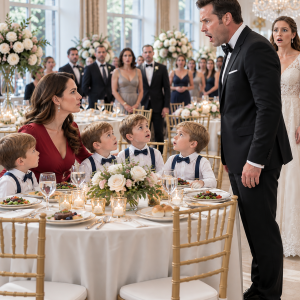

Vanessa frowned.

“Douglas told me the dinner was being paid through his company.”

“Then you should ask him why my card is attached to the reservation.”

Douglas stood.

“This is absurd. Sit down and quit embarrassing yourself.”

I turned toward the server again.

“My son originally requested the filet with mashed potatoes. Would you please bring it medium-well, along with the chocolate cake he chose for dessert?”

Jamie’s face brightened, though he still looked uncertain.

“Put that on my separate check,” I added.

“Certainly.”

Douglas pressed both hands against the table.

“You are making a scene over a hotdog.”

I looked directly at him.

“No. I’m responding to what the hotdog revealed.”

The Gift

Douglas had always been skilled at redirecting attention, and that evening was no exception. Before anyone could question him further, he reached into his suit jacket and removed a long velvet box.

“We’re supposed to be honoring Dad,” he announced. “Maybe this will help everyone remember why we came.”

He walked to our father’s chair and placed the box on the table.

“Dad, you gave this family everything. I wanted to give you something worthy of what you accomplished.”

My father opened the lid.

Inside was a gleaming luxury watch with a gold bezel and a dark blue face.

My aunt covered her mouth.

“Douglas, that must have cost a small fortune.”

He lowered his eyes with carefully rehearsed humility.

“Dad deserves it.”

My father looked deeply moved.

“Son, this is far too much.”

“Nothing is too much for you.”

Douglas glanced at me, and the meaning in his expression was unmistakable. He believed he had regained the room. Once again, he was the devoted son, the successful businessman, the generous host.

I opened my folder.

Four days earlier, I had received an alert for an unusually large purchase at a jewelry boutique. Because the card was meant to cover family-care expenses, I had called the store and requested a copy of the receipt.

I removed it from the folder and placed it beside the watch.

“It is a lovely gift,” I said.

My father picked up the paper.

“What is this?”

“The purchase receipt.”

Douglas stopped moving.

“Look at the payment information near the bottom,” I continued. “The watch was charged to the family-care reserve—the account created for Mom’s appointments, prescriptions, and unexpected household needs.”

My mother’s chair shifted sharply against the floor.

“Douglas?”

He reached for the receipt.

“She’s twisting this. Dad told me the account could be used for family expenses.”

I moved the paper out of his reach.

“A twelve-thousand-dollar watch is not a family-care expense.”

“I was going to replace the money.”

“With what?”

That question landed harder than I expected.

Vanessa slowly turned toward him.

“What does she mean, ‘with what’?”

Douglas avoided her eyes.

At that moment, the dining-room doors opened, and the restaurant manager entered with the server. He wore a charcoal suit and carried himself with the calm precision of someone accustomed to handling wealthy people during uncomfortable moments.

“Ms. Mercer,” he said to me, “your card has been removed from the event account, as requested. Your separate order has been entered.”

Then he turned to Douglas and placed the bill folder in front of him.

“The balance for the remaining guests is six thousand five hundred and forty dollars. We’ll need another method of payment to keep the account open.”

Douglas pulled a silver card from his wallet and placed it on the server’s tray.

“Use that.”

The server entered the amount into a portable terminal.

A moment later, he looked up.

“I’m sorry, sir. The card wasn’t approved.”

Douglas frowned.

“Run it again.”

The server did.

The result was the same.

Douglas handed him another card.

That one was not approved either.

Vanessa’s expression changed from irritation to fear.

“Use our joint account.”

Douglas said nothing.

“Douglas, pay the bill.”

He stared at the table.

“I can’t.”

“What do you mean, you can’t?”

“The contract I was expecting didn’t close.”

“You told me it closed in April.”

“It fell apart before the final signatures.”

Vanessa stepped away from him.

“Then how have we been paying the school tuition, the club membership, and the car leases?”

He looked at me before quickly turning away.

That brief glance gave her the answer.

“You’ve been using Rachel’s account?”

“Only temporarily.”

“For how long?”

He did not respond.

“How long, Douglas?”

“A couple of years.”

The relatives around the table became very interested in their phones, purses, and watches. One uncle suddenly remembered an early appointment. A cousin announced that her babysitter needed her at home. Another aunt said she had a long drive ahead of her.

Within minutes, nearly everyone who had praised Douglas’s generosity had left the room.

My parents remained at the table, along with Douglas and Vanessa.

My father looked at the watch as though it had changed into something unfamiliar.

“You used your mother’s care fund to buy this?”

Douglas sat down heavily.

“I wanted the evening to be special.”

“You wanted people to admire you,” Vanessa said.

The door opened again, and a server carried in Jamie’s dinner. He placed a perfectly cooked filet in front of him, along with mashed potatoes, green beans, and an enormous slice of chocolate cake.

Jamie looked from the plate to me.

“Can I really have all of this?”

I smiled and brushed his hair away from his forehead.

“Of course. You belonged at this dinner from the moment you walked through the door.”

He picked up his fork, sitting straighter than he had all evening.

Across the table, Douglas watched him take the first bite.

For once, my brother had nothing to say.

The Cost of Pretending

My parents arranged a payment plan with the restaurant because neither Douglas nor Vanessa could cover the bill. The luxury watch was returned the following morning, and the money was placed back into the family reserve.

Over the next several days, the rest of Douglas’s finances came into view. He had borrowed against nearly everything he owned and had used my account to maintain the appearance of success. The vacations, impressive gifts, and extravagant family events had not been signs that his business was thriving. They had been decorations placed over a structure that was quietly collapsing.

Vanessa moved into her sister’s home before the end of the week and began formal separation proceedings soon afterward.

Douglas blamed me.

He sent a long message accusing me of ruining our father’s retirement celebration and dividing the family over a child’s dinner.

I replied with one sentence.

“You gave my son a paper plate while using my money to purchase luxury for everyone else, and you expected me to call that family.”

Then I left the family message group.

Two weeks later, my father appeared at my front door.

Without his tailored suit and polished shoes, he looked smaller than I remembered. He wore an old gray sweater and held an envelope in both hands.

I remained in the doorway.

“What brings you here?”

“I came to return the rest of the money Douglas used.”

He offered me the envelope.

“There’s also a card.”

“For me?”

He shook his head.

“For Jamie.”

I took it.

“Does it say that you’re sorry for what happened, or does it explain why everyone else was wrong?”

My father looked down.

“It says I should have spoken up.”

That was the first honest thing I had heard from him in a long time.

“I’ll let Jamie decide whether he wants to read it.”

That evening, I carried the card to Jamie’s room. He was on the carpet building a spaceship from plastic bricks, completely absorbed in balancing a narrow wing across the top.

“Grandpa sent you something,” I told him. “He wants to apologize for the dinner.”

Jamie opened the card and read it quietly. When he finished, he folded it, placed it in the bottom drawer of his desk, and returned to his spaceship.

There was no dramatic response, no angry speech, and no immediate forgiveness.

Children sometimes understand boundaries more clearly than adults do. Jamie did not feel obligated to make his grandfather comfortable simply because an apology had arrived.

I followed his example.

A Table for Two

I closed the family reserve account and placed the remaining money into a protected education fund for Jamie. I stopped paying for gatherings I had not arranged and declined invitations where I knew respect would be treated as optional.

Some relatives called me unforgiving. Others said I should make peace because family relationships were too important to lose.

I agreed with the second part.

Family relationships were important, which was precisely why they should never be built on humiliation, silence, or access to someone else’s bank account.

Jamie and I began a new Friday tradition at a small Italian restaurant near the river. The tables were crowded together, the kitchen was always noisy, and the owner greeted every customer as though they were returning from a long trip.

We ordered garlic bread, shared a large bowl of spaghetti, and finished with one slice of tiramisu and two spoons.

No one measured Jamie’s worth by the price of his meal. No one expected me to finance an evening while pretending someone else had provided it. There were no velvet boxes, no carefully managed appearances, and no relatives waiting to see who would pay.

One Friday, after Jamie had eaten the last spoonful of dessert, our server approached with a cheerful smile.

“Will this be one check or two?”

I looked across the table at my son. He had chocolate on the corner of his mouth and was telling me a long story about a science project involving a cardboard volcano.

I handed the server my card.

“One check,” I said. “Only for the people who came together.”

Related Posts

My Future Mother-in-Law Shoved My Working-Class Parents Into the Resort Pool in Front of Every Wedding Guest and Called Them “Tr@sh”—My Fiancé Only Whispered, “She’s Had Too Much Champagne,” So I Quietly Walked Away, Made One Phone Call, and Watched Secrets My Future Family Had Buried for Years Begin to Surface

The Morning Everything Still Looked Perfect Wedding mornings are supposed to feel magical. Mine smelled like fresh coffee and garden roses. I stood barefoot on the balcony of...

My Husband Thought The Biggest Problem That Night Was Getting Caught Kissing His Employee. Then I Connected My Phone To The Media Wall And Displayed Hotel Bills, Luxury Gifts, And Company Payments Linked To Their Relationship. The Affair Ended In Seconds. The Corporate Investigation Lasted Much Longer.

Part 1: The Image Above the Fireplace During the final commercial break of the Academy Awards, my husband kissed another woman inside the west gallery of my home....

Fourteen Minutes Before Our Wedding, I Saw My Bride Knock Away My Injured Mother’s Cane—Seconds Later, I Uncovered the Secret Agreement Giving Her Family Control of My Company, Canceled the Wedding in Front of 200 Guests, and Watched Their Perfect Plan Collapse

The Wedding That Never Reached the Vows The first sound I remember from my wedding day was not music. It was the sharp crack of my mother’s cane...

The Morning I Won a $20 Million Lottery, I Thought It Was a Miracle That Would Save My Hospitalized Son—Until I Heard Him Laughing Behind His Hospital Door About How Easy It Was to Make Me Sell Everything I Owned, Borrow Money, and Eventually Hand Over My Fortune – This Made Me Walk Away Without Saying a Single Word

Every morning for nearly six weeks, I stopped at the same bakery before driving to St. Matthew’s Medical Center. The woman behind the counter knew my order by...

My Wife Arrived Expecting An Anniversary Dinner. Instead, She Found Her Husband, Her Boyfriend, A Man She Owed Money To, And A Divorce Attorney Waiting In The Same Condominium. Then Her Handbag Fell Open, And So Did Every Secret She Had Spent Years Protecting.

Part 1: The Woman in the Ivory Suit At six fifteen every morning, Ethan Caldwell prepared breakfast inside the townhouse kitchen while his children argued about cereal, missing...

Để lại một bình luận

Email của bạn sẽ không được hiển thị công khai. Các trường bắt buộc được đánh dấu *