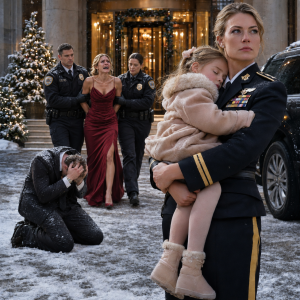
“Captain Calloway, I’m sorry for the way I spoke to you tonight. I should have shown you the respect your rank and service deserved. I won’t make that mistake again.”
I returned his salute.
“At ease, Sergeant. Get your men home safely.”
“Yes, ma’am. Thank you for your service.”
Then he walked out.
My mother hurried toward me.
“Elise, wait. You have to call him. Tell him this was all a misunderstanding. Tell him you’re only an analyst. You can’t let him leave Paige like this.”
I looked at her hand gripping my wine-soaked sleeve.
“Let go of my uniform, Mom.”
“She’s your sister.”
“I’m done being the person who has to fix everything for her.”
My father stepped forward, his voice rising.
“You arranged this. You wore that patch so you could embarrass your sister. Pay the bill, apologize, and stop acting like you’re better than the rest of us.”
I didn’t raise my voice.
“The dinner is paid for. The car repair, the money for your house, and the credit cards I covered for Paige are paid for too. Keep it all. I’m finished paying for a place in this family.”
My mother’s eyes filled with tears.
“Elise…”
“Don’t call me. Don’t come to my apartment. If you contact my command, I’ll ask military legal services to help me set clear boundaries.”
I turned and left the restaurant.
The First Quiet Night
My phone began ringing before I had reached the parking lot. Paige called, then my mother, then my father. When messages arrived from cousins, I blocked those numbers too. I blocked my family’s social media accounts and email addresses, then set my phone on the passenger seat and let the quiet settle around me.
For the first time in years, I took a full breath without wondering whose problem I would be expected to solve next.
About forty minutes later, while I waited for my uniform to finish washing at my apartment building, an unfamiliar number appeared on my screen.
“Captain Calloway,” I answered.
“Ma’am, this is Staff Sergeant Harlan.” His voice was subdued. “I know I shouldn’t have called your personal number. I wanted to apologize before I went home.”
“You don’t need to do that, Sergeant.”
“I do. I let Paige’s version of you shape what I thought, and I joined in when I should have known better. We depend on intelligence teams when we’re out there. I know that, and I acted as if I didn’t.”
I leaned back against the wall.
“What happened with Paige?”
He exhaled slowly.
“She followed me to the truck and said I was throwing away our future over a glorified typist. I returned the ring. I’m not going to start a campaign against her, Captain, but I won’t pretend that what happened was acceptable.”
“That’s your decision.”
“I wanted you to know I’m sorry. Take care of yourself, ma’am.”
After we hung up, I changed out of my uniform and took a shower. The water carried the wine from my hair and sleeves, but the stain on the fabric remained. I stood there longer than I needed to, letting myself feel the quiet exhaustion I had postponed for weeks.
A New Assignment

On Monday morning, Colonel Whitaker called me back into her office. A formal memorandum lay open on her desk.
“Staff Sergeant Harlan submitted a report to his commander about the dinner,” she said. “He took responsibility for his conduct and asked that it be documented.”
I said nothing.
She closed the folder.
“His commander called me. I told him we consider the matter handled.” Her expression softened. “He also told me your family asked you to apologize after your sister threw wine on you.”
I looked down at the carpet.
“Captain, you’ve spent years doing difficult work with little recognition, and you’ve done it well. You’re taking the two weeks of leave I ordered.”
“Yes, ma’am.”
“When you come back, I have a transfer order for you. U.S. Special Operations Command at MacDill, in Tampa. You’ve been selected for early promotion to major, and they need a chief targeting officer.”
For a moment, I thought I had misheard her.
“Tampa, ma’am?”
She smiled.
“Tampa. More responsibility, a new team, and a command that understands the work you do.”
I felt the tension in my chest loosen.
“I accept, ma’am.”
“Good. Go rest. We’ll see you in two weeks.”
I rented a small cabin in the Blue Ridge Mountains, turned off my personal phone, and spent my days walking among pine trees and reading books that had nothing to do with military operations. I slept late. I ate when I was hungry. I let the silence around me be peaceful rather than something I had to defend.
When I returned, the story of the dinner had spread through some of the military and defense communities around Washington. Paige’s public relations firm placed her on leave while it reviewed the situation, and her polished online image drew attention she had never wanted. My father left several messages on my work line, sometimes asking for financial help and sometimes demanding that I clear Paige’s name. I forwarded them to the appropriate office and didn’t respond.
Three months later, I packed my belongings and moved south to Florida.
One Year Later
The air near Tampa Bay was warm, and the evening light turned the water copper as the sun lowered toward the horizon. I stood on a balcony at MacDill Air Force Base with the gold oak leaves of a major on my uniform, watching aircraft cross the open sky.
My life had become quieter in the ways that mattered. My colleagues didn’t ask me to prove that my work counted. They knew that a good operation depended on many kinds of service, and they treated one another accordingly.
With the help of a counselor who worked with military families and service members, I began to understand how long I had carried the belief that my family’s happiness was my responsibility. I had kept giving because I hoped that one day they would see me clearly. Letting them go was not an attempt to punish them. It was a decision to stop making myself smaller in the hope that they might finally be satisfied.
My phone buzzed. A message had arrived on a professional networking site from Lieutenant Commander Maren Harlan, a naval flight officer stationed in Norfolk. She introduced herself as Nolan’s older sister and said her brother had told her what happened at the restaurant.
“He told me how you held your composure and returned his salute after he had treated you unfairly,” she wrote. “He says he uses that evening to remind new soldiers that the work done quietly matters, and that real respect is shown through your actions. Thank you for giving him an example he could learn from.”
I read it more than once before closing the message.
“Major Calloway!”
I turned. My operations sergeant stood near the entrance to the watch floor, holding a tablet.
“The satellite feed is live for the maritime exercise. The commander wants you to review the target vectors.”
“I’m on my way, Sergeant.”
I looked once more toward the bay, then adjusted my collar and headed inside. For years, I had believed that being unseen meant being unimportant. Now I knew better. Some work is meant to happen out of sight, but that doesn’t make it any less worthy.
I had found the place where I belonged, and I no longer needed my family’s permission to know it.