The Promise My Husband Never Forgot

On the morning of our fifth wedding anniversary, my mother called me shortly after eight, speaking in a trembling voice that sounded nothing like the confident, composed woman who had raised me. She had just received a package from my husband, and although I had no idea what he had sent her, the expression on his face suggested that he had been waiting a very long time for this particular conversation.
“Natalie, did you know about this? Did you know your husband was going to send me something like this?” she asked, struggling to finish her sentence.
I shifted against the pillows, resting one hand on my rounded stomach while looking toward my husband, Russell, who was sitting beside me with two cups of freshly brewed coffee.
“Mom, I don’t even know what you’re talking about. What did he send you?”
Instead of answering immediately, she began crying, and I could hear the faint rustling of paper on the other end of the line.
Russell placed his coffee on the nightstand, reached for my hand, and gave it a gentle squeeze.
“Put her on speaker, sweetheart. I think it’s time we all had this conversation together.”
There was no bitterness in his expression, no trace of anger or satisfaction, only the quiet confidence of a man who had finally arrived at the end of a journey that nobody else knew he had been traveling.
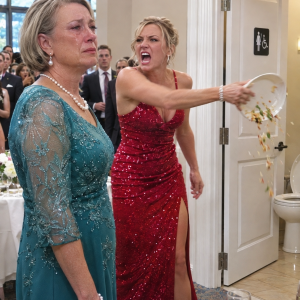
Five years earlier, standing before two hundred people at our wedding reception, my mother had publicly predicted that our marriage would fail before our first anniversary.
What I didn’t know was that her wedding toast hadn’t been the worst thing she had done.
And for five years, the man beside me had carried that knowledge without ever allowing it to diminish the happiness of our marriage.
The Wedding Toast I Wanted to Forget
Russell and I were married on a beautiful September afternoon at a restored country estate outside Pittsburgh, Pennsylvania, where the gardens were still filled with late-summer roses and the surrounding hills had just begun to show their autumn colors.
I had spent nearly a year planning the wedding, choosing everything from the ivory table linens to the little arrangements of white hydrangeas that decorated the reception hall, but what mattered most to me was finally marrying the man who had made ordinary life feel more meaningful than anything I had previously imagined.
Russell was a residential electrician, a profession he had learned through years of apprenticeship and practical experience, and although his work often left him exhausted at the end of the day, he possessed a patience, intelligence, and generosity that I had rarely encountered in anyone else.
I worked as a children’s book editor, and our conversations frequently wandered from the practical details of our respective jobs to the kind of home we hoped to create together, the children we wanted someday, and the traditions we would carry into our own family.
My mother, Diane, had never understood what I saw in him.
She believed that a woman’s future depended largely upon the professional standing and financial security of the man she married, and she had made it painfully clear throughout our engagement that Russell did not meet her expectations.
Nevertheless, I had convinced myself that she would put aside her reservations on our wedding day, if only because she loved me and understood how much the occasion meant to us.
For most of the afternoon, it appeared that she had.
She smiled during photographs, complimented the flowers, greeted our relatives, and even became emotional when I walked down the aisle carrying a small photograph of my father inside my bouquet.
It wasn’t until dinner had been served and the speeches began that I discovered how mistaken I had been.
My mother rose from her chair, accepted the microphone from our wedding coordinator, and lifted her champagne glass with the practiced elegance of someone accustomed to being the center of attention.
“Every mother hopes her daughter will make wise choices in life,” she began, looking directly at me. “And although Natalie and I haven’t always agreed about what those choices should be, I suppose there’s only so much advice a mother can give.”
A few guests smiled politely, assuming she was about to share an affectionate story from my childhood.
Instead, she turned toward Russell.
“I hope you’ll prove me wrong, Russell, but between the two of us, I’ll be surprised if this marriage makes it through its first year. Natalie could have had a very different future, and I still believe she deserves considerably more.”
The silence that followed was unlike anything I had ever experienced in a room filled with so many people.
My aunt lowered her eyes, one of Russell’s friends stared at his plate, and several guests exchanged uncomfortable glances while my mother continued holding her glass as though she had said something perfectly reasonable.
I felt Russell’s hand settle over mine beneath the table.
Then, rather than responding with the anger that would have been entirely understandable, he stood, picked up his glass, and faced my mother.
“I appreciate knowing exactly where we stand, Diane. I won’t forget what you’ve said tonight, and I hope that someday you’ll feel differently.”
He sat down and turned toward me with a reassuring smile, but I could no longer trust myself to remain at the table.
I excused myself and hurried into the restroom, where I spent the next fifteen minutes trying to regain my composure, wondering how the woman who had taught me to treat people with kindness could speak so carelessly about the person I loved most.
When I returned, Russell was waiting near the dance floor.
He opened his arms, drew me close, and held me as the band began playing our wedding song.
“We’re building our own family now, Natalie,” he whispered. “Your mother’s opinion doesn’t get to decide what kind of marriage we’re going to have.”
I rested my cheek against his shoulder, grateful that at least one of us understood what truly mattered that evening.
The House We Had Left Behind

To understand my mother’s behavior, I have to go back to my childhood in Lancaster, Pennsylvania, where my parents and I once lived in a charming white farmhouse with pale blue shutters, a generous backyard, and an enormous maple tree that turned brilliant shades of orange every October.
My father, Arthur, was a cabinetmaker who took enormous pride in his craftsmanship, and some of my earliest memories involved sitting on a wooden stool in his workshop, watching him transform ordinary pieces of lumber into beautiful furniture.
He wasn’t a wealthy man, but he possessed a remarkable ability to make our home feel abundant.
On Saturday mornings, he prepared blueberry pancakes while singing along to the radio, and during the summer, he helped me plant flowers along the backyard fence, patiently explaining why certain plants needed more sunlight than others.
Above the kitchen window, he had painted a row of little yellow songbirds perched on flowering branches, a cheerful decoration that my mother initially considered unnecessary but that eventually became one of my favorite features of the house.
Every birthday, my father measured my height against the pantry doorframe, writing the date beside each pencil mark and pretending to be astonished by how quickly I was growing.
For twelve years, that house represented everything I understood about belonging.
Then my father’s business encountered serious financial difficulties when several major customers failed to pay for completed projects, leaving him struggling to cover expenses that had once seemed manageable.
Despite his best efforts, the situation gradually became impossible to sustain, and eventually my parents made the difficult decision to sell our home.
I still remembered standing beside the moving truck, staring at the upstairs window of my bedroom while my father promised that the memories we had made there would always belong to us, regardless of who owned the property.
Four years later, we lost him following a period of declining health.
My mother never entirely recovered from those experiences.
She became intensely concerned with financial stability, surrounding herself with people whose careers, homes, and lifestyles offered the appearance of security she had once enjoyed.
Somewhere along the way, her understandable fear of hardship developed into an unfair judgment of anyone whose livelihood depended upon skilled manual work.
When I introduced Russell to her, she didn’t see a capable, hardworking man who treated her daughter with extraordinary consideration.
She saw the possibility of repeating a chapter of her own life that she desperately wanted to forget.
I understood where her fears came from, but understanding them did not make her treatment of Russell acceptable.
A Marriage Built in Ordinary Moments
Our first home was a modest two-bedroom house in a quiet neighborhood outside Harrisburg, where the kitchen cabinets were slightly outdated, the bathroom needed new flooring, and the backyard was considerably smaller than the one I remembered from childhood.
We loved it immediately.
Russell spent several evenings repainting the living room, and together we searched secondhand furniture stores for pieces that would make the house feel welcoming without stretching our budget.
We celebrated the completion of each little project with homemade pizza and inexpensive sparkling cider, and although there were certainly months when we had to be careful about spending, I never felt that our life was lacking anything essential.
My mother declined our housewarming invitation, claiming she had already committed to a luncheon with friends.
When she finally visited several weeks later, she walked through the house with an expression of restrained disappointment.
“Well, I suppose everyone has to start somewhere,” she remarked, examining our kitchen.
Russell smiled and offered her a cup of coffee.
At our first Christmas as a married couple, she presented him with a carefully wrapped envelope, explaining that she had chosen something particularly useful.
Inside was a prepaid appointment with a professional career consultant who specialized in helping people transition into corporate positions.
“You’re still young enough to change directions,” she told him. “There are respectable opportunities available if you’re willing to think beyond electrical work.”
I looked at Russell, expecting him to object, but he simply returned the envelope to its wrapping and thanked her.
Later, while he was helping my uncle carry dishes into the kitchen, I confronted my mother privately.
“Why would you give him something like that when you know how much he enjoys his profession?”
She sighed as though my question demonstrated a disappointing lack of maturity.
Related Posts

My Husband Froze My Bank Accounts and Flew First Class to Meet Another Woman, Leaving Me 28 Weeks Pregnant With Triplets and Just $23. That Night, I Went Into Labor on a City Bus in the Freezing Rain. A Wealthy Stranger Suddenly Rushed Aboard, Stared at My Face, and Whispered, “You Look Exactly Like Her.” The Next Morning, Beside My Three Newborns, He Opened an Old Envelope—and I Finally Understood Why He Had Come Running Through the Rain

“I’ve Quit My Job and Given Up My Apartment! Your Father Can Support Us Now!” My Mother-in-Law Declared, Dragging Two Suitcases Into Our Home One Day After My Wedding. My Husband Had Secretly Resigned Too. They’d Even Planned a New Truck and Florida Vacations. Then My Father Opened His Briefcase and Asked Who Would Pay the Rent.
“Come On, Sweetheart! Help Daddy Blow Out the Candles!” After 10 Hours of Dangerous Labor, I Discovered My Husband Wasn’t in London—He Was Celebrating His Other Woman’s Son’s First Birthday With His Entire Family at a Luxury Hotel. I Signed My Emergency C-Section Papers Alone. After Delivering Our Twins, I Made a Phone Call I Had Avoided for Three Years. That Afternoon, 10 Helicopters Arrived—and My Husband Had No Idea Who I Had Just Called…
On My 18th Birthday, My Father Handed Me a $250 Monthly Rent Bill Instead of a Birthday Present. For the Next Five Years, I Worked Extra Shifts, Sacrificed My Dream of Becoming a Musician, and Grew to Resent the Man Who Raised Me. On the Evening of His Funeral, His Best Friend Delivered a Box Containing a Key and an Unfamiliar Address — When I Finally Unlocked That Door, I Couldn’t Believe What My Father Had Been Hiding From Me All Those Years.