The Woman at Her Own Funeral

The Kind of Peace That Costs Too Much
On the morning we were supposed to lay my wife to rest, my ten-year-old daughter slipped her hand into mine and whispered something that made the cold Virginia rain seem to stop in midair.
“Dad, Mom isn’t gone.”
We stood beneath a canvas canopy in a small cemetery outside Charlottesville, surrounded by relatives dressed in black and rows of folding chairs sinking slowly into the wet grass. A closed casket rested above the open ground, its polished surface shining beneath the gray sky, while a minister spoke in the gentle, measured voice people use when ordinary language feels inadequate.
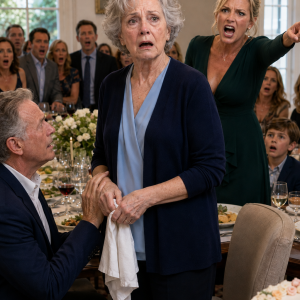
My mother, Eleanor, was kneeling in the mud, clutching the side of the casket as though grief had emptied all the strength from her body.
“She was the daughter I never had,” she cried. “How could she leave us like this?”
Everyone looked at her with sympathy.
I looked at the casket and felt only doubt.
My wife, Rachel Bennett, and I had been married for eleven years. She was a physical therapist who operated a modest rehabilitation clinic from the first floor of a brick building her parents had left her in downtown Charlottesville. Our daughter, Hannah, had spent half her childhood doing homework behind the reception desk, greeting elderly patients and drawing pictures for anyone who appeared nervous.
Two years earlier, after my stepfather passed away, I invited my mother to move into our home. Rachel agreed before I had finished asking. She prepared the guest room, rearranged the kitchen cabinets to accommodate my mother’s arthritis, and drove her to every medical appointment.
Yet nothing Rachel did ever seemed to become hers in my mother’s telling.
If Rachel spent an entire Saturday preparing Thanksgiving dinner, Eleanor praised my sister-in-law, Brooke, for bringing a store-bought pie. When Rachel cared for my mother through a severe winter infection, Eleanor later told relatives that my younger brother, Nolan, had been the one who never left her side, though he had visited only once.
Rachel rarely complained in public. In private, however, she tried to make me understand.
“I’m not asking you to argue with your mother,” she told me one evening. “I’m asking you to acknowledge what she’s doing.”
I gave her the same answer I had given too many times.
“You know how Mom is. She’s getting older. It isn’t worth turning every little thing into a battle.”
Rachel studied me with an expression I would remember long after that conversation.
“Refusing to choose is still a choice, Adam.”
At the time, I dismissed the remark as frustration. I did not understand that every time I stood in the middle, I was not protecting both sides. I was simply leaving Rachel to stand alone.
The trouble grew worse after she sold a parcel of farmland she had inherited from her parents. The sale brought in a little over $410,000, which Rachel planned to divide between renovating her clinic, building Hannah’s college fund, and creating a secure reserve for the future.
Without asking her, I told my mother.
Two days later, Nolan appeared at our kitchen table claiming his roofing business was about to collapse. He wanted $175,000. Rachel asked to see his contracts, tax records, outstanding invoices, and a clear repayment plan.
My mother reacted as if Rachel had accused him of a serious offense.
“He’s family, not some stranger applying for a bank loan.”
Nolan was equally offended, and I, eager to end the tension, pressured Rachel to lend him $58,000.
“If he can’t repay it, I’ll take responsibility,” I promised.
She finally agreed, but she required a written contract with a six-month deadline.
Seven weeks later, we learned that Nolan’s business had already closed before he asked for the money. Most of Rachel’s loan had gone toward interest on private debts and the recovery of his repossessed truck.
She did not raise her voice when she confronted him.
“Never use my name or my property to ask anyone for money again.”
I believed that ended the matter.
What I did not know was that my mother had entered our bedroom while Rachel was at work, opened the drawer where she kept personal records, and photographed her identification, the building deed, and several pages containing her signature.
She sent the images to Nolan with one message:
“I found what you need. Adam and Rachel can’t know.”
The Signature That Wasn’t Hers

Three days later, Rachel received a call from a private lending company asking her to verify an application that used her clinic building as collateral.
At first, she assumed it was a scam. Then the representative read her full name, address, identification number, and the registration details of the property.
“I never applied for this,” Rachel said.
After a long pause, the woman replied, “Then you need to come to our office today. Your signature appears in the file.”
Rachel returned home that evening carrying a thick envelope. She spread its contents across the dining table while Nolan, who had come to see our mother, stood near the kitchen doorway.
The signature looked similar to Rachel’s, but the loops were too careful and the angle was wrong.
“Tell me where this came from,” she said.
Nolan denied everything until Rachel showed him the attached copies of her identification. Then he admitted that he had sent “a few documents” to someone who arranged private financing.
My mother eventually confessed to taking the photographs.
“They were only pictures,” she insisted. “No one has taken your building.”
“You entered our bedroom, opened my private files, and handed them to someone without my permission.”
Eleanor abruptly dropped to her knees.
“If you report your own brother-in-law, you’ll have to go through me first.”
And once again, I failed my wife.
Instead of looking at the false papers spread across the table, I looked at my mother on the floor.
“Rachel, Nolan says he’ll withdraw the application. Let’s not take this any further.”
She turned toward me slowly.
“So I’m the one you’re asking to surrender again?”
The next morning, Rachel placed the original deeds in a secure bank box, changed every password she could think of, and delivered copies of the suspicious documents to her friend, Claire Walsh, an attorney.