“Yes.”
“Then why didn’t she say hello?”
No parenting class prepares you for every question. You can rehearse answers alone in the kitchen, but a child will always find the tender place for which no script exists.
“She was very surprised,” I said. “Sometimes adults feel so many things at once that they need time before they can speak wisely.”
Sophie looked down at her shoes. “Does she want to know me?”
I pulled her close. “I don’t know yet. But whatever she decides has nothing to do with how lovable you are.”
A quiet knock came at the door several minutes later. I asked Andrew to stay with Sophie and stepped into the hallway.
Brooke stood there barefoot, carrying her shoes in one hand. Her hair had come loose around her face, and her eyes were swollen from crying. Grant was nowhere in sight.
“Can I see her?” she asked.
“Not tonight.”
Her chin lifted. “I’m her mother.”
“You are her first mother. That place matters, and I will never pretend it doesn’t. But I am the mother raising her.”
Brooke flinched, though I kept my voice gentle.
“I have sat beside her through fevers, difficult nights, school registrations, dentist visits, lost teeth, and mornings when she needed to be reminded that I would return after work. She still sometimes asks whether people can vanish without warning. I will not place her inside an emotional reunion tonight merely because the adults around her are overwhelmed.”
Brooke leaned against the wall and covered her mouth. “I know,” she whispered. “I know you’re her mom.”
For a while, neither of us spoke. Music drifted faintly through the closed door at the end of the hall.
“Do you hate me?” she finally asked.
“No.”
“Why?”
Brooke had been unkind, and her silence had injured people, but hatred would have required me to wish away the choice that eventually brought Sophie into my home.
“Because if you had made a different decision seven years ago, Sophie would not be my daughter. Your choice came from fear, but it led the greatest joy of my life to me. I can hold both truths at once.”
Brooke began to cry again, quietly this time. She told me she had checked the adoption agency’s website for years, always hoping for an update yet too frightened to request contact. She feared Sophie’s anger, feared rejection from the adoptive family, and feared that reopening the past would force her to confess everything to Grant.
“If you truly want to know her,” I said, “then we begin with what is healthiest for Sophie, not what relieves your guilt.”
She nodded.
I told her to email me the following morning. Before any meeting, we would speak with Sophie’s therapist and a post-adoption counselor. There would be no dramatic promises, no demand that Sophie call her anything, and no attempt to use the child to repair her relationship with Grant. Contact would move at Sophie’s pace, under clear boundaries.
“I’ll agree to all of it,” Brooke said. “Whatever she needs.”
When I returned downstairs later to collect our coats, most guests had moved inside for the final dance. Grant stood alone at the bar, looking into a glass he did not seem interested in drinking. His suit was wrinkled, his tie had been loosened, and without his easy smile he seemed older.
“Did Brooke speak with Sophie?” he asked.
“No.”
He nodded, then stared toward the ballroom. “You really adopted her by yourself?”
“Yes.”
“You always wanted to be a mother.”
“I always wanted to raise a child. Back then, neither of us understood that parenthood could reach us by another road.”
He turned the glass slowly between his hands. “I said unforgivable things to you.”
“You said very cruel things.”
“I was angry, and I felt powerless.”
“I know.”
He waited for me to rescue him from the discomfort of his own admission. Once, I would have. I would have explained that we were both hurting and hurried to make his regret easier to carry. That night, I let silence do the honest work.
At last, he asked, “Are you happy, Julia?”
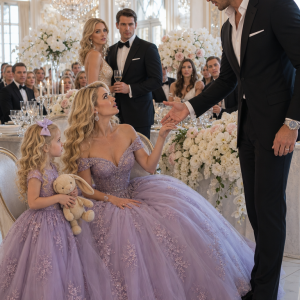
Across the ballroom, Sophie had slipped off her shoes and was dancing with Natalie. Her yellow skirt spun around her like sunlight, and both of them were laughing so freely that several guests stopped to watch.
“Yes,” I said. “I truly am.”
Grant followed my gaze. “I thought you’d never get over us.”
“That belief was useful to you.”
For once, he did not argue.
The Box That Opened the Past

Grant and Brooke left separately. They remained together for several weeks, wondering whether a life built partly on concealment could be repaired by honesty. Grant complained that Andrew had known about Sophie, but Andrew reminded him that my daughter’s life was not family gossip and that Grant could have learned about my world by treating me with ordinary decency after our divorce.
Three months after the wedding, Grant moved out. I heard the news from Natalie and felt neither triumph nor sadness. Their ending belonged to them, just as their secrets had.
Brooke, however, kept her promise.
Her email arrived at nine the morning after the wedding. It was six lines long. She offered no excuses and asked for no immediate forgiveness. She wrote only that she wanted to do whatever Sophie’s therapist believed would be healthiest, even if that meant waiting.
Our first meeting took place two months later in a counselor’s quiet office. Sophie sat in a blue beanbag chair with the hospital photograph in her lap. Brooke sat across from her holding a carved wooden box.
Inside were pieces of Ethan’s life: copies of his untidy college letters, a photograph of him laughing beside a lake, a recipe for beef stew written in hurried pencil, and a silver key ring shaped like a hockey skate.
Brooke placed the key ring on the low table. “He bought this at a roadside shop on the day we learned you were a girl.”
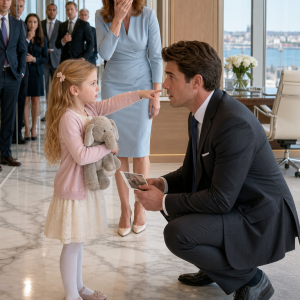
Sophie picked it up carefully. “Was he nice?”
Brooke smiled through tears. “Often. He was also messy, late for almost everything, and completely unable to put his shoes where they belonged.”
Sophie giggled.
That ordinary answer made the room safer than any grand speech. Brooke offered Sophie a real person, full of warmth and flaws, whose hands might have looked like hers.
For forty minutes, Sophie asked whether Brooke liked raspberries, whether Ethan could skate backward, and whether he feared thunderstorms. Then she reached the question beneath all the others.
“Why didn’t you keep me?”
Brooke drew a breath and looked directly into her eyes.
“I loved you, but I was young, frightened, and unprepared. I believed another family could give you a steadier home than I could then. I still have complicated feelings about that choice, and I wish many things had happened differently. But none of it was because of you. You were never unwanted, and you never did anything wrong.”
Sophie turned toward me, looking for reassurance. I nodded.
Then she reached across the table and rested her hand over Brooke’s. It was not a magical solution or instant forgiveness, simply a child acknowledging that she had heard the truth.
Over the next year, they met occasionally, first with the counselor and later with me present. Brooke became an important, aunt-like person in Sophie’s life, never a replacement for me. She sent birthday cards, attended a school play, and learned to ask before entering the parts of our life that belonged only to Sophie and me. Healing did not move in a straight line, but it moved.
Grant never returned to my life. Fourteen months after the wedding, he sent a brief email. He admitted that he had been wrong about my ability to become a mother. Watching Sophie run into my arms with complete trust, he wrote, had shown him something about love and family that he should have understood years earlier.
I read the message twice and closed my laptop.
There was a time when I would have given almost anything to hear those words. By the time they arrived, I no longer needed them. His apology could not grant me worth because my worth had never truly been his to take away.
When I remember that October wedding, I do not think first of Grant’s bewilderment or Brooke’s fear. I remember Sophie in the bridal room, purple icing on her cheek, asking whether she had done something wrong merely by recognizing a face and speaking the truth.
For years, the adults around her had carried private burdens. Grant carried resentment. Brooke carried shame. I carried the old belief that motherhood was a door my body had closed forever. Sophie had carried none of those things until our unfinished history suddenly landed at her feet.
Driving home beneath the dark outline of the Hudson hills, while she slept in the back seat with her stuffed fox beneath one arm, I made myself a promise. Sophie would learn every truth about where she came from when she was ready, but she would never be asked to carry responsibility for choices made before she could speak her own name.
Five years of silence ended at a wedding, not because I planned a confrontation and not because Grant finally understood the harm he had caused. It ended because a brave little girl recognized someone from a faded picture, ran toward the mother who had raised her, and opened a door the adults had been too frightened to touch.
The truth did not repair every relationship. It did something quieter and more valuable: it gave Sophie a story in which she had never been the secret, the mistake, or the burden. She was, and had always been, the child at the center of many imperfect choices—and the beloved daughter at the center of my life.