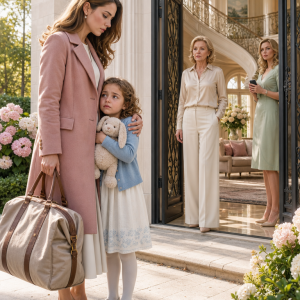
Natalie paused.
“Yes.”
Carol arrived carrying a bag of clementines and a puzzle for Ellie.
After greeting her granddaughter, she asked Natalie if they could talk privately.
They sat at Diane’s kitchen table.
Carol looked strangely uncertain.
Perhaps being uncomfortable in someone else’s house was useful.
“Ryan told me how upset you are,” she began.
“It’s more than being upset.”
Carol nodded.
“I know.”
She looked down at her hands.
“I’ve been thinking about that ledger.”
Natalie waited.
“I didn’t understand why it would hurt you. I’ve kept records my entire adult life. At the dental office, everything had to balance. Money in, money out, supplies, hours. I still think that way.”
“I’m not an expense category, Carol.”
Carol closed her eyes briefly.
“I know that now.”
Natalie had not expected the answer.
Carol continued.
“In my head, you were staying in my house, utilities were higher, groceries cost more, and you were helping with things. I thought of it as everyone contributing.”
“Helping wasn’t the problem. I would have helped anyway.”
Carol looked puzzled.
“Then what was?”
Natalie decided not to soften it.
“You turned help into a debt I never agreed to owe. Every meal I cooked and every room I cleaned became another payment in your mind.”
Carol stared at the table.
“Maybe that’s true.”
“And I felt as though the payment was never finished.”
Outside, Ellie laughed at something her grandfather had said.
Carol’s eyes moved toward the window.
“What I said about you not earning money was wrong.”
Natalie’s throat tightened.
“Ellie heard you.”
“I know.”
“That’s what changed everything for me. I kept thinking I could tolerate it because we were adults and this was temporary. Then I realized she was learning from us. She was learning what a mother is supposed to accept. She was watching me become available to everyone all day long and hearing people talk as if I contributed nothing because nobody handed me a paycheck.”
Carol was quiet for a long time.
Then she said, “That’s how I lived.”
Natalie looked at her.
Carol folded her hands.
“When George and I first married, we lived with his mother. I worked all day, came home, cooked for everyone, cleaned, washed clothes. Nobody asked me whether I wanted that arrangement. It was simply what women did in that house.”
Her voice softened.
“I suppose somewhere along the way I stopped remembering how much I hated it and started believing it was normal.”
Natalie felt something she had not expected.
Compassion.
But compassion did not require surrender.
“Something being done to you doesn’t make it something you have to pass on.”
Carol nodded.
“No.”
Then she looked toward the yard where Ellie was playing.
“Especially not to her.”
There was no dramatic embrace.
Natalie did not say everything was fine.
Everything was not fine.
Instead she said, “I don’t hate you, Carol. But things have to be different.”
“Tell me what that means.”
“Call before coming over. Don’t reorganize my house. Don’t treat my work as a cute hobby from my past. And decisions about Ryan and me belong to Ryan and me.”
Carol swallowed.
“All right.”
Her eyes drifted toward the windowsill.
One of Natalie’s damaged plants sat there, and a tiny new leaf had begun to unfold near the stem.
Carol smiled faintly.
“That one made it.”
Natalie followed her gaze.
“Barely. It’s stubborn.”
Carol gave a tired little laugh.
“Sometimes stubborn things survive.”
The Work That Had Always Counted
They moved back into the condo near the end of winter.
Paul was gone.
The kitchen smelled of fresh paint and new wood.
Ellie ran from room to room as though she had been away for years.
“My room! My bed! My books!”
Natalie walked more slowly.
She touched the hallway wall.
Opened the kitchen cabinets.
Stood near the living-room window.
Ryan came up behind her.
“You okay?”
She turned toward him.
“Yeah.”
Then he asked again.
“Are you sure?”
Natalie smiled.
“Thank you for asking twice.”
Ryan understood what she meant.
The surviving plants returned to the windowsill.
Ellie chose a small violet for herself.
“This one is mine.”
“Then you’re responsible for it,” Natalie said.
Ellie considered this.
“Okay. But if I forget, you can remind me.”
“Deal.”
A few weeks later, Natalie found her old portfolio in a moving box.
She sat at the dining table and opened it.
For months she had avoided looking inside.
The last completed pages seemed to belong to another woman—someone who knew exactly what shades of blue belonged beside gray, how much white space an invitation needed, how a single painted branch could make thick paper feel elegant.
Natalie picked up a pencil.
Her hand felt awkward at first.
She sketched a few leaves.
Then a wreath.
Then tiny wildflowers curling around the edge of an imaginary card.
Ryan walked past the table.
He stopped.
“That’s beautiful.”
Natalie looked up, expecting him to say something about finding clients or making money again.
Instead, he smiled.
“I’m glad you’re doing this.”
Then he continued toward the kitchen.
Two weeks later, a former client emailed Natalie and asked whether she still accepted custom stationery orders.
Natalie almost typed no.
She stared at the screen.
Then she looked at her portfolio.
She wrote:
“Yes. I’m taking a few projects again.”
The first commission was small—anniversary cards for a couple celebrating twenty-five years together.
Then came a set of wedding invitations.
Then a family wanted a hand-painted crest for their new home.
Natalie worked at the dining-room table while Ellie colored beside her.
On two afternoons each week, Ryan took Ellie to the library or playground so Natalie could work uninterrupted.
By spring, Natalie created a simple online portfolio.
By early summer, she had enough commissions to rent a desk in a shared studio with two other local artists.
She did not become wealthy.
That was never the point.
One afternoon, a client sent payment for a large stationery order while Ellie was sitting beside Natalie eating apple slices.
Natalie’s phone chimed.
Ellie leaned toward the screen.
“Did somebody pay you for your pictures?”
“They did.”
Ellie’s eyes widened.
“So you do know how to make money.”
Natalie stopped.
For one second, the old living room at Carol’s house returned to her—the blocks on the rug, the green piece of grass, the sentence her little girl had repeated without understanding its weight.
Natalie crouched beside her daughter.
“Listen to me, sweetheart. Mommy always knew how to work.”
Ellie watched her seriously.
“Even when I stayed home with you, I was working. Taking care of you mattered. Cooking mattered. Cleaning mattered. Making sure you were safe and loved mattered. Nobody has to hand someone money for their work to have value.”
Ellie thought about this.
“And now you paint because you want to?”
Natalie smiled.
“Exactly.”
Ellie nodded.
That answer seemed to satisfy her.
That evening, Natalie opened her old portfolio and turned to the very first page, faded slightly from years of use.
Beneath an early watercolor sketch, she wrote one new sentence:
Never confuse gratitude with an obligation to disappear.
Then she closed the book.
From the living room, she heard Ryan helping Ellie put away her toys.
“Dad, that doesn’t go there.”
“Where does it go?”
“You have to ask me. They’re my things.”
There was a pause.
Then Ryan laughed.
“Fair enough. Where would you like me to put it?”
Ellie began issuing extremely specific instructions.
Natalie laughed quietly to herself.
That was when she understood that the story had not truly ended the afternoon she carried a suitcase out of Carol’s house.
It had taken much longer.
Carol had to learn that generosity did not give her authority over another adult’s life.
Ryan had to learn that staying neutral while his wife carried everything was not actually neutrality. Comfort had simply allowed him to avoid choosing.
And Natalie had to learn something perhaps even more important.
She did not need someone else to be cruel before she was allowed to set a boundary.
She did not need a villain.
She did not need screaming, insults, or some dramatic final offense that everyone else would immediately understand.
Sometimes a person could love you and still become so accustomed to what you provided that they stopped noticing what providing it cost you.
Sometimes families did not fall apart because someone finally said no.
Sometimes the word no was the first honest thing anyone had said in years.
And sometimes walking out of a house was not the end of a family at all.
Sometimes it was how everyone finally learned what a home was supposed to feel like.