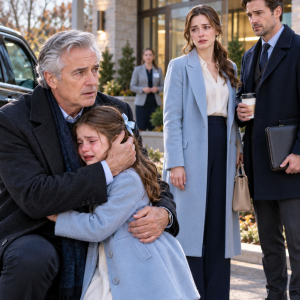
I helped Emma into her coat and knelt beside her.
“Can you walk okay, or do you want me to carry you?”
“I can walk.”
She took my hand.
I remember that detail clearly because she held it with both of hers.
As we stepped outside, Rebecca called my name again.
I did not answer.
For the first time that evening, I understood that I did not need to solve my marriage before leaving the driveway.
I needed to help my daughter.
Everything else could wait.
What the Doctor Saw
The pediatric urgent-care center was attached to a larger hospital in a suburb west of Madison, and although the waiting room was busy, the nurse at the desk brought Emma back quickly after hearing why we had come.
A pediatric physician named Dr. Caroline Pierce examined her while a family-support specialist sat nearby.
I remained beside Emma throughout the examination.
The doctor spoke to her directly, explaining what she was doing before touching her and stopping whenever Emma became uncomfortable.
That mattered.
I could see Emma gradually relax as she realized nobody in the room was going to rush her.
Imaging showed no serious bone injury, which brought a relief so profound that I had to sit down.
Still, Dr. Pierce was concerned about the extent of the soreness and, especially, the presence of several older marks.
She asked Emma questions gently.
Had she fallen recently?
Had she been hurt while playing?
Did anyone at home ever grab her when angry?
Emma answered slowly at first.
Then more confidently.
I sat several feet away, listening as my daughter described moments I had never known about—being grabbed too firmly by the upper arm, being pushed toward her room during arguments, being told not to make her mother angry, being warned that if she complained to me, our family might fall apart.
None of the individual stories sounded dramatic when Emma told them.
That somehow made them harder to hear.
They sounded ordinary to her.
That was the part I could not forget.
The family-support specialist, a calm woman named Megan, explained that the hospital was required to document what Emma had shared and contact the appropriate child-welfare authorities so the situation could be reviewed properly.
I nodded.
I had no argument.
My phone began vibrating inside my jacket.
Rebecca.
Then again.
And again.
I finally looked.
There were messages asking me to come home, apologizing for losing her temper, insisting that I was misunderstanding everything, and warning that involving outsiders would permanently damage our family.
One message stayed with me.
You’re choosing strangers over your wife.
I stared at those words for several seconds.
Then I looked through the half-open examination-room door.
Emma was sitting on the edge of the bed with a sheet of paper on her lap while Megan helped her draw a house surrounded by enormous flowers.
My daughter was not asking me to choose strangers over my wife.
She was asking whether she could trust her father.
The answer suddenly seemed very simple.
I showed the messages to Megan and later to the officer who arrived to document the situation.
The next few hours became a blur of questions, forms, names, phone calls, and explanations.
Emma grew tired around midnight, and eventually she fell asleep with her head against my shoulder.
I sat completely still because I did not want to wake her.
Looking down at her face, I remembered the day she was born, when I had stood beside a hospital window holding a bundle so small I was afraid even to breathe too heavily.
Back then I had thought protecting a child meant keeping the doors locked, driving carefully, saving money, buying medicine when she was sick, and making sure strangers could never harm her.
I had never considered that protection might someday require believing her when the truth threatened the life I thought I knew.
The Things I Had Missed

Emma and I did not return to the house that night.
We stayed with my older sister, Claire, who lived twenty minutes away with her husband and teenage son.
Claire did not ask questions in front of Emma.
She simply prepared the guest room, found an extra night-light, and placed a stuffed rabbit on the pillow.
Emma slept for nearly eleven hours.
I barely slept at all.
The following days were filled with interviews and appointments.
Rebecca was instructed to remain away from Emma while the situation was evaluated, and temporary arrangements were put in place so my daughter could stay exclusively with me.
I contacted an attorney.
I also canceled every upcoming business trip on my calendar.
For years I had been proud of my career because it allowed us to live comfortably, but suddenly hotel points, promotions, and expense accounts seemed like artifacts from another man’s priorities.
Three days later, I returned to the house while Emma stayed with Claire.
The place looked exactly as I had left it.
That felt strange.
The same family photographs lined the staircase. Emma’s backpack hung beside the kitchen. A bowl of apples sat on the counter.
Ordinary objects can become almost unbearable when you realize they belonged to a version of your life that no longer exists.
I walked through the rooms slowly, remembering things I had dismissed.
Emma becoming unusually quiet whenever Rebecca corrected her.
Long sleeves during warm weather.
The way she sometimes asked exactly when I would be home.
A phone call from Indianapolis when she had started crying for no apparent reason, only to tell me a minute later that she was fine.
I had believed what I wanted to believe.
That realization carried its own weight.
While gathering documents from the desk in our bedroom, I found a small notebook tucked beneath several folders.
It belonged to Rebecca.
I did not read every page, but what I saw was enough to deepen my concern.
There were entries about feeling trapped, overwhelmed, and resentful whenever I traveled. Several pages described arguments with Emma and Rebecca’s frustration when our daughter cried or resisted punishment.
The notebook did not answer every question.
People write complicated things when they are upset, and I knew professionals—not me—would determine what mattered.
So I stopped reading, placed it aside, and contacted my attorney.
That afternoon, I sat alone at the kitchen table until the room became dark.
For years I had believed the greatest danger to my family was instability.
Losing my job.
Not earning enough.
Missing a mortgage payment.
Failing to provide.
Now I understood something I wish I had learned sooner: a peaceful-looking home is not necessarily a peaceful home, and financial security cannot substitute for emotional safety.
Learning to Listen Again
The following months were not easy.
There were court appointments, counseling sessions, difficult conversations, and many evenings when Emma asked questions I did not know how to answer.
“Is Mom mad at me?”
“Did I cause this?”
“Are we still a family?”
I learned not to rush those questions.
At first, I wanted to fix everything with reassuring sentences.
I wanted to tell her that nothing would ever hurt again, that I would make everything right, that she never needed to worry.
But her counselor taught me something important: children who have learned to distrust their own feelings do not need grand promises nearly as much as they need adults who consistently tell the truth.
So I stopped promising perfection.
Instead, I told her what I knew.
“You didn’t cause the grown-up problems.”
Or:
“You’re allowed to tell me when something hurts or scares you.”
And sometimes:
“I don’t know yet, but when I do, I’ll tell you.”
Those answers seemed small.
Over time, they rebuilt something enormous.
Trust.
I also changed jobs.
A former colleague helped me find an operations position with a local manufacturing company, which meant less money and considerably less prestige, but I could leave work most afternoons before four-thirty.
I accepted immediately.
We eventually moved to a smaller house near Verona, where Emma could walk to an elementary school surrounded by maple trees and quiet streets.
The house was nothing impressive.
Three bedrooms.
A modest kitchen.
A backyard with a crooked wooden fence.
I loved it the first time I saw it.
Emma chose the upstairs bedroom facing the backyard and asked if we could paint one wall pale blue.
We spent an entire Saturday doing it ourselves.
Most of the paint ended up where it belonged.