“Since he left.”
I stood so quickly my chair scraped against the floor.
“Thirteen years?”
“Rebecca—”
“You knew where he was for thirteen years?”
“Yes.”
I stared at my father, the man who had helped me survive every difficult year, and felt something inside me shift.
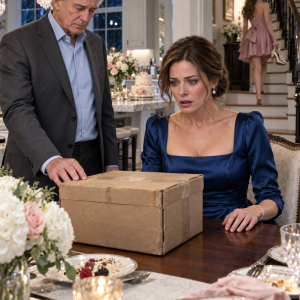
He pushed the box toward me.
“Before you decide what you think of me, open it.”
I tore through the tape.
On top was a letter.
Nathan had written it the night before he left.
His first paragraph destroyed the explanation I had spent thirteen years constructing.
Four months before Sophie became ill, Nathan had learned that he had a progressive neurological condition.
He had hidden it from me while undergoing additional evaluations because he wanted to understand what his future might look like before frightening me.
Then Sophie was gone.
And Nathan, already terrified about his own future, watched me struggle simply to get through each day while caring for Claire.
He made a decision.
A terrible decision, perhaps.
But not the one I had believed.
He decided that if he stayed, eventually I would become responsible not only for my grief and for raising Claire, but also for helping him through an increasingly difficult medical condition.
So he removed himself.
Not because he stopped loving us.
Because, in his distorted and frightened understanding of love, he believed leaving would protect us.
I lowered the letter.
“You knew?”
Dad nodded.
“He told me before he left.”
I could barely speak.
“And you let me believe he abandoned us?”
Dad’s eyes filled.
“I wanted to tell you hundreds of times.”
Under the letter were folders.
Financial statements.
Every month for thirteen years, Nathan had sent money to my father, who had quietly used it whenever Claire and I needed help. The summer-camp fee Dad had supposedly paid. Part of Claire’s orthodontic work. Emergency repairs when my furnace failed. Contributions to her college account.
I had believed my father was helping us from his own savings.
Some of it had come from Nathan.
“He knew I wouldn’t take it from him,” I said.
“Yes.”
“So he sent it through you.”
“Every month.”
There were medical records too, documenting years of treatment and gradual changes in Nathan’s condition.
Then I found a photograph.
He was sitting beside a window in a small apartment, visibly older, thinner than I remembered, but unmistakably Nathan.
He was smiling.
At the bottom of the box was another letter, much shorter than the first.
He wrote that Claire was eighteen now and deserved the truth. He apologized for the silence. He said my father had sent him photographs once or twice a year, allowing him to watch our daughter grow from a distance.
Then came a sentence that broke whatever composure I had left.
She laughs like Sophie now.
Nathan wrote that he had heard it in a short video Dad sent the previous Christmas and replayed it more times than he could count.
I looked at my father.
“You sent him pictures of her?”
“Every birthday. Usually Christmas too.”
“Without telling me.”
“Yes.”
I wanted to be furious.
Part of me was.
But then Dad said quietly, “I watched you rebuild your life one inch at a time, Rebecca. Every year I thought, this is the year I tell her. And every year I became afraid that I would tear open something you had finally managed to close. I was wrong. I understand that now.”
I looked back at the box.
There was one final envelope.
Inside was a note concerning Sophie.
Years after leaving, Nathan had undergone extensive genetic screening as part of his own medical care. That testing led him to revisit the rare condition Sophie had been born with, and further consultation suggested there could be a hereditary component from his side of the family.
That meant Claire needed to be evaluated.
The note was direct.
Please have her screened. If she carries the same vulnerability, doctors may be able to monitor and manage it. Do not wait because of me.
I called my father at two in the morning.
He answered immediately.
“Dad, Claire needs an appointment.”
There was a pause.
Then he said, “Monday at nine.”
I sat upright.
“What?”
“I arranged it last week. I knew what was in the envelope.”
I should have been angrier.
Instead, I started crying.
“You should have told me.”
“Yes,” he said. “I should have. Loving you did not give me the right to decide what truth you could handle.”
That sentence stayed with me.
The Truth Claire Deserved
Claire’s screening showed no sign of the inherited condition.
When the specialist explained that to me, relief moved through my body so strongly that I had to cover my face with both hands.
Claire was safe.
That evening, I told her everything.
We sat at the same kitchen table where Nathan had left thirteen years earlier and where my father had placed the box two nights before.
Claire listened without interrupting.
I told her about Nathan’s diagnosis.
I told her why he believed he had to leave.
I told her about the money.
The photographs.
The birthday phone calls.
The medical research.
Sophie.
Everything.
When I finished, Claire stared at the table for a long time.
Finally she said, “So he thought leaving us was taking care of us.”
“Yes.”
“That’s incredibly sad.”
“It is.”
She looked at me.
“Do you forgive him?”
I considered the question.
“I understand him better. That isn’t exactly the same thing.”
Claire nodded slowly.
“Was he wrong?”
“Yes.”
“Even if he did it because he loved us?”
“Especially then,” I said gently. “Love doesn’t give us permission to make someone else’s choices for them.”
She turned her glass between her palms.
“But he really did love us.”
“Yes.”
That truth was perhaps the hardest one.
Nathan had loved us.
And Nathan had hurt us.
Neither truth erased the other.
After a while Claire asked, “Are you going to see him?”
I had been asking myself the same question since opening the box.
“Yes.”
Her answer came immediately.
“Then I want to come.”
The Garden

Nathan was living in a residential community about two hours away, where he could remain largely independent while having help nearby when he needed it.
Claire and I drove there the following Saturday.
During the trip, she asked me about Sophie—not about what happened to her, but about who she had been.
So I told her.