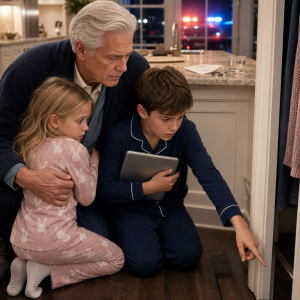
“You frightened the baby. Lower your voice, or leave.”
She took a step forward.
“I drove forty minutes because your sister is beside herself. Her children are expecting those tablets, and you are sitting here ignoring everyone.”
“I just had a baby.”
“Women have babies every day, Claire. That doesn’t excuse turning your back on your family.”
The sentence settled over me with surprising clarity.
She had not come to help. She had not brought a meal, offered to hold June, or asked whether I had slept. She had come to collect money.
“I’m not paying for the tablets,” I said. “And I’m not covering Lauren’s bills anymore.”
My mother’s face flushed.
“You have a secure city paycheck. Lauren doesn’t have that kind of stability.”
“Then she needs a plan that doesn’t depend on my paycheck.”
“After everything this family has done for you, this is how you behave?”
I wanted to ask what she believed they had done for me. Instead, I looked down at June, whose small hand had closed around the fabric of my shirt.
“Please give me the key and leave.”
“I am your mother. I don’t need permission to visit.”
“You need permission to enter my home.”
She searched my face, perhaps waiting for the old Claire to return—the daughter who became nervous whenever anyone was unhappy with her. When I held out my hand and remained silent, she removed the key from her ring and dropped it onto the coffee table.
At the door, she turned back.
“One day you’ll need us, and you’ll remember this.”
“Maybe I will,” I said. “But you still have to leave.”
After she drove away, I locked the door, sat on the couch, and cried quietly while June slept against my heart. The tears were not regret. They were grief for the loving family I had spent years pretending we might become if I only gave enough.
When My Body Said Enough
The following days brought no peace. My mother and sister alternated between blame, warnings, and carefully designed emergencies.
“Lauren’s electricity may be disconnected.”
“The boys think you don’t love them.”
“Your father would be ashamed of the way you’re treating us.”
I did not block their numbers because I told myself I might need the messages as documentation. The more honest reason was harder to admit: I kept hoping one of them would eventually ask whether I was all right.
Neither did.
Ten days after June’s arrival, I stood at the kitchen counter preparing a bottle when the room seemed to tilt. A powerful pressure gathered behind my eyes, the light became painfully bright, and my hands trembled so badly that the formula scoop slipped onto the floor.
I placed June safely in her bassinet and called Marissa, who lived two houses away.
She arrived within minutes, still wearing gardening gloves. One look at me was enough. She wrapped June in a blanket, helped me into the passenger seat, and drove us to the hospital.
My blood pressure had risen to a dangerous level. The physician explained that I was experiencing postpartum preeclampsia and needed immediate monitoring and medication. Stress had not created the condition by itself, but it had placed an already vulnerable body under an additional burden.
When I called Owen, he listened without interrupting.
“What room are you in?”
I told him.
“I’m coming home.”
“Owen, the bridge inspection—”
“They have another engineer taking over. I’m already packing.”
He arrived early the next morning, still wearing work boots marked with dried mud. He kissed June, rested his forehead against mine, and sat beside the bed without letting go of my hand.
For a while, neither of us spoke.
Then he asked, “May I see the messages?”
I handed him my phone.
He read slowly, taking screenshots and recording dates. His expression remained controlled, but I noticed his jaw tighten when he reached the messages sent during the hours before I returned to the hospital.
“Why didn’t you tell me it had become this bad?”
“You were dealing with the flooding. I didn’t want to add another problem.”
Owen looked at me for a long moment.
“Claire, you are not a problem I have to manage. You’re my wife. There’s a difference.”
That sentence reached a place in me I had guarded for years. In my childhood home, needing help had always been treated as a weakness unless Lauren was the person asking. I had learned to make myself easy, competent, and useful. Even with a kind husband, I had carried the fear that love might disappear if I became inconvenient.
Owen pulled his chair closer.
“You don’t have to earn your place in this family,” he said. “You already belong here.”
From my phone, we sent one final notice explaining that I needed quiet while recovering, that no one was permitted to enter our home without an invitation, and that requests for money would no longer receive a response.
My mother called almost immediately.
Owen silenced the phone and placed it in the drawer beside my bed.
“Rest,” he said, pulling the blanket over my shoulders. “June and I are right here.”
Those words gave me something my own family had rarely offered: permission to stop managing everyone else long enough to care for myself.
The Ledger Owen Never Expected to Find

When I returned home, Owen changed the locks and installed a camera near the front door. He also helped me organize every message, transfer, and email into dated folders.
At first, I thought he was being excessively thorough. Then we opened my banking records.
Over six years, I had sent my mother and sister nearly seventy-three thousand dollars.
The number did not include groceries purchased directly, furniture delivered to Lauren’s apartments, or school expenses I had paid without reimbursement. It also did not include the countless hours I had spent calling landlords, arranging payment plans, revising résumés Lauren never used, and calming my mother whenever a crisis appeared.
Seeing everything collected in one place changed the way I understood the past.
The money had never solved their problems. It had merely postponed the moment when they would have to change.
My mother answered our boundary with a long email about loyalty. She described every sacrifice she had made raising us and accused Owen of turning me against my family. Lauren wrote that I had embarrassed her in front of her sons. Then, when neither approach worked, she sent Owen a message that was different from the others.
“Ask Claire what she really knows about her father’s finances. There are things in that family history she wouldn’t want the city reviewing.”
My father had been gone since I was thirteen. He had been a gentle, withdrawn man who avoided disagreement, and Lauren’s vague warning awakened every old fear my family had taught me to carry.
Because I handled municipal budgets, even the suggestion of hidden financial wrongdoing frightened me. I imagined an anonymous complaint reaching my supervisor. I pictured an investigation based on records I had never seen. For several minutes, I considered sending the money simply to make the threat disappear.
Owen sat across from me at the dining table.
“If she had real information, she would state it clearly,” he said. “She wants you frightened enough to obey.”
“What if there’s something I don’t know?”
“Then we learn the truth. We don’t pay for silence.”