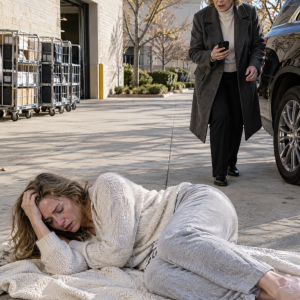
There it was.
Not whether Lucy’s treatment could finally continue.
Not whether I could afford to stay home.
Not whether my shoulder still hurt.
When do you get it?
I shrugged.
“Soon.”
That was all I gave them.
Mom sat down.
“Well, then we need to be smart.”
I almost smiled.
“About what?”
“Taxes. Property. Investments. You shouldn’t rush into anything because you’re upset.”
Brianna nodded.
“Exactly.”
Lucy stood beside the front door holding her bag.
Neither of them looked at her.
I let the silence stretch.
Then Mom said:
“You could finally buy that bigger house we talked about.”
“We?”
She blinked.
“The family.”
I looked at Lucy.
Then back at Mom.
“Right.”
I picked up the bag.
“We’ll talk later.”
Mom followed us outside.
“Nathan, don’t sign anything until we sit down together.”
I opened the passenger door for Lucy.
“Okay.”
Mom relaxed slightly.
She thought she still had time.
That was exactly what I needed her to think.
I Let Them Tell Me What They Wanted
For the next three days, my phone barely stopped.
Mom sent listings.
Five-bedroom houses.
One had a finished basement Brianna could use for her business.
Another had an in-law suite.
Brianna sent me a link to a commercial property that could expand her salon.
Nobody sent me information about Lucy’s treatment.
Nobody asked what the doctor had said.
Mom did text once:
“Hope Lucy is feeling better.”
Thirty seconds later, another message arrived.
“Did your attorney say when the settlement clears?”
I took screenshots.
Not because I needed some complicated legal case.
I needed to stop lying to myself.
For four years, I had explained everything away because Theresa was my mother.
A new SUV? She deserved something reliable.
New floors? The old ones were worn.
Brianna’s business? Maybe Mom had loaned her money.
Lucy sounding tired? She was stressed.
Every explanation required me to assume the best.
Lucy had been doing the opposite.
She had been living with the consequences.
On Friday, I asked Mom and Brianna to meet me at the house.
Lucy stayed at the apartment.
When I arrived, Mom had documents spread across the kitchen island.
Property listings.
Bank brochures.
A printout about investment accounts.
“I did some research for you,” she said.
I sat down.
“Before we talk about the million, I want to talk about the hundred thousand.”
Her hands stopped moving.
Brianna leaned back.
“Again?”
“Again.”
I placed my phone on the counter.
“I want an accounting of where my money went.”
Mom’s voice cooled.
“I don’t have receipts for four years of living expenses.”
“I’m not asking for grocery receipts.”
I pointed toward the driveway.
“SUV.”
Then the floor.
“Renovation.”
Then Brianna.
“Salon.”
Brianna stood.
“You don’t own my salon.”
“Did my money pay for it?”
“Mom invested in me.”
“With whose money?”
She looked at Theresa.
Mom gathered the property listings into one stack.
“You sent that money to me voluntarily.”
Finally.
The sentence I needed.
“Yes.”
She looked almost relieved.
“Then you can’t come back years later and dictate every dollar.”
“You’re right about one thing. I trusted you with it voluntarily.”
Mom’s expression shifted.
“Nathan—”
“I sent it because you promised to take care of Lucy.”
“I did.”
I took the piece of broken ceramic from my pocket and placed it on the island.
Mom stared at it.
“What’s that?”
“The plate she was picking up when I came home.”
Nobody spoke.
“She told Brianna she hadn’t eaten since the day before.”
Brianna crossed her arms.
“She could’ve eaten whenever she wanted.”
I looked at her.
“Then why didn’t she?”
No answer.
I slid the ceramic piece toward Mom.
“You told me everybody was taken care of.”
Mom’s face tightened.
“I did the best I could.”
“Then the best you could do isn’t good enough anymore.”
I stood.
“The transfers are finished.”
Mom pushed back her chair.
“What about the settlement?”
I picked up my phone.
“What about it?”
“You said we would talk.”
“We just did.”
Her voice rose for the first time.
“Nathan, you cannot throw away a million dollars because you’re angry.”
“I’m not angry about the million.”
“Then what are you doing?”
I looked at the hummingbird necklace still hanging around her neck.
“Taking my wife home.”
The One Thing I Asked For
I didn’t sue my mother for every dollar.
My attorney explained that recovering money voluntarily transferred over several years would be complicated, expensive and uncertain, especially because some of it had clearly paid ordinary household expenses.
I didn’t need a courtroom to tell me what happened.
I needed boundaries.
The settlement eventually finalized, but the amount I received after fees and other deductions was less than the headline number I’d told them.
Mom never learned exactly how much.
I paid Lucy’s medical expenses directly.
I rented us a quiet apartment close to her treatment center, and for the first time in four years, I stopped taking overtime.
My shoulder still bothered me, but I found lighter work a few months later.
Lucy slowly started eating regularly again.
Her treatment wasn’t easy, and I won’t pretend everything became perfect because I came home. Some mornings she barely spoke. Some nights I woke up and found her sitting at the kitchen table because she couldn’t sleep.
But she wasn’t alone anymore.
About two weeks after we left Mom’s house, Theresa called.
“Can we please stop doing this?”
I was washing dishes.
“Doing what?”
“Punishing each other.”
I dried my hands.
“I asked you for one thing.”
“What?”
“Take care of Lucy.”
Mom was quiet.
“I had an entire household to manage.”
“I know.”
“Brianna needed help too.”
“I know.”
“And you weren’t here.”
That one landed because it was true.
I looked toward the living room.
Lucy was asleep on the couch with a blanket pulled over her legs.
“You’re right,” I said. “I wasn’t.”
Mom’s voice softened.
“Then you understand.”
“No. That’s why I sent the money.”
She didn’t answer.
A few seconds later, I asked about the necklace.
Mom sighed.
“Seriously?”
“Yes.”
“After everything, that’s what you’re worried about?”
“It’s Lucy’s.”
“She was going to sell it.”
“Because she needed a doctor.”
Silence again.
Then Mom said:
“Fine.”
The necklace arrived in a padded envelope four days later.
No note.
Lucy opened it at our kitchen table.
The silver hummingbird was slightly scratched, but otherwise it looked the same.
She held it in her palm.
“I don’t want to wear it.”
“You don’t have to.”
She looked at me.
“I thought about selling it so many times.”
I pulled out the chair across from her.
“Then sell it.”
She smiled a little.
“You bought it for me.”
“Which means it’s yours.”
She closed her fingers around it.
A month later, I found the necklace hanging from the corner of the bathroom mirror.
She still didn’t wear it.
That was fine.
Some things don’t have to go back to what they were.
One Saturday morning, Lucy was making toast when I heard something break in the kitchen.
I came around the corner too fast.
A white plate had slipped from her hand and shattered across the floor.
Lucy froze.
Then she looked at me.
For half a second, I saw the backyard again.
The bucket.
The oversized cardigan.
Her knees against the concrete.
I reached for the broom.
Lucy stopped me.
“I can help.”
I handed her the dustpan.
We cleaned it up together.
When the last piece was gone, Lucy threw the bag into the trash, washed her hands, and went back to making breakfast.
This time, there was food waiting for her.