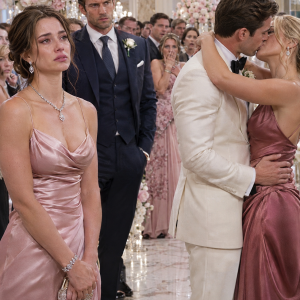
I took the suitcase and walked out. The rain met me at the entrance, cold against my face. One of the guards opened the car door; neither man tried to stop me. As the gates closed behind us, my hands shook in my lap.
My phone buzzed before we reached the end of the drive.
You can leave the house, Julian wrote. But you’re not taking my daughter out of my life.
I looked down at my belly. The baby moved under my hand. I had thought leaving the mansion would be the hardest part. Now I understood that Julian might let me go physically while still believing he could decide what happened next.
A Small Apartment and a Larger Truth
The first night in my apartment, I woke reaching across the mattress for Julian. My hand found only an empty space and a cool sheet. For eight years, I had organized my life around his routines: the coffee he drank before meetings, the way he loosened his collar when he came home tired, the quiet kiss he sometimes left on my forehead when he thought I was asleep.
Now I wondered how many of those kisses had followed an evening with Vanessa.
The apartment had one bedroom, a narrow kitchen, and a shower that rattled when I turned on the hot water. It was small enough that I could see almost all of it from the bed, and every inch belonged to me. I could lock the door, make tea, and choose which cup to use without wondering whether someone else would take it.
I had bought a plain white mug on my way there. It cost almost nothing. When I wrapped both hands around it the next morning, I cried, then laughed at myself for crying over a mug. The feelings were not really about the cup, of course. They were about being able to choose something small for myself without asking permission.
Julian sent eleven messages before dawn. He wanted to know where I was, told me to come home, and insisted we were not separating. I answered only that I was safe and that he should contact Rhea about practical matters.
He called soon after.
“You’re pregnant, alone, and you left with one suitcase,” he said. “You can’t manage everything yourself.”
“I’m managing.”
“For how long?”
“As long as I need to.”
He asked me to come home. I asked whether Vanessa was gone. After a pause, he said that wasn’t the point.
“It is to me,” I told him. “Will you end your relationship with her?”
He wouldn’t answer over the phone. I ended the call before he could ask me to return without offering anything that would make returning safe.
At my first appointment with Dr. Palmer, my new obstetrician, I explained that my living situation had changed. She didn’t ask for gossip; she asked whether I felt safe and whether I had support. Then she checked on the baby. When I heard the steady rhythm of her heartbeat, I covered my face and cried with relief.
That evening, Vanessa texted me from an unfamiliar number. She said there were things Julian hadn’t explained and asked if she could call. I nearly refused, but there were gaps in my understanding that had kept me awake, and I wanted to hear the truth from someone who had been there.
She admitted that she and Julian had known each other for years, long before our wedding. When I asked whether there had been a time during my marriage when they were not involved, she was quiet.
“Not really,” she said at last.
She told me Julian had never promised to leave me. He had said there was room in his life for both of us, and that eventually I would understand his world.
“Did he tell you I’d agree?” I asked.
“He said you understood him. That you’d never break up the family over something he could manage.”
I sat down slowly. He had mistaken my love for a lack of limits. Vanessa had believed him.
“I’m not leaving because I think he loves you more,” I said. “I’m leaving because he believed he had the right to decide how little respect I deserved. And you helped him believe that.”
She said she was sorry I was hurting. It wasn’t the apology I wanted, but I no longer intended to spend my life asking people to feel remorse before I could act.
I called Rhea and told her what Vanessa had said. Together we put my position in writing: I would remain in my own home, continue independent medical care, and discuss responsible arrangements for our daughter. I would not return to the mansion under conditions that required me to accept Julian’s relationship with Vanessa or give him control over where the baby and I lived.
His attorney sent a proposal offering household expenses, a private residence, transportation, security, and medical care. It was full of familiar comforts, but the conditions asked me to return, preserve the appearance of a happy marriage, and accept Vanessa’s place in Julian’s personal life. He also wanted broad say over the decisions surrounding our child.
“He thinks this will convince me?” I asked Rhea.
“He may think you’re afraid of supporting yourself.”
Money did matter. I made a budget and saw how much I had to learn about rent, bills, and childcare. But I had worked before my marriage, and I could work again. The life I had with Julian was comfortable; it was not the only life I could have.
I declined the proposal. When Julian called, he asked why I was reducing everything to Vanessa.
“You offered me the house I just left,” I said. “You offered stability if I agreed to let you keep her.”
“I never wanted to hurt you.”
“But you knew you would.”
The line went quiet.
Then he said, “I didn’t know how to give up either of you.”
That answer hurt more than another excuse might have. It made plain that he had known I would leave if I understood the truth, so he had kept me from making that choice.
“You didn’t protect our marriage,” I told him. “You protected your ability to keep both of us.”
He wanted me to meet him face-to-face. I agreed to a meeting arranged through our attorneys. In a neutral conference room, I placed photographs and dates on the table. This time, he admitted he had been with Vanessa on our anniversary and on other nights when he had told me he was working.
“I never stopped loving you,” he said.
“Then why did you keep lying?”
He rubbed his forehead. “Because I knew what you’d do if I told you.”
“You knew I’d leave.”
He didn’t deny it.
For a moment, I wondered whether his admission should have made me feel better. It didn’t. He knew the truth would cost him something, so he had let me pay the cost instead.
When he asked whether I still loved him, I told him I did, but that I no longer trusted him. I had been afraid of making him angry, afraid of seeming ungrateful, and afraid that refusing him would make me unworthy of his love.
“I never wanted you to be afraid of me,” he said.
“You told your pregnant wife to leave because she wouldn’t accept your companion,” I answered. “Then when I tried to go, you blocked the door.”
For once, he didn’t tell me I was being emotional. We discussed the practical questions with our attorneys: finances, living arrangements, and communication about the baby. Some matters remained unsettled, but I made one thing clear: I would not come home because Julian demanded it.
The Truth I Wouldn’t Hide
 Three days after the meeting, an invitation arrived for a charity dinner I had helped organize. It was addressed to Mr. and Mrs. Julian Mercer, our names printed together in gold lettering.
The organizer called to ask whether we would attend. I nearly gave my old answer automatically, but stopped.
“I’m afraid I won’t be there,” I said. “Julian and I are living separately at the moment. I’d appreciate your discretion.”
She was kind and wished me well. I hadn’t shared the photographs or explained what had happened. I had simply told the truth.
Julian called within an hour.
“Why would you tell them we’re separated?”
“Because we are.”
“You couldn’t have said you were feeling unwell?”
I looked down at my belly. “So you wanted me to use the pregnancy as an excuse?”
“That’s not what I said.”
He was worried about people talking and about the effect on his business. I understood that privacy mattered, especially when it concerned our daughter. I had no intention of turning our marriage into public entertainment. But privacy did not require me to lie.
“I haven’t told anyone about Vanessa,” I said. “I’m not going to pretend we’re happily married to make your life easier.”
He accused me of enjoying the separation. I told him I was grieving it. He asked what I wanted from him, as if every choice I made had to be a negotiation.
“I want you to respect that I left,” I said. “I want us to handle our daughter’s future responsibly. And I want you to stop treating my decisions as threats.”
Later, Rhea called. Julian’s attorney wanted me to sign a statement saying we were only taking time apart because of the pregnancy, with no significant marital problems. I refused.
That night, Julian called again and said he had asked Vanessa to leave the mansion. For one brief moment, I felt the old hope rise in me. Then he added that Vanessa believed he was doing it because he couldn’t bear losing control of me.
“Is she wrong?” I asked.
He was quiet.
“I don’t know,” he said finally. “I couldn’t stand looking at her in the house while you were gone.”
“That isn’t the same as choosing me.”
“I know that now.”
He admitted that when I left, all he could think about was everything getting away from him. I asked whether it had occurred to him that I was afraid too: afraid I wouldn’t be allowed to leave, afraid I wouldn’t know where to go, and afraid he would make decisions about our daughter without me.
“You’re right,” he whispered. “I wasn’t thinking about what it felt like for you.”
He asked if he could see me. I wasn’t ready to meet without the protection of our attorneys, but I thanked him for listening. A few days later, a handwritten note arrived with some paperwork. Julian wrote that he had believed providing for me was enough, that he had treated honesty as optional, and that he was sorry he had made leaving feel like the only way for me to be respected.
I read it twice. It was the apology I had once hoped to hear, because he had finally named the injury rather than simply asking me to return. I missed the man who had cooked pasta for me after a late workday and sat beside me during my mother’s long illness. I missed parts of our marriage that had been real. But the good memories did not undo the years of deception.
I replied that I appreciated his acknowledgment, but an apology didn’t mean I could return to the marriage. He asked whether I would ever forgive him. I told him I didn’t know, and that even if I did, forgiveness would not necessarily make us husband and wife again.
As my due date approached, I began to prepare for the baby. I washed blankets, packed a hospital bag, and arranged the care I needed. I also arranged to return to the mansion and collect a few personal belongings. Rhea offered to come with me, and I accepted.