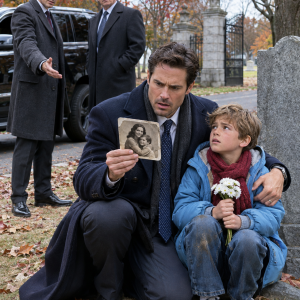
“Because I made him a promise.”
“What promise?”
She looked at me, then toward the twins.
“Not yet.”
I wanted to press her, but the boys were stirring, and she had not fully recovered. I let the question sit, though it seemed to take up more room in our apartment than the table did.
A few days later, Silas knocked at the door with a paper bag of soup. He asked if my mother would see a doctor. She resisted at first, saying she could not afford another bill, so he offered to have the visit handled through the grocery company rather than his personal account. My mother considered that carefully before agreeing, and only after making sure the arrangement would be put in writing.
The doctor said she needed medicine and rest. Her illness wasn’t serious, but she had tried to work through it for too long. When the doctor left, my mother held the prescription bottle in her hand and looked at me.
“I don’t want him buying our lives.”
“Then don’t let him,” I said.
She smiled tiredly.
“You make that sound simple.”
“Isn’t it?”
She touched the cardigan pocket where the old letter rested.
“Sometimes it’s hard to accept help from someone you don’t know how to forgive.”
Silas did not come by again for several days. Instead, someone from his grocery business visited with an offer of work for my mother: bookkeeping and inventory at a neighborhood market, with flexible hours and no heavy lifting. My mother did not like the idea that Silas had gone looking through old employment records, but the job was real, and she was qualified to do the work.
She decided to interview.
While we were sorting the application papers, she told me that she had once worked at Mercer Distribution, an old warehouse on the riverfront. I asked whether that was where the fire had happened.
Her face changed.
“There was an accident at the warehouse,” she said. “A long time ago.”
“Were you there?”
“Yes.”
“Was Silas?”
She nodded.
The next day, the school secretary called me in because the district was correcting old enrollment records. A photocopied form showed that my mother had been working at the warehouse when I was born. On a note beside her name were the words: employee absent after warehouse fire.
There was also a faded photograph of the workers standing outside the brick building. My mother was in the picture, younger than I had ever seen her, one hand resting on the shoulder of a man whose face was turned away. Her other hand rested over her middle.
She was carrying me.
When I brought the photograph home, my mother’s face went pale. She admitted that she had been at the warehouse the night of the fire, but she would not tell me more until she knew what had happened to a ledger she had kept hidden.
Silas arrived that afternoon with a folder. He saw the photograph on the table and stopped.
“I remember that day,” he said. “I remember you leaving the warehouse.”
“I didn’t leave because I wanted to.”
He looked at her as if the sentence had changed the ground beneath him.
“What happened after you left?”
My mother looked at the folder.
“Is that why you came?”
“No. We found an incident report in the company archive. It says a ledger was missing.”
Her hand tightened around the photograph.
“Then the report is incomplete.”
What the Warehouse Hid

My mother explained that the ledger had listed shipments that did not belong in an ordinary grocery warehouse. It showed destinations, payments, and names connected to an operation that had been hidden inside Silas’s distribution business.
His former partner, Gideon Price, had controlled the warehouse operations. My mother had discovered the records while checking labels and loading slips. When the numbers failed to match, she found a duplicate set of paperwork and realized that people were being moved through the network.
She took the ledger because she could not pretend she had not seen it.
“I left you a message at the office,” she told Silas. “I waited for you that night.”
Silas’s face tightened.
“I never received it.”
“I learned that later. I only knew you didn’t come.”
He told her he had been kept in the east office by a dispute over another shipment. He had trusted Gideon to handle the warehouse, and he had mistaken his own lack of knowledge for proof that nothing was wrong.
My mother had waited until the rain started. Then smoke spread through the loading area. She found Silas trapped near the office door beneath a fallen beam, and she helped the night crew pull him outside. Afterward, she went back for the ledger.
“You went back in?” Silas asked.
“I knew what it proved.”
He stared down at the photograph.
“You saved me.”
“People helped each other that night.”
My mother had left the warehouse before dawn. Gideon found her and told her that he knew she had taken the ledger. He offered her a choice: return it and keep her job, or disappear before he decided what to do about her. She was pregnant, frightened, and uncertain how much of Silas’s company Gideon controlled. She did not know whether Silas would believe her, or whether going to him would put her unborn child in greater danger.
That was why she left Pittsburgh.
Silas listened without interrupting. When she finished, he looked at me with a stunned expression.
“You were carrying me?” I asked.
My mother nodded.
Silas lowered his eyes.
“I never knew.”
“I know,” she said. “But you can’t tell me what you would have done. I had to make the choice with what I knew then.”
She had never said Silas was my father. My father was Thomas Bell, the man whose name appeared on my birth certificate and who had been absent from our lives for years. The old letter Silas wrote after the fire had been delivered too late, and my mother had kept it unopened because she did not know whom she could trust.
She finally broke the seal. Silas had written that he had heard she left town and hoped she was safe. At the bottom, he had added that if she ever came back, he would help her find a way out of the life he was trying to leave.
Beside that letter was a small note written in another hand. Silas studied the faint marks on it and shaded the paper lightly with a pencil until the pressed words appeared.
The second ledger, it said, had been given to my father.
My mother had no idea whether Thomas had kept it, whether he knew what it contained, or whether he had been present at the warehouse that night. Silas found his name on an old personnel sheet: Thomas had worked as a temporary driver and signed for a sealed package two days after the fire. The entry did not say what was inside.
Silas gave the record to his attorney and began cooperating with investigators. He also told us that he was closing old transport contracts and moving the remaining assets into the lawful grocery and distribution companies.
“I may have to face consequences for what I knew and what I chose not to question,” he said over the phone. “I don’t want you to think I’m trying to make the past disappear by opening a grocery store.”
My mother thanked him for telling us plainly. She did not promise to forgive him.
When investigators were ready to receive the ledger, she carried it to Silas’s office in a canvas bag. The book was smaller than I expected, with a cracked spine and swollen pages. My mother had kept it hidden for years, believing it was the only proof she had that the warehouse records were real.
The investigators photographed every page and asked questions. My mother answered what she knew. Silas did the same.
When they asked whether he had known about the shipments, he did not look at my mother before responding.
“I knew there were irregularities,” he said. “I didn’t know what was being done to people, but I should have asked more questions, and I failed to.”
He did not blame Gideon for every choice he had made. He admitted that he had trusted his partner too easily and that he had ignored warning signs because the business was profitable and he wanted to believe it was being run properly.
When the investigators left with the ledger, my mother stared at the empty place where it had rested.
“Are you sorry you gave it to them?” I asked.