A ridiculous possibility had entered the room, and neither of us wanted to say it aloud.
Two days later, Christopher received a courier envelope.
I was carrying tea past the study when I heard him shout.
“No. Run it again.”
I stopped.
“I don’t care what the report says. Run the test again.”
The study door opened so suddenly that I barely had time to move. Christopher stormed past me, his face pale, and drove away.
He returned that evening with Dr. Wallace.
They locked themselves in the study for almost two hours.
When they finally left, I went upstairs and told Raymond everything.
He listened without interrupting, then asked me to place Theodore beside him. My son crawled toward Raymond’s arm and grabbed his finger.
Raymond stared at that tiny hand.
“If Christopher tested Theodore against me because he wanted to prove you were trying to manufacture some connection…”
I finished it for him.
“And the test found one instead.”
Raymond closed his eyes.
For the first time since I had discovered he was conscious, he looked afraid.
Not for his money.
For us.
Christopher had spent years believing he was Raymond’s closest remaining relative. If Brandon was Raymond’s biological son, then Theodore was his grandson.
Whatever Christopher had been planning before, he had just discovered that the family tree was not what he thought it was.
“He knows now,” I whispered.
Raymond opened his eyes.
“Yes.”
“What do we do?”
He held out his hand.
“Give me the phone.”
I placed it in his palm.
This time, Raymond did not text Harrison.
He called him.
PART 2 — THE BLANKET ON HIS LAP

Harrison arrived the following morning with an independent physician and one investigator his firm regularly used for financial matters. There were no police cars filling the driveway and no dramatic raid. Raymond had been very clear about that.
He wanted facts before accusations.
By then, he could stand with assistance.
When Harrison entered the library, Raymond was already seated in his favorite armchair with a cane beside him and Theodore’s blue blanket folded across his knees.
Harrison stopped in the doorway.
“Ray.”
Raymond smiled faintly.
“You look disappointed. I was told my funeral planning was coming along nicely.”
Harrison crossed the room and embraced him carefully. The joke lasted only a moment. Then they spent nearly an hour reviewing my notes, photographs of medication packaging, Wallace’s visit schedule, and the medical records Harrison had obtained with Raymond’s authorization.
The independent physician did not make dramatic pronouncements. He simply said there were enough inconsistencies to justify immediate hospitalization, toxicology testing, and formal review of Wallace’s treatment.
That was enough.
Raymond refused to return upstairs before Christopher came home.
Shortly after noon, we heard his car in the driveway.
Christopher entered while talking on his phone.
“I need you to get over here because Wallace is saying—”
He stopped.
First he saw Harrison.
Then me.
Then Raymond.
Christopher lowered the phone.
“What are you doing out of bed?”
Raymond rested both hands on the cane.
“Sit down, Christopher.”
“The doctor said you couldn’t move.”
“The doctor said quite a few things.”
Christopher’s eyes shifted toward me.
“What did she do?”
I had expected anger from him. Instead, what I heard was panic disguised as accusation.
“Nora didn’t do this,” Raymond said.
“You don’t know that. She comes into this house with a baby, gets close to you, and suddenly—”
“Suddenly what?”
Christopher stopped.
Harrison opened the folder in front of him.
“Suddenly a DNA test you arranged without Nora’s consent produced a result you weren’t expecting?”
Christopher stared at him.
Nobody spoke for several seconds.
“I was protecting him,” Christopher finally said.
Raymond’s fingers tightened around the cane.
“From a nine-month-old?”
“From her.”
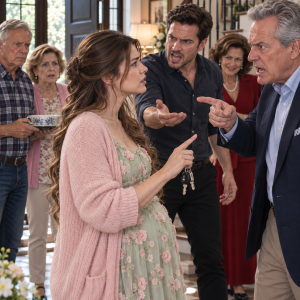
He pointed at me.
“You were barely conscious. She had access to your bedroom, your medication, your personal papers. I needed to know whether she was setting something up.”
It was exactly the kind of explanation Christopher always used: invasive behavior presented as responsibility.
Harrison remained calm.
“Then why did you contact Dr. Wallace immediately after receiving the result?”
Christopher looked toward the door.
Raymond watched him.
“Because the result connected Theodore to me.”
Christopher said nothing.
Raymond continued.
“And that frightened you.”
“It surprised me.”
“No. It frightened you.”
Christopher’s jaw tightened.
Then Raymond said the sentence that finally broke through his composure.
“I heard you.”
Christopher stared at him.
“What?”
“I was conscious, Christopher. Not every minute, but enough of them. I heard you discussing my funeral. I heard you ask Wallace whether moving me to a hospital would complicate things. I heard you complain that I was taking too long.”
Christopher looked genuinely sick.
“You couldn’t have.”
“But I did.”
Harrison did not threaten him with prison or announce some perfectly wrapped case. He simply told Christopher that Raymond’s medical care had been transferred, his financial authority had been revoked wherever Raymond had previously granted it, and the relevant records were being turned over for professional review.
One consequence.
Immediate and real.
Christopher was no longer controlling Raymond’s care or business affairs.
“After everything I’ve done for you?” Christopher asked.
Raymond’s expression changed.
There was no satisfaction in it.
“That is what makes this difficult. I raised you after your father died. I helped you through college. I brought you into my company. I kept telling myself your impatience was ambition because that was easier than admitting what I was hearing from my own bed.”
Christopher looked away.
“You’re choosing strangers over family.”
Raymond glanced at Theodore, who was sitting on my lap twisting the edge of his blanket between his fingers.
“No. I’m finally going to find out what my family actually is.”
Christopher left without another word.
The investigation that followed took months rather than hours.
Wallace’s medical records contained discrepancies that could not be explained by ordinary changes in treatment. Financial records also showed payments connected to Christopher that investigators considered significant enough to examine further. Toxicology and independent medical reviews supported what Raymond had suspected: his condition had been worsened by medication that had not been properly documented in his official treatment plan.
The case eventually moved beyond anything I personally needed to manage.
That mattered to me.
I had spent weeks believing I had to keep Raymond alive while protecting Theodore and watching every sound in the hallway. Once qualified people took over, I stopped trying to become an investigator, physician, and bodyguard all at once.
Christopher and Wallace ultimately faced serious criminal consequences for what could actually be proven. Raymond attended only the hearings where his presence mattered. He never celebrated.
One afternoon after Harrison called with an update, I found Raymond in the garden.
“You don’t seem relieved,” I said.
He leaned on his cane.
“Christopher was a boy when his father died. I helped raise him.”