The Invitation That Was Supposed to Embarrass Me
“Invite the woman who scrubs the upstairs bathrooms,” Victoria Whitmore said with a careless laugh. “But make sure someone explains the dress code. I’m genuinely curious what she thinks ‘black tie’ means.”
The women around her laughed.
I was standing only a few yards away, wiping fingerprints from the glass doors that opened onto the garden.
They thought I couldn’t hear them.
I could.
For almost three years, I had worked inside the Whitmore home in Belle Meade, Tennessee. I arrived early, usually before anyone came downstairs, and I left after the last room had been put back in order.
To Victoria, I was simply Mara Ellis, the quiet thirty-year-old housekeeper who carried laundry upstairs and disappeared whenever important guests arrived.
That was exactly how I wanted it.
Victoria called me into the sitting room.
Her friends, Felicity Crane and Jocelyn Mercer, watched me with amused expressions while another woman, Audrey Pike, stared uncomfortably at her hands.
Victoria lifted an ivory invitation.
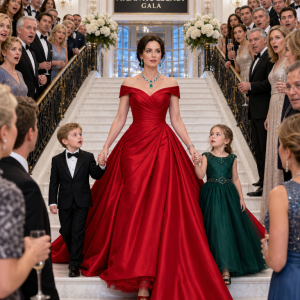
“Mara, I’m celebrating my fifty-fifth birthday Saturday evening. Around three hundred people will be here.”
She held the envelope toward me.
“I’ve decided you may attend.”
I accepted it.
“That’s very generous. Thank you.”
Her smile widened.
“It’s an extremely formal evening. Evening gowns, tailored suits, proper jewelry. I wouldn’t want you arriving dressed for… work.”
Felicity laughed into her glass.
I met Victoria’s eyes.
“I understand the dress code.”
For one brief second, something in my expression seemed to bother her.
Then I returned outside.
As soon as the doors closed behind me, I heard Jocelyn ask:
“Do you really think she’ll come?”
Victoria answered immediately.
“Of course. People like her spend their lives wondering what rooms like this look like from the inside.”
I stopped polishing the glass.
There were dozens of things I could have said.
Instead, I looked at the invitation in my hand and realized something I had resisted admitting for years.
Maybe it was finally time to stop hiding.
The Name I Had Left Behind

My apartment in Nashville was small enough that I could cross the living room in eight steps.
I liked it that way.
Nothing inside it had been purchased to impress anyone.
There was a faded couch, a wooden kitchen table, stacks of books, two plants beside the window, and an old photograph hidden in the bottom drawer of my desk.
That evening, I placed Victoria’s invitation on the table.
Then I opened the drawer.
The photograph showed me at twenty-four, standing beside my grandfather outside the headquarters of Ashford Meridian Holdings in Denver.
My real name wasn’t Mara Ellis.
It was Mara Ashford.
And my grandfather, Harrison Ashford, had spent more than forty years building a company involved in sustainable agriculture, regional housing, logistics, and renewable infrastructure across the western United States.
I had grown up attending dinners where governors, executives, investors, and community leaders knew my name before I entered the room.
For years, I had hated it.
Not the money.
The uncertainty.
I never knew whether people liked me or what my surname could provide them.
The final breaking point came when a man I planned to marry began discussing my future inheritance with an attorney before we had even chosen a wedding date.
I ended the relationship.
Then I walked away from everything.
I used my late grandmother’s maiden name, Ellis, moved to Tennessee, found ordinary work, rented a modest apartment, and refused financial help from my family.
I wanted to know who Mara was when Ashford meant nothing.
I got my answer.
Some people were wonderful.
Others looked straight through me.
Victoria Whitmore belonged to the second group.
I picked up my phone.
My grandfather answered almost immediately.
“Mara?”
I smiled.
“You still recognize me that quickly?”
“You’re my only granddaughter. I’d recognize your silence.”
I looked at the invitation.
“Grandpa, I think I’m ready.”
He became quiet.
“Ready for what?”
“To come back.”
Another pause.
Then his voice softened.
“Tell me what happened.”
So I told him everything.
When I finished, he asked:
“Do you want me to intervene?”
“No.”
“Good.”
I laughed quietly.
“You could at least pretend you were going to respect my decision.”
“I do respect it. That doesn’t mean I wouldn’t enjoy sending twenty attorneys to that woman’s front door.”
For the first time all evening, I laughed.
Then I became serious again.
“I want to attend the gala.”
“As Mara Ellis?”
I looked at the invitation.
“No. I think Mara Ellis has learned what she needed to learn.”
The One Person Who Already Knew

Victoria’s eldest son, Nolan Whitmore, was nothing like his mother.
At forty-one, Nolan managed most of the family’s commercial real-estate investments. He spoke to employees by name, carried his own coffee cup to the kitchen, and occasionally ate lunch with the grounds crew.
Several months earlier, he had found me sitting behind the carriage house reading a regional development report.
He stopped beside me.
“That’s not exactly light lunch-break reading.”
I closed the report.
“I like understanding why cities grow the way they do.”
He sat across from me.
“What do you think of the proposed development?”
I told him the transportation assumptions were unrealistic and the land acquisition model underestimated long-term infrastructure costs.
Nolan stared at me.
“Where did you learn that?”
I shrugged.
“Books.”
Apparently, he didn’t believe me.
He quietly investigated my background.
Eventually, he found an old photograph.
He never confronted me.
Instead, several weeks later, he simply said:
“Everyone deserves to tell their own story when they’re ready.”
That was when I knew he had discovered the truth.
On Saturday afternoon, my grandfather called Nolan.
“Mr. Whitmore?”
“Speaking.”