It meant a voicemail from my father saying I was embarrassing the family.
It meant learning that sometimes people collect proof only after trust has stopped protecting them.
The Morning at My Door
Lucy and I arrived home shortly before sunrise.
She fell asleep during the drive, but when I tried carrying her upstairs, she became frightened, so I made a bed for her on the living-room sofa.
I turned on cartoons quietly.
I made toast she barely touched.
Then I sat on the carpet beside her until she fell asleep again with her fingers tangled loosely in my hair.
At 8:51, the doorbell rang.
My mother stood outside.
My father was sitting in their SUV at the curb.
I stepped onto the porch and pulled the door nearly closed behind me.
For one foolish second, I hoped my mother had come to ask about Lucy.
Instead, she began crying.
“Please don’t do this to Allison.”
I stared at her.
Not How is Lucy?
Not Can I see her?
Not Is she okay?
Allison.
“You should leave.”
My mother grabbed my sleeve.
“Your sister was upset. She’d had too much to drink. She wasn’t thinking clearly.”
“Lucy is four.”
“I know, but Allison could lose her job. This could affect custody of Mason. It could follow her forever.”
Again, Allison.
Again, her future.
Again, the consequences everyone had spent decades moving out of her path.
I pulled my arm free.
“You need to go.”
My mother reached into her handbag.
“Wait. She wrote something.”
My father suddenly got out of the SUV.
“Margaret, don’t.”
His voice stopped me.
It was the first time since arriving that either of them sounded genuinely afraid.
My mother pulled out a white envelope.
Across the front was my daughter’s full name.
Lucy Claire Bennett.
Not Lucy.
Not sweetheart.
Her full name.
I took the envelope.
Inside was one handwritten page.
It was not an apology.
Allison had written that I had been emotionally overwhelmed since losing my wife and that perhaps my judgment could not be trusted.
She described Lucy as unusually sensitive.
She suggested that Lucy’s marks might have happened while the child was having an emotional outburst.
And near the bottom of the page, she wrote that if authorities became involved, the family needed to stay consistent about what had happened.
I read that sentence twice.
Then I looked at my parents.
“You’ve read this?”
My mother started crying harder.
My father looked away.
“Some of it,” he said.
I folded the paper carefully.
“She isn’t sorry.”
“She’s scared,” my mother said.
“No. She’s preparing a story.”
Behind me, I heard small footsteps.
Lucy stood several feet inside the hallway, clutching the stuffed dog from the hospital.
She saw my parents and immediately stopped.
Then she asked something I still hear in my head sometimes.
“Daddy, am I supposed to say sorry?”
My mother covered her mouth.
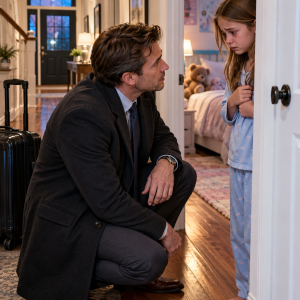
I went inside and knelt in front of Lucy.
“No, honey.”
She watched my face carefully.
“I’m not in trouble?”
“Not even a little bit.”
“Grandma’s mad?”
I glanced toward the porch.
“Grown-ups are responsible for their own feelings. Your job is to be four.”
She thought about that.
Then she leaned against me.
I stood, closed the door, and called the officer whose card was still in my wallet.
The Letter Nobody Could Explain Away

The officer arrived less than an hour later.
My parents had remained near the curb, arguing quietly beside their SUV, and when he asked whether they had read Allison’s letter before delivering it, my mother struggled to answer.
My father finally said they had read portions of it.
The officer placed the page and envelope into a clear protective sleeve.
By lunchtime, Allison had called more than a dozen times.
I did not answer.
Then the messages started.
“You’re ruining everything.”
A few minutes later:
“You’ve always thought you were better than me.”
Then:
“Mom says you kept my letter. Give it back.”
And finally:
“You can’t prove what really happened.”
I saved every message.
The weeks afterward were nothing like the dramatic idea people have of justice.
Mostly, they were exhausting.
Forms.
Phone calls.
Appointments.
Interviews.
Waiting rooms.
Lucy began seeing a child therapist named Dr. Emily Hart, a patient woman who wore soft sweaters and kept washable markers in a wooden box beside her desk.
During the first several sessions, Lucy barely spoke.
She drew houses.
Then doors.
Then pictures of our dog, even though we did not own a dog.
Dr. Hart told me that children often repeat questions because reassurance has to become familiar before it begins to feel true.
So Lucy asked.
And I answered.
“Do I have to go to Aunt Allison’s house?”
“No.”
“Do I have to sleep at Grandma’s?”
“No.”
“Are you mad at me?”
“Never for telling me you’re scared.”
“Will you stay until I fall asleep?”
“Every time you need me.”
Some nights she asked those questions three times.
Other nights, ten.
I answered every single one.
My parents continued contacting me.
My mother moved through stages.
First pleading.
Then bargaining.
Then criticism.
Then sadness about holidays.
She left a voicemail asking how I could possibly let one terrible afternoon break apart an entire family.
I listened to it twice before deleting it from my regular inbox, though I kept a saved copy with the other records.
What she never seemed to understand was that I had not broken anything.
I had simply stopped pretending it was whole.
My father sent only one message.
“This has gone too far.”
I stared at those words for nearly an hour before replying.
“You’re right. It went too far when the adults in that room decided silence mattered more than Lucy.”
He never answered.
Learning to Laugh Again
Recovery did not happen in a straight line.
For a while, Lucy refused to close the bathroom door.
She wanted the hallway light on at night.
If somebody raised their voice in a grocery store, she reached for my hand.
If I disappeared into the garage without telling her, she searched the house calling my name.
But gradually, ordinary childhood returned in small pieces.
One morning, I burned pancakes and set off the smoke detector.
Lucy screamed at first.
Then she saw me standing on a kitchen chair waving a dish towel beneath the alarm while complaining to the ceiling that breakfast had betrayed me.
She started laughing.
Not politely.
Not nervously.
Really laughing.
I nearly cried right there on the chair.